
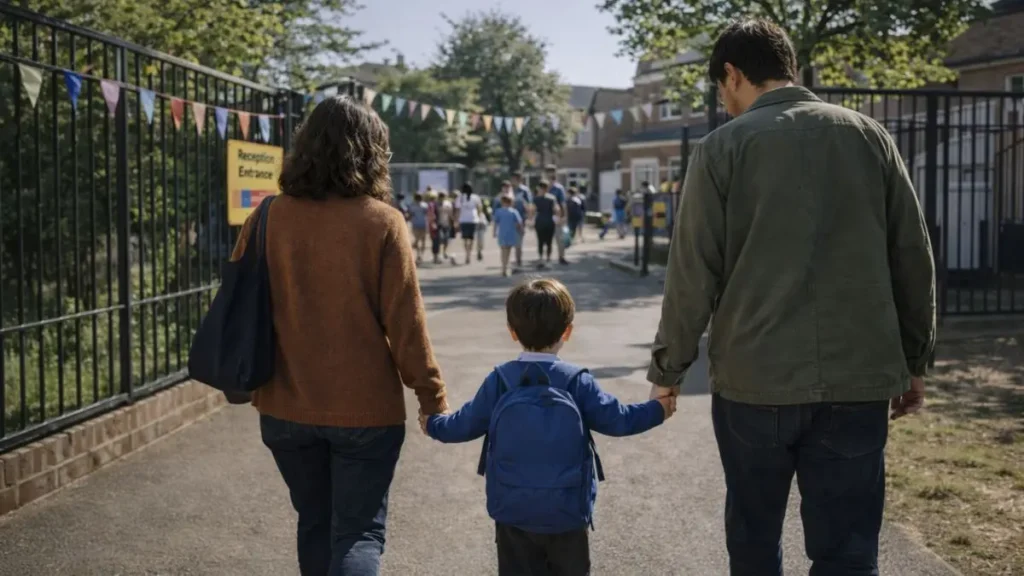
Starting school can quietly feel like a test for parents as much as children. In the UK, “school readiness” is often talked about as a checklist of skills, but in reality it is far more human and far less rigid than many families are led to believe. This article looks at what school readiness really means, without pressure or perfection.
Quick summary
School readiness in the UK is less about what your child can do on paper and more about how supported they feel as they start school:
- There is no official checklist a child must pass to start Reception
- Emotional readiness and confidence matter more than academic skills
- Schools expect children to arrive at very different stages
- Parents are not expected to ‘prepare’ children to a fixed standard
This article is for / not for
This article is for:
- UK parents with a child starting Reception
- Parents feeling anxious about whether their child is “ready enough”
- Families who have heard mixed messages from nurseries, friends, or online
This article is not for:
- Parents looking for academic coaching or early learning targets
- Families outside the UK school system
If this isn’t quite right for you
If this isn’t quite right for you, you might find these more helpful:
Or, browse all our School articles.
If this is relevant to you, read on.
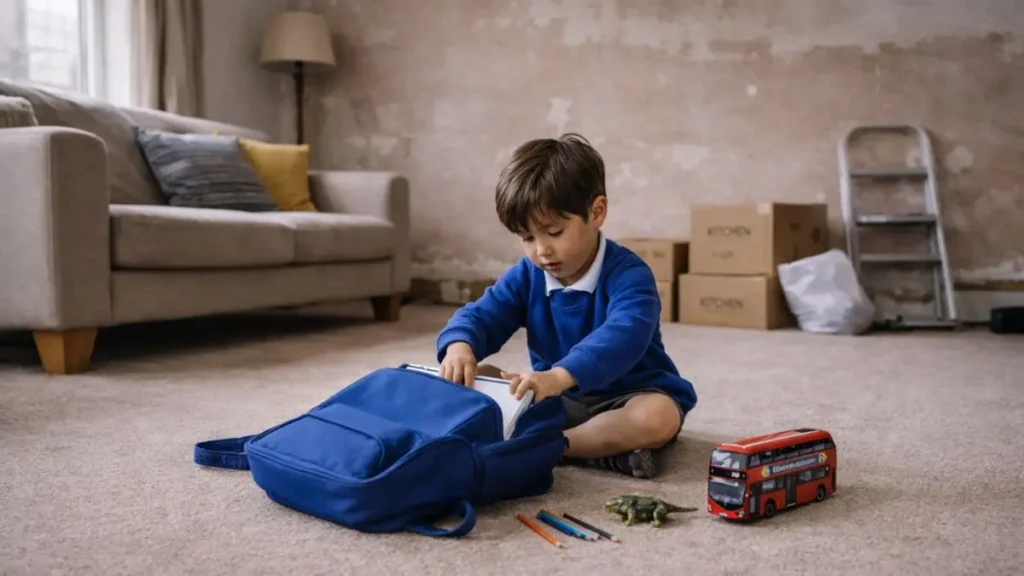
What parents are usually told school readiness means
When people talk about school readiness, they often focus on practical or academic skills. Things like recognising letters, holding a pencil properly, or sitting still for short periods.
While these skills can be helpful, they are not the benchmark schools use to decide whether a child is ready to start. In practice, Reception teachers expect a wide range of abilities and experiences in every class.
Many children start school without being able to read, write their name clearly, or count confidently. That is normal.
What school readiness actually means in the UK
In the UK, school readiness is about how a child copes with a new environment, not how much they already know. It is less about arriving with certain skills already mastered, and more about how a child adjusts to new routines, new adults, and being part of a group for the first time.
Schools are looking at how a child manages change with support, not whether they can perform on demand.
It usually comes down to a few broad areas:
- Feeling reasonably safe separating from a familiar adult
- Being able to communicate basic needs, even if imperfectly
- Beginning to manage emotions with adult support
- Showing curiosity or willingness to engage, in their own way
These are not pass-or-fail skills. They develop over time, and schools are set up to support children as they learn them.
Schools expect children to start at different stages
Reception classes are built on the assumption that children arrive with very different experiences. Some will have attended nursery full-time, others part-time, and some not at all.
Teachers are trained to support children who take time to settle, struggle with transitions or routines, or find listening and group activities difficult at first.
These behaviours are expected in Reception classrooms and are part of what teachers plan for, rather than something parents are expected to resolve in advance.
This is not seen as a problem to fix before school starts. It is part of the job.
What parents are not expected to do
Parents are often left feeling they should be ‘training’ their child for school. In reality, there are no official expectations that a child should:
- Read or write before starting Reception
- Sit still for long periods
- Follow instructions perfectly
However, it is generally expected that children starting Reception are reliably toilet trained, unless there is an additional need or medical reason.
This has been discussed widely in recent years because schools are not set up to provide routine nappy changing for otherwise typically developing children. Where a child is not yet toilet trained, early conversations with the school are important so expectations and support can be discussed clearly and calmly.
While guidance and starting ages differ slightly across England, Wales, Scotland, and Northern Ireland, the practical expectation around toilet training is broadly similar across the UK.
A realistic way to think about readiness
A helpful shift is to think less about readiness as preparation, and more as support. For many parents, it helps to step back from skills and ask gentler questions about how their child experiences the world.
You might notice whether your child can gradually feel safe with new adults, even if it takes time. Whether they are able to let someone know when something feels wrong, or when they need help. And whether they understand, at least in a simple way, that adults at school are there to support them.
These everyday signs of trust and communication matter far more at this stage than academic milestones or early learning targets.
When worries are understandable
Some worries are completely understandable, particularly if your child finds change overwhelming, has delayed speech or communication, or is neurodivergent or awaiting assessment.
In these situations, school readiness is not about catching up or pushing a child to meet expectations they are not ready for. It is about open communication between parents and school, sharing what helps your child feel safe, and working together to put the right support in place from the start.
Related reading
You might also find these articles helpful as you think about starting school:
- Helping children manage big emotions without punishments
- Why comparison parenting makes everything harder
External support and guidance
If you would like official guidance on starting school in England, these resources are helpful and reassuring:
A calm takeaway
If there is one thing worth holding onto, it is this: school readiness is not something you either have or do not have.
It is something that develops with time, support, and understanding. Schools are prepared for children who are still learning how to be in the world, and that includes learning how to be at school.
If you are worried, a quiet conversation with your child’s school can be far more useful than any checklist.