

For many families, the hardest part of the day isn’t the morning rush or the school run. It’s what happens after. A child who has coped all day can fall apart at home, leaving parents confused, drained, and wondering what they’re missing. This article explains what’s really happening, without blame or quick fixes.
Quick summary
After-school meltdowns are not usually about bad behaviour or something going wrong at school. They tend to happen because:
- School places sustained demands on attention, behaviour, and social processing
- Children use a lot of energy to regulate themselves and mask difficulties
- That energy runs down across the day
- When structure drops away, the system finally tries to reset
This article is for / not for
This article is for:
- Parents of primary-aged children who cope at school but struggle afterwards
- Families trying to understand the mechanics behind after-school meltdowns
- Parents who want explanation rather than advice or discipline strategies
This article is not for:
- Situations involving immediate safety concerns
- Behaviour management or discipline programmes
What after-school meltdowns often look like
After-school meltdowns can take many forms. Some children cry over small things. Others become angry, withdrawn, or suddenly oppositional. Some seem unable to cope with requests they would normally manage.
What’s confusing is how quickly this can happen – sometimes within minutes of getting home – especially when the school day has been reported as positive.
What’s actually going on underneath
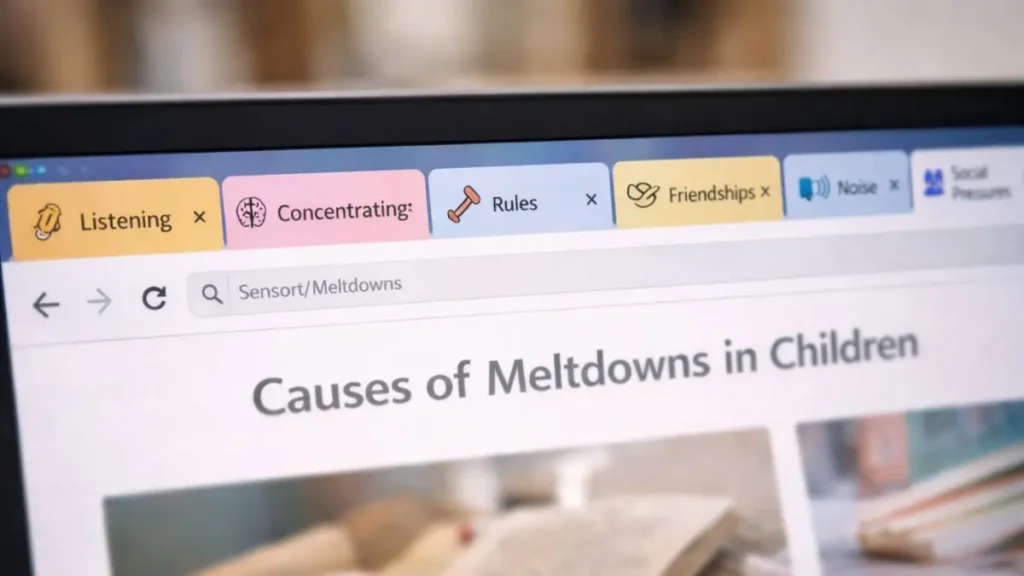
School places constant demands on children. Even on a ‘good’ day, they are listening, concentrating, following rules, navigating friendships, coping with noise, managing social pressures, and dealing with the behaviour of other children.
To manage this, many children use a huge amount of effort to stay regulated. They may hide/ mask tiredness, anxiety, sensory overload, or emotional stress in order to get through the day.
For most adults, the brain is able to filter out large amounts of background information. Noise fades into the background. Social rules are understood and mostly automatic.
Small frustrations are filtered, prioritised, or ignored without much conscious effort.
Children are still developing those filtering systems. Many have very little ability to tune out noise, movement, social tension, or internal sensations. Everything comes through at once, and this can be incredibly tiring.
The browser tabs analogy
A useful way to think about it is like carrying lots of tabs open in a browser. Too many tabs open slows the system down, uses more processing power, and therefore more energy.
An adult might have learned how to close or ignore some of those tabs as the day goes on. A child often has to keep every tab open, all day.
By the time they get home, the energy required to maintain that effort has run out.
Why it happens at home
When the school day ends, there is a sudden shift. Structure drops away, expectations change, and the child is no longer having to actively hold themselves together in the same way.
By the time they get home, the environment finally feels safe and predictable. The brain no longer has to keep everything tightly controlled.
Going back to the browser analogy, this is often the moment the system tries to close all those tabs at once. For an adult, that might happen gradually and quietly in the background. For a child, the system can slow, freeze, or crash as it resets.
The meltdown isn’t planned or manipulative. It’s what happens when a system that has been under constant load finally drops its guard and attempts to reset.
In that moment, a child cannot simply control it or calm themselves down.
The brain systems needed for self-control and calming are temporarily overwhelmed or offline.
This is why meltdowns so often happen with the adults a child trusts most.
It doesn’t mean school is failing your child
After-school meltdowns often make parents question whether something is being missed at school. Sometimes there are issues worth exploring, but in many cases school is only seeing part of the picture.
The significant effort children put into masking during the school day means the school doesn’t see your part of the picture. Children copy others, follow rules closely, stay quiet, or work hard to appear settled and engaged, even when they are overwhelmed internally.
Because this effort is effective, staff may not see obvious signs of difficulty.
What shows up at home is not school failure, but the cost of sustained self‑control across the day.
Why this happens even when a school day is ‘fine’
After-school meltdowns often surprise adults because there’s no obvious visible trigger. Teachers may report a settled day, no incidents, and good engagement.
What this misses is the accumulation of effort. Regulation isn’t used up by one big event – it’s drained by lots of small, constant demands. Listening, waiting, coping with noise, managing social expectations, and staying ‘within the rules’ all add up.
By the end of the day, there may be nothing left in reserve.
Understanding the timing of meltdowns
The timing of after-school meltdowns is a clue. They rarely happen mid-morning or during structured lessons. They often begin as soon as the school day ends – in the car, on the walk home, or shortly after arriving back.
They tend to appear at the point where structure drops away. That transition – from school expectations to home freedom – requires another adjustment. For a child who is already depleted, that final shift can be the tipping point.
Why meltdowns don’t come with clear explanations
After-school meltdowns are usually driven by overload rather than a single identifiable problem.
Because of that, children may not be able to explain what’s wrong, not because they are unwilling, but because the brain systems needed for reflection and language are temporarily offline.
When a child is overwhelmed, the brain prioritises regulation and safety over thinking and explanation. Energy is directed toward settling the body and managing emotion, not analysing causes.
This means a child may feel flooded by sensation or emotion without being able to turn that experience into words.
Shutdown after a meltdown
In some cases, a meltdown may be followed by a shutdown. This can look like a child becoming very quiet, withdrawn, or unwilling to talk about what has just happened.
In my experience, this is often not avoidance or defiance. After the intensity of a meltdown, the brain may still be in recovery mode. The systems needed for speech, reflection, and social engagement can take longer to come back online.
During this time, a child may feel confused, embarrassed, or guilty about what has happened, even if they cannot express that clearly. Giving space rather than pushing for discussion helps the nervous system settle and reduces additional pressure.
Once regulation has returned, children are usually better able to reflect, if reflection is needed at all.
When worries are understandable
If meltdowns are frequent, intense, or affecting your child’s mental wellbeing, it’s reasonable to seek extra support.
Talking to the school, your GP, or a trusted support service can help build a clearer picture and ensure your child is supported consistently.
Related reading
You might find these articles helpful:
- Why some children cope all day at school then fall apart at home
- Helping children manage big emotions without punishments
External support and guidance
If you’d like to explore this further, these UK resources are helpful:
A calm takeaway
After-school meltdowns are often a sign that a child has been coping for a long time in a demanding environment.
They are not a failure of parenting or schooling. They are a signal that a child needs rest, safety, and understanding – and that starts at home.