

When a child becomes overstimulated at home, it can feel sudden, confusing, and hard to calm. You might not know what tipped them over, only that everything feels too much for them right now. This guide walks you through simple, realistic steps that can help your child settle, without shouting, bribing, or guessing.
TL;DR
If your child is overstimulated at home, the goal is not to fix their feelings but to help their nervous system settle again. A calm, predictable response usually helps more than talking or reasoning in the moment:
- Reduce noise, light, and demands as quickly as you can
- Stay close and calm rather than asking lots of questions
- Offer grounding input like pressure, warmth, or quiet movement
- Give them time to recover before expecting anything else
This article is for / not for
This article is for:
- Parents of children who become overwhelmed, irritable, tearful, or explosive at home
- Families who notice meltdowns or shutdowns after school or busy days
- Parents who want practical steps they can try straight away
This article is not for:
- Situations where a child is in immediate danger
- Ongoing behavioural concerns that need professional assessment
- Parents looking for strict behaviour control techniques
Medical and wellbeing note
This article offers general parenting support, not medical or therapeutic advice. If your child’s overwhelm is frequent, severe, or affecting daily life, it may help to speak with your GP, health visitor, or school, or seek guidance from NHS child mental health services.
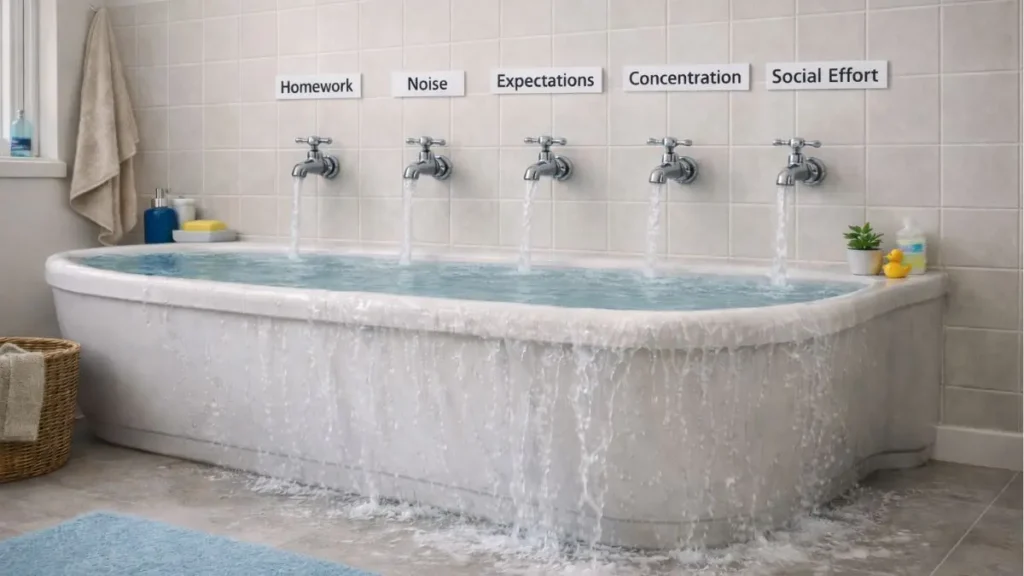
What overstimulation at home can look like
Most of us picture overstimulation as a noisy soft play or a busy supermarket. But at home, it’s often the build-up that does it.
A child can look “fine” right up until they are not. Then it can come out as tears, anger, silliness, shouting, or suddenly going very quiet.
Common signs include:
- Snapping at siblings or arguing over something tiny
- Saying everything is annoying, unfair, or too loud
- Refusing simple requests or getting stuck on one thing
- Covering ears, hiding, pacing, or curling up
- Complaining of being tired, hungry, hot, or “done”
This is not your child being difficult. It’s their nervous system saying: I’ve had enough input.
When a nervous system is overloaded, logic, reasoning, and self-control all drop offline. Your child isn’t choosing to react this way, their body is reacting for them. That’s why calm support and reducing pressure helps more than explanations or consequences in the moment.
With that in mind, here’s a simple way to respond when it happens.
The step-by-step plan (use this like a script)
If you only remember one thing, let it be this: reduce the load first, then offer calm connection, then give recovery time.
Step 1: Pause demands and lower the “volume” of the house
Before you talk about behaviour, school, manners, or what they “should” do, change the environment.
Try one or two quick switches:
- Turn off the TV, music, or noisy toys
- Dim a bright light or close curtains if it feels harsh
- Ask siblings to go to another room, or put a simple boundary in place: “Give them space for five minutes.”
A helpful way to think about it: you are not rewarding anything. You are removing extra sensory input so their body can settle.
Step 2: Get your own body calm first (even if you’re fuming)
Children often cannot calm while the adult energy feels sharp or urgent.
Pick one thing you can do in ten seconds:
- Drop your shoulders
- Slow your breathing a little
- Lower your voice by one level
Then use fewer words.
Good phrases:
- “I’m here.”
- “You’re safe.”
- “We’ll sort it when you’re ready.”
These short phrases work because they reassure without demanding anything back. They signal safety and presence, which helps your child’s nervous system begin to settle, even if they don’t respond straight away.
Avoid in the moment (even if it’s true):
- “Calm down.”
- “What’s wrong with you?”
- “Stop it right now.”
- “You were fine a minute ago.”
These phrases can unintentionally escalate things because they add pressure, imply blame, or expect self-control that your child doesn’t have access to right now. When a child is overstimulated, their body hears threat long before it hears logic.
Step 3: Stay close, but don’t force interaction
Some children want a cuddle. Some want space. Many want both at different moments.
Offer a simple choice (not lots of questions):
- “Do you want me close, or do you want space?”
- “Cuddle or blanket?”
- “Quiet room or sofa?”
If they cannot answer, choose the gentlest option and stay available.
If they are escalating, prioritise safety and space. Standing slightly side-on, keeping movements slow, and quietly removing hard objects nearby can help reduce risk without adding more pressure.
Step 4: Offer grounding input (only if it helps your child)
Grounding is anything that helps the body feel safer and less “buzzing”. What works varies a lot.
You don’t need to try all of these. One option that fits your child is enough.
Try offering one option at a time:
- Deep pressure or warmth: a firm hug, squeezed cushion, cosy hoodie, blanket, or warm drink
- Heavy or steady movement: carrying cushions, pushing a laundry basket, wall pushes, or gentle rocking
- Quiet sensory: a dim corner, noise-cancelling headphones, or a favourite soft toy
If they reject it, don’t push. Rejected support can feel like more input.
Step 5: Make the next 20 minutes “easy mode”
This is the part parents often skip because life is busy. But it is usually the fastest route back to calm.
For the next short window, aim for:
- No lectures
- No extra demands
- No sudden transitions
Trying to reintroduce demands, conversations, or transitions before your child has fully regulated often sends them straight back to the boil. Their body may look calmer on the outside, but if the nervous system is still overloaded, pushing on too soon can restart the whole cycle.
If there’s homework, practice, or chores, delay it. You will get more cooperation later when their system is back online.
To increase the calm think:
- Snack or drink
- Quiet activity (TV, colouring, Lego, audiobook)
- Low voice, low pace
Or suggest another low‑stress activity they find relaxing, which helps their nervous system stay settled by keeping demands low and signals that it’s safe to slow down.
Step 6: When they’re calm, decide if you even need a “debrief”
Some children feel worse if you revisit it. Others like a quick, gentle chat.
If you do talk, keep it simple:
- “Your body looked overloaded earlier.”
- “Was anything too loud, too busy, too much?”
- “Next time, shall we try quiet time first?”
If your child is young or struggles to explain which is completely normal, you can narrate what you noticed:
- “I think you were hungry and everything felt too much.”
No blame. Just patterns.
What if they are shouting, swearing, or being aggressive?
This can feel intense and unsettling in the moment. If you’re feeling unsure or on edge, that’s a very normal response. Your first priority here is safety.
Try:
- Create space between siblings
- Keep your own voice low and steady
- Use one short boundary: “I won’t let you hit.”
- Move breakable items away rather than trying to physically restrain
If you are concerned about harm to themselves or others, or this is happening frequently, it’s worth seeking professional support.
A small insight that often surprises parents
Many children do not calm down because you found the perfect words.
They calm down because you lowered the sensory load, stayed emotionally steady, reduced demands, and gave recovery time.
That is why “talking it through” often works better later, not in the moment.
Related reading
If this connected with what you’re seeing at home, these might help next:
- After-school meltdowns and why they happen
- Why some children cope all day at school then fall apart at home
For further UK guidance alongside other support, these resources can be useful:
- Barnados: Improving your family’s calmness and wellness
- NHS Looking after a child or young person’s mental health
A final thought
You are not doing anything wrong if your child becomes overstimulated at home. Many children hold it together all day and release everything where they feel safest.
Remember, If you can do just one thing next time, work to lower the load and slow the pace. Calm actions beat perfect explanations.