
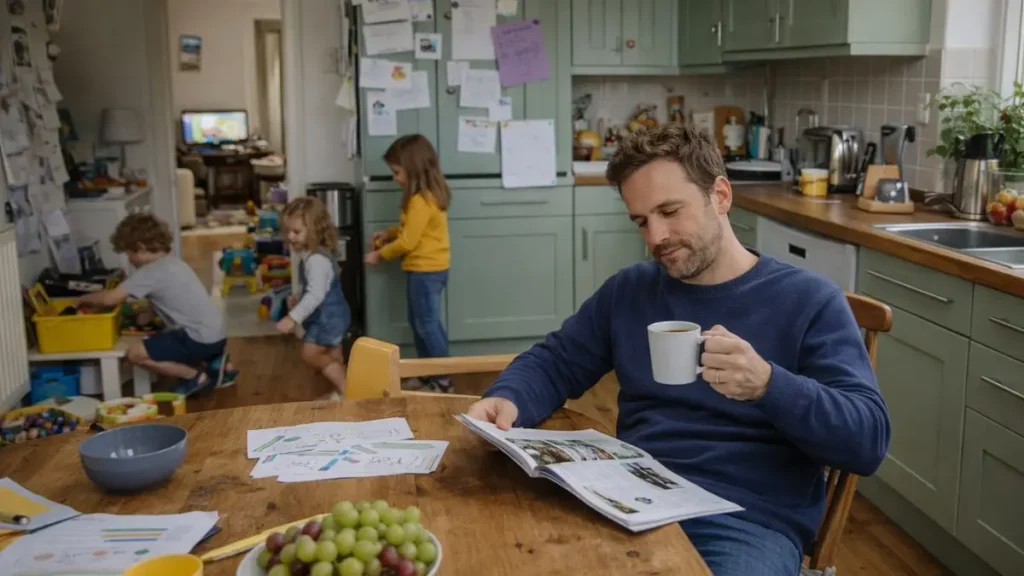
Calm family life is often pictured as quiet, tidy, and under control. In real homes, especially busy ones, it usually looks very different. This article explores what calm actually feels like day to day, and why it is often less about silence and more about reduced pressure.
Quick summary
In busy homes, calm often looks different to what we expect.
Calm family life is not about getting rid of noise, mess, or emotion. In real homes, it is usually something softer and more realistic:
- Noise can still be there without everything feeling overwhelming
- Mess can still be there without it creating constant tension
- Children can still be emotional without every moment escalating
- Things can still feel imperfect without the whole day feeling heavy
- Calm often comes from less pressure, not more control
This article is for / not for
This article is for:
- Parents who feel their home is never “calm enough”
- Those who compare family life to unrealistic versions online
- Parents who want things to feel lighter, not perfect
This article is not for:
- Parents looking for a strict routine or behaviour system
- Situations where family stress feels severe and needs professional support
What people often imagine calm looks like
When people think about a calm family, they often picture a quiet house, children playing happily, everything tidy, and parents who stay patient all day.
It is an appealing picture, but it also creates a standard that most real families cannot hold for long. In everyday life, children get loud, plans change, people get tired, and the house gets messy.
That does not mean calm has disappeared. It usually means the picture of calm was too narrow to begin with.
What calm actually feels like in a busy family
In real family life, calm is less about what is happening around you and more about what is happening underneath it.
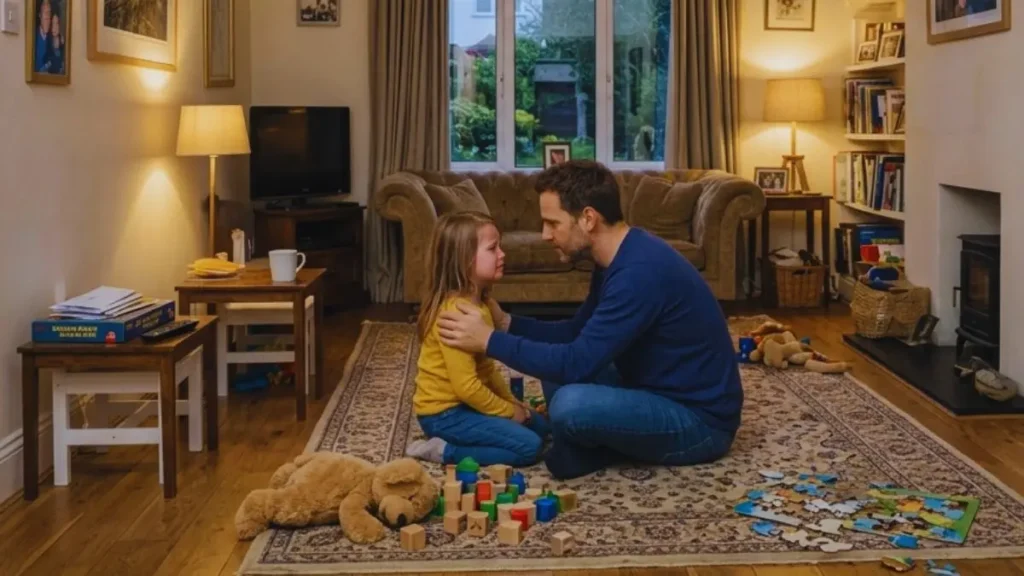
It can look like a noisy room that still feels manageable. It can look like toys on the floor without a constant urge to sort them immediately. It can look like a child having a hard moment while the adult is able to stay relatively calm in themselves.
In other words, calm is often not about removing the chaos. It is about how much tension sits around it.
That is an important difference, because many parents try to create calm by removing every disruption. In practice, what often helps more is reducing the pressure that sits on top of those normal family moments.
Calm is not the same as control
This is where many parents get pulled into a cycle that feels exhausting. When life feels noisy or messy, it is easy to respond by tightening everything.
More reminders and correcting, and more effort to keep everyone regulated and everything running smoothly.
That can create short-term order, but it often raises the emotional temperature over time. Keeping everything under control takes constant input, and that constant input is tiring.
Calm usually comes from something different. It often comes from allowing a little more to exist without needing to manage it straight away. Letting some noise be noise. Letting some mess stay for a while. Letting a mood pass without trying to fix it immediately.
This is often why doing less can sometimes feel calmer than doing more.
Why calm can feel hard to reach
Even when you understand this idea, calm can still feel difficult to access.
That is often because the barrier is not just what your family is doing. It is also what your own mind is carrying. If you are already scanning for what needs fixing, anticipating the next interruption, or trying to hold everything together, even small disruptions can feel much bigger.
In that state, calm can seem far away, even if nothing dramatic is actually happening.
This is why calm is not only about the environment. It is also about capacity. When your internal load is high, the house does not need to be especially difficult for it to feel too much.
A more realistic way to recognise calm
A lot of parents miss calm because they are looking for the wrong signs.
Instead of asking whether everything is under control, it can help to ask whether the moment feels manageable. Whether you feel like you need to step in right now. Whether things feel tense, or simply untidy, noisy, or imperfect.
For example, you might walk into a messy room, notice toys everywhere, and feel the urge to tidy it straight away. Then you pause and realise nothing actually needs fixing in that moment. The room is untidy, but it is not overwhelming. That is often what calm looks like.
That is often where the shift happens.
A room can be messy and still feel calm. A family can be busy and still feel fairly settled. A child can be emotional and the moment can still feel contained.
Calm is often present in ordinary moments that do not match the image we had in mind.
What calm often looks like in real life
In practice, calm in a busy family rarely looks like a big change or a perfect day. It tends to show up in small, almost unnoticeable moments where the pressure eases slightly and things feel manageable, even if nothing looks especially calm from the outside.
Moments like these:
- You pause before reacting, even if it is just a brief moment to take a breath
- You let one small thing go instead of correcting it
- You accept “good enough” instead of pushing for better
- You notice that the house is noisy, but you are not at breaking point
- You realise nobody is especially regulated, but the moment still feels manageable
None of this looks particularly impressive from the outside. That is part of the point.
Real calm is often quiet in a different way. Not quiet because everything has stopped, but because the pressure has eased.
Why this matters more than a perfect calm home
This reframing matters because many parents end up feeling like they are failing simply because family life does not look peaceful enough.
But calm is not a performance. It is not a spotless room, a perfectly followed routine, or children who are never dysregulated.
It is a felt sense that things are manageable enough for now.
That makes it much more achievable and much more useful. Once calm is defined this way, it becomes something you can notice and build towards in real life, rather than something you keep missing because it does not match an ideal.
You might also find this helpful
If you are trying to move towards a calmer way of parenting, these articles may help from slightly different angles:
- Why doing less in parenting can feel calmer and easier – explores why stepping back a little can reduce pressure and make family life feel more manageable
- Small wellbeing habits that make parenting feel lighter – looks at low-effort habits that support your own capacity, which often affects how calm family life feels
If you want further guidance on family wellbeing and mental health, this UK resource can help:
What matters most
Calm family life rarely looks the way people imagine it will. It is not silence, perfect behaviour, or having everything under control. More often, it is the feeling that a moment is manageable, even if it is noisy, messy, or imperfect.
That matters, because it means calm may already be present more often than you think, and getting closer to it is often not about doing more, but about lowering the pressure around what is already there.