
Christmas with children can be lovely, but it can also get noisy, expensive and more full-on than people admit. This guide is here to help you choose simple Christmas ideas that feel special without turning December into a project. Whether you have a baby, a toddler or older children, the aim is not to do everything. It is to find a few things that suit your family, your budget and your energy.
Quick summary
The best Christmas activities and ideas for kids are the ones that fit your budget, your child’s age and your energy. A few simple traditions and low-cost activities usually do more than a packed festive plan.
If you are tired, short on money, or just trying to keep Christmas from becoming too much, these are the main things worth keeping in mind:
- A good family Christmas does not need to be packed with activities to feel memorable.
- The easiest wins are usually simple home traditions, one or two low-cost activities, and a calmer plan for the busiest days.
- Babies often need comfort, routine and a few sensory moments more than big festive plans.
- Toddlers usually enjoy repetition, simple decorating, songs, books and helping with small jobs.
- Older children often like choice, ownership and small traditions they can count on each year.
- Christmas Eve boxes, festive outings and extra gifts can be nice, but they do not need to be elaborate to feel exciting.
- If you want more detail on one area, it usually helps to go deeper on that specific topic rather than trying to do every festive idea at once.
This article is for / not for
This article is for:
- parents who want Christmas ideas that feel realistic, not Pinterest-perfect
- families trying to make Christmas feel special without spending heavily
- parents of babies, toddlers and children who want a mix of home ideas, traditions and calmer planning
- anyone who wants a broad starting point before deciding what is actually worth doing
This article may not be for you if:
- you only want craft activities or printables
- you are looking for Christmas events in one specific town or city
Start by choosing your kind of Christmas
One thing that makes Christmas feel harder than it needs to is trying to do bits of every version of it at once. A few home activities, lots of outings, matching pyjamas, a perfect Christmas Eve box, handmade decorations, class events, present wrapping, food planning, family visits and the pressure to make it all magical can pile up quickly.
What helped me see Christmas differently was realising that children usually remember the feel of it more than the volume of it. They notice whether the house felt excited, cosy, silly, calm or tense. That does not mean activities do not matter. It means they work best when they support the mood you want, rather than create more work.
A useful place to start is to choose the version of Christmas that suits your family this year. That might be:
- a low-cost Christmas with more home time than outings
- a cosy Christmas with films, books, baking and lights
- a playful Christmas with games, music and simple crafts
- a calm Christmas with fewer plans and more routine
- a family-and-friends Christmas where the social side matters most
You do not have to label it formally, but having a rough idea helps you say yes to the right things and quietly drop the rest.
Easy Christmas activities to do at home with kids
Most families do not need fifty festive ideas. They need a few that are easy to pull out when energy dips, the weather is grim, or the children are bouncing off the walls in the days just before Christmas.
The most useful at-home activities are usually the ones that do not need a special shop, a long set-up, or a parent performing like an events manager. Things like these tend to earn their place:
- decorating the tree in stages rather than all at once
- reading one Christmas book each evening
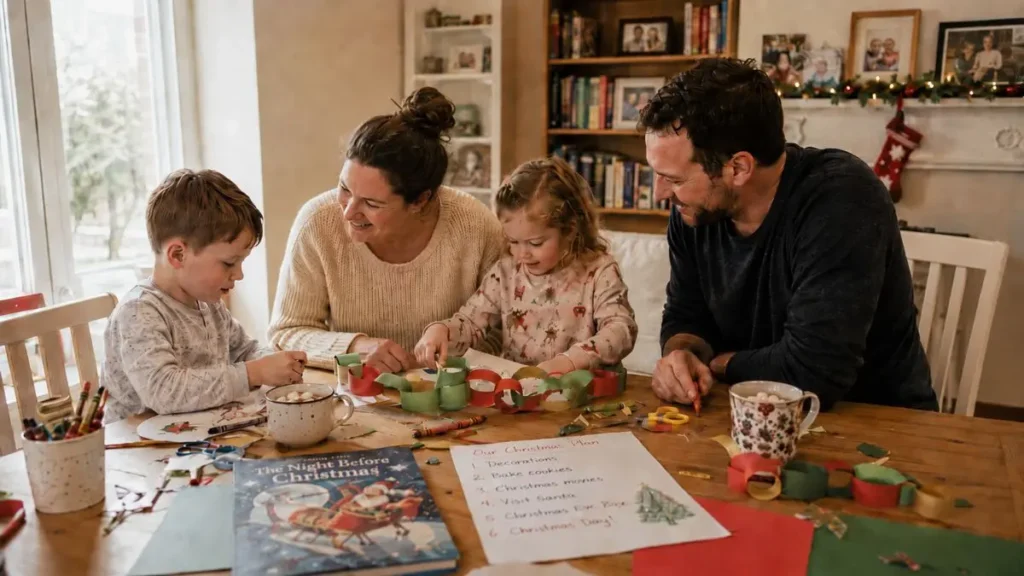
- making paper chains, cards or simple decorations
- doing festive colouring while music is on
- baking something basic such as gingerbread, shortbread or fairy cakes
- having a Christmas film afternoon with blankets and snacks
- going out to spot lights in your street or nearby area
- writing a letter to Father Christmas
- making a simple Christmas playlist together
- turning an ordinary bedtime story into a festive one
The trick is not squeezing them all in. It is choosing the ones your children are most likely to enjoy at their age.
With babies, the activity may be more about atmosphere than doing. Looking at tree lights, touching safe textures, listening to songs and being carried round a lit-up room can be enough.
With toddlers, repetition matters more than novelty. Singing the same songs, hanging the same soft decoration on the tree, or putting a Santa hat on a favourite teddy can be far more exciting than a complicated plan.
With older children, it often helps to give them a bit more say. They might choose the family film, design a scavenger hunt, help make hot chocolate, or decide which night you go out to look at lights.
If you want a fuller list of low-effort home ideas, the supporting article Free and low-cost Christmas activities for kids at home goes deeper without turning it into a huge to-do list.
Simple traditions families can actually keep
The best Christmas traditions are usually small enough to repeat. That is the part people do not always say out loud. A tradition only feels lovely if it still works when you are busy, tired or not having the most organised December of your life.
That might mean opening a new Christmas book each year and reading it together, driving or walking to see lights with snacks along the way, or letting the children hang one special decoration each. For some families it is a Christmas Eve buffet tea, a simple Christmas morning breakfast, one festive board game after lunch, or a photo taken in the same spot every year. Even donating a toy, book or winter item before Christmas can become part of the season in a way that feels grounded rather than performative.
A lot of parents put pressure on themselves to create magical traditions from scratch, when often the strongest traditions grow out of ordinary things repeated with a festive twist. A takeaway picnic under the tree, a Christmas film night with snacks and blankets, or pyjamas and a story by fairy lights can count just as much as the more Instagram-friendly ideas.
If traditions are the part you want to build on, Family Christmas Traditions to Start This Year is where to go next. It helps you choose traditions you are likely to keep, rather than ones that sound good and then quietly disappear after one year.
Christmas Eve boxes without the pressure
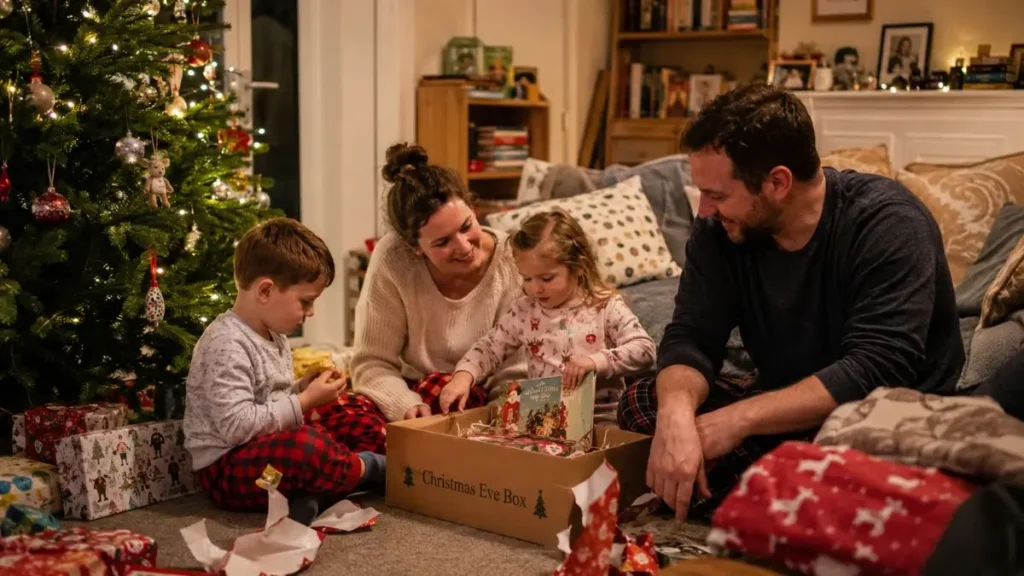
Christmas Eve boxes can be fun, but they have also become one of those things that can feel bigger online than they do in real life. For most children, the excitement comes from the ritual, not the price tag.
A simple Christmas Eve box could be no more than pyjamas or cosy socks, one snack or hot chocolate sachet, a Christmas book, and a small activity such as colouring, stickers or a puzzle. Some parents also like to add a note about what the evening will look like, especially if that helps build excitement without making the box feel overdone.
That is enough for many families. You do not need to recreate a second mini Christmas on 24 December.
For babies, a Christmas Eve box may not be needed at all, unless it is more for you than for them. For toddlers, one or two items is often plenty. For older children, it can help to include something they will actually use that evening, such as choosing a festive film, putting on cosy socks or playing a simple family game, so it feels part of the routine rather than just more stuff.
If this is the part of Christmas you enjoy and want to do properly, Christmas Eve Box Ideas for Kids: Simple, Budget-Friendly Ideas gives you more options without making it feel like another shopping task.
Non-toy gifts can still feel exciting
Not every child needs a pile of plastic to have a good Christmas morning. In fact, one thing many parents notice after a few years is that too many presents can blur together. Children open things quickly, the room gets chaotic, and the day can feel oddly flat after the initial rush.
Non-toy gifts can help balance that out, especially if your child already has plenty of toys or gets overwhelmed by too much at once. Books, craft kits, pyjamas, themed clothing, baking bits, hobby supplies or memorable experiences can all work well. For children who enjoy helping, baking tools can feel more exciting than they sound. Older children may like bedroom or desk items, activity books, magazine subscriptions, or a planned day out instead of yet another toy that ends up forgotten by New Year.
This does not mean toys are bad. It just gives you another route if you want gifts to feel useful as well as fun.
A simple way to approach presents is to ask yourself what will still matter in January. That question often cuts through a lot of last-minute noise. If you want more ideas in that direction, Non-Toy Christmas Gift Ideas for Kids is a good next step.
How to keep Christmas manageable with babies and children
A calmer Christmas often comes less from finding the perfect activity and more from reducing the friction around the edges. Children vary a lot, but tiredness, hunger, routine changes, noise and overstimulation are common reasons festive days wobble.
A few things usually help:
- keep one part of the day predictable, such as breakfast, nap timing or bedtime
- build in quieter moments before or after louder plans
- do not leave every exciting thing until one day
- have an easy meal option in reserve
- accept that children may enjoy a short festive outing more than a long one
- think about space, noise and timing if you are visiting relatives
- lower the number of must-do moments
This matters with babies because Christmas can easily become adult-led while they are expected to fit around it. With toddlers, it matters because excitement and dysregulation can look very similar. With older children, it matters because anticipation can tip into overwhelm, especially if there are late nights, family tensions or lots of social demands.
There is also a practical side to this. If you know that Christmas morning gets hectic, set out the breakfast things the night before. If your child gets overwhelmed by noise, do the loudest bit in shorter bursts. If you are going to relatives, pack one or two familiar things without overthinking it. Small adjustments often do more than grand plans.
For a fuller look at this side of the season, A Calm Christmas with Kids: How to Avoid Overwhelm is the article that goes deeper on pressure, regulation and keeping things more manageable.
You do not need every kind of Christmas activity
One reason broad Christmas articles can become unhelpful is that they make it sound as though a successful festive season needs activities, traditions, events, gifts, baking, pyjamas, crafts, Santa prep and a perfect family day. Most families do better when they choose a few categories and leave the rest lighter.
For example, your Christmas might work well with:
- one or two low-cost home activities
- one repeatable family tradition
- one simple Christmas Eve ritual
- a thoughtful gift approach
- one plan that protects the calm
That is already plenty.
If money is tight, the emotional part of Christmas can get mixed up with guilt very quickly. It is worth remembering that children usually respond to attention, rhythm and anticipation more than price. A torch-lit evening walk to see lights, a special snack plate, a blanket film night, or letting them help with tiny jobs can all feel genuinely exciting.
If energy is low, the same principle applies. You are allowed to choose what is easy to sustain. A simpler Christmas is still a real Christmas.
Where to go next
If you want a bit more support around the calmer, more practical side of family life, these may help:
- What calm family life actually looks like: a good follow-on if you want to hold on to the less-pressure, more-connection side of Christmas and family life more generally.
- How to talk to family about parenting choices without conflict: useful if Christmas brings extra opinions, awkward family moments or pressure around how you do things.
- Family Christmas for Babies, Kids and Parents: the main Christmas topic page, where you can browse the wider set of festive articles in one place.
A couple of useful UK resources
If the emotional or financial side of Christmas is weighing on you, these are sensible places to look for extra support:
- Mind – Christmas and mental health: practical support for coping if Christmas affects your mental health, including stress, overwhelm, loneliness or difficult family dynamics.
- Money Helper: clear guidance on budgeting and managing seasonal spending if cost is one of the main pressures around Christmas.
What matters most
A good Christmas with children is usually less about doing more and more about choosing well. A few easy activities, one or two traditions, and a calmer pace often land better than trying to create a perfect festive schedule.
If you are not sure where to begin, pick one thing from this article that feels easy, not impressive. That is often the better sign that it will actually help. Children do not need a professionally produced December. They need a version of Christmas that your family can enjoy and live through without everyone ending up wrung out by Boxing Day.
FAQ
What are easy Christmas activities to do at home with kids?
The easiest ones are usually decorating, colouring, baking something simple, reading Christmas books, festive film afternoons, writing a letter to Father Christmas and going out to look at local lights. The best choice depends on your child’s age and your energy.
How can I make Christmas feel special without spending much?
Small rituals often do a lot of the work. Music, lights, a festive snack, a favourite film, a bedtime story by the tree, or a simple drive to see decorations can all feel special without costing much.
What are simple Christmas traditions to start as a family?
Good traditions are usually repeatable and low-effort. You might choose Christmas morning breakfast, an annual photo, a Christmas Eve walk, a December library trip, or opening one festive book together each year.
What can I put in a Christmas Eve box without overdoing it?
A pair of pyjamas, a book, a snack and one small activity is enough for many children. The box does not need to be big to feel exciting.
How do I keep Christmas calmer with young children?
It helps to protect some routine, avoid packing too much into one day, build in quiet time, and lower the number of things that feel compulsory. Young children often cope better with a simple festive day than a packed one.