

If you’ve been reading about ADHD and Autism and feeling more confused than clear, you’re not alone. Many parents notice traits that seem to fit both, or shift over time, and wonder what the difference actually is, and whether it even matters day to day.
TL;DR
Here’s what you’ll find in this ADHD vs Autism article:
- ADHD and Autism can look very similar in children, especially around focus, emotions, and social situations
- Some children show traits of both (often called AuDHD)
- The differences matter mainly for understanding support needs, not for labelling a child
- You don’t need a diagnosis to start making things easier at home or school
This article is for / not for
This article is for:
- Parents noticing overlapping ADHD and autism traits
- Families are wondering why descriptions never seem to fully fit
- Parents are early in the research or assessment journey
This article is not for:
- Diagnosing a child
- Deciding which label is “right”
- Clinical or educational instruction
Medical note
This article is for general understanding and reassurance only. It cannot diagnose ADHD or autism, and it doesn’t replace professional assessment or advice. If you’re concerned about your child’s development, behaviour, or wellbeing, speak to your GP or health visitor, or visit the NHS guidance on ADHD and autism for children.
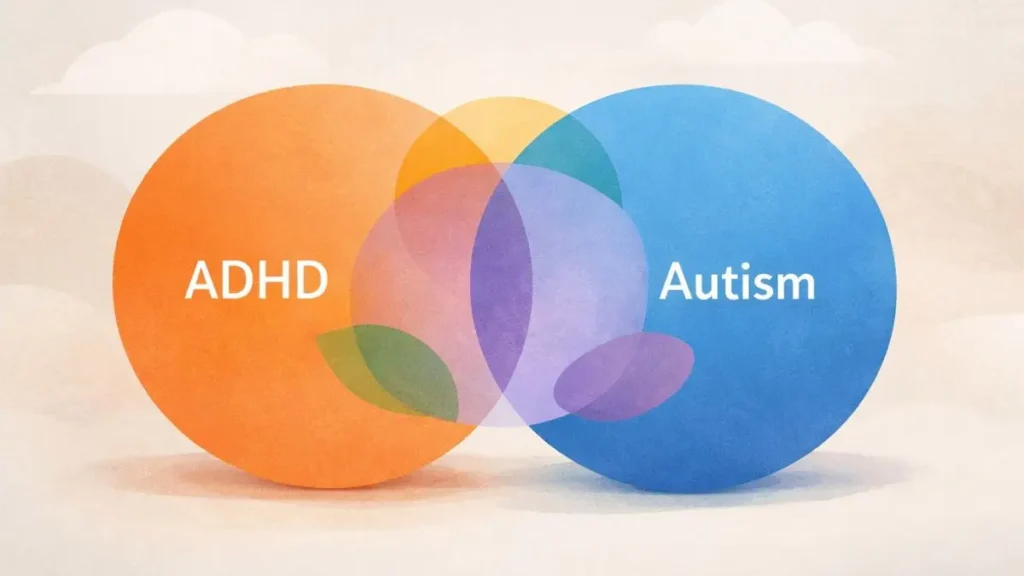
A different way to think about ADHD and autism
One thing that helped me was letting go of the idea that ADHD and autism are neat, separate boxes. In real life, children don’t present as textbook examples. Traits overlap, change with age, and show up differently depending on stress, environment, and expectations.
Many parents only start questioning things when everyday situations feel harder than expected — school mornings, homework, friendships, emotional outbursts, or exhaustion after social days.
Where ADHD and autism often overlap
This is often the point where parents start to feel unsure, because everyday struggles don’t neatly point to one explanation. In real life, many challenges look the same on the surface, even if the reasons underneath are different.
Children with ADHD and autistic children can both experience:
- Difficulty with attention and focus (especially on things they didn’t choose)
- Strong emotional reactions or quick overwhelm
- Sensory sensitivities (noise, clothes, food, crowds)
- Social challenges, particularly in busy or unstructured settings
- High anxiety around change or uncertainty
This overlap is why many parents feel stuck between descriptions that almost fit, but not quite.
Some key differences that can help make sense of things
Once you step back from labels, these differences can be useful as patterns, not checklists. Many parents recognise bits of their child in both descriptions, which is completely normal.
These are not rules, just common patterns that can help parents notice where their child might lean.
ADHD often centres around:
- Difficulty regulating attention (too little or too much)
- Impulsivity or acting before thinking
- Needing movement, novelty, or urgency to engage
- Big swings in motivation and energy
Autism often centres around:
- Differences in social communication and understanding
- A strong need for predictability and routine
- Deep, focused interests
- Sensory processing differences that affect daily life
Many parents find this is the moment things start to click, the same child can seek novelty and stimulation in one situation, while needing predictability and safety in another. That isn’t a contradiction; it’s often a sign of overlapping needs rather than mixed messages.
A child can show traits from both lists, which is why the term AuDHD exists, though not everyone finds labels helpful.
A brief bit of history (and why this confusion exists)
For a long time, ADHD and autism were treated as completely separate. Earlier diagnostic manuals didn’t allow a person to be diagnosed with both, so clinicians had to choose one or the other.
That shaped how research, schools, and support systems developed, and it’s why many older descriptions still sound like they’re describing two very different types of child.
Over time, research and lived experience showed something different: many people clearly met criteria for both. As understanding improved, it became accepted that ADHD and autism can and do co‑occur. That shift helps explain why so many parents today feel caught between overlapping descriptions.
Why the overlap can be confusing for parents
Support systems often treat ADHD and autism as separate paths, but families don’t experience them that way. You might recognise ADHD traits at home and autistic traits at school, or vice versa.
What surprised me was realising that behaviour often makes sense once you see it as regulation, not misbehaviour. Many struggles are about coping with overload rather than not trying hard enough.
A lived experience: when overlap isn’t recognised yet
When our son was diagnosed as autistic, we continued to see the paediatrician who made that diagnosis for follow-ups. Over time, we started to notice things that didn’t quite sit comfortably under autism alone — difficulties with attention, emotional regulation, and constant mental restlessness.
We raised ADHD as a possibility. I don’t remember the exact wording now, but the sense of the response was that we’d be better off going down a learning difficulty route instead.
At the time, that seemed reasonable. We trusted the process and focused on getting whatever support we could.
Looking back — especially after learning more about ADHD through my own diagnosis — it’s clear to me that our son shows ADHD traits too. Not instead of autism, but alongside it.
That doesn’t mean the paediatrician was wrong. It reflects how, until fairly recently, ADHD and autism were often treated as separate paths, even when children clearly sat in the overlap.
What I’ve learned since is that this kind of delay or mis-direction is common. It isn’t a failure by parents to notice, or children to fit a description. It’s a sign that our understanding is still catching up with real life.
For many families, this kind of hindsight is what eventually makes the overlap make sense.
What matters more than the label
For most families, the useful question isn’t “Which one is it?” but:
- What situations are hardest for my child?
- What drains them the most?
- What helps them recover or feel safe?
Small adjustments — quieter transitions, clearer expectations, more recovery time, can help regardless of diagnosis.
Reassurance and a gentle next step
If you’re in the early stages of learning, it’s okay to sit with uncertainty. Understanding grows over time, and support doesn’t have to wait for a formal label.
A gentle next step can be noticing patterns for a few weeks and writing them down. This can help you advocate later, while also making day-to-day life calmer now.
If you’d like to explore this further, you may find these helpful:
- Neurodivergent explained in simple terms and what it means for families
- Signs of ADHD in children that parents often miss
- Autism traits in children that don’t look like stereotypes
For clear, UK‑relevant guidance and next steps:
Key takeaways
If you take nothing else from this article, these are the points many parents find most reassuring.
- Overlap between ADHD and autism is common and normal
- Real-life traits rarely fit neatly into one description
- Support needs matter more than labels
- You can make helpful changes without waiting for a diagnosis