
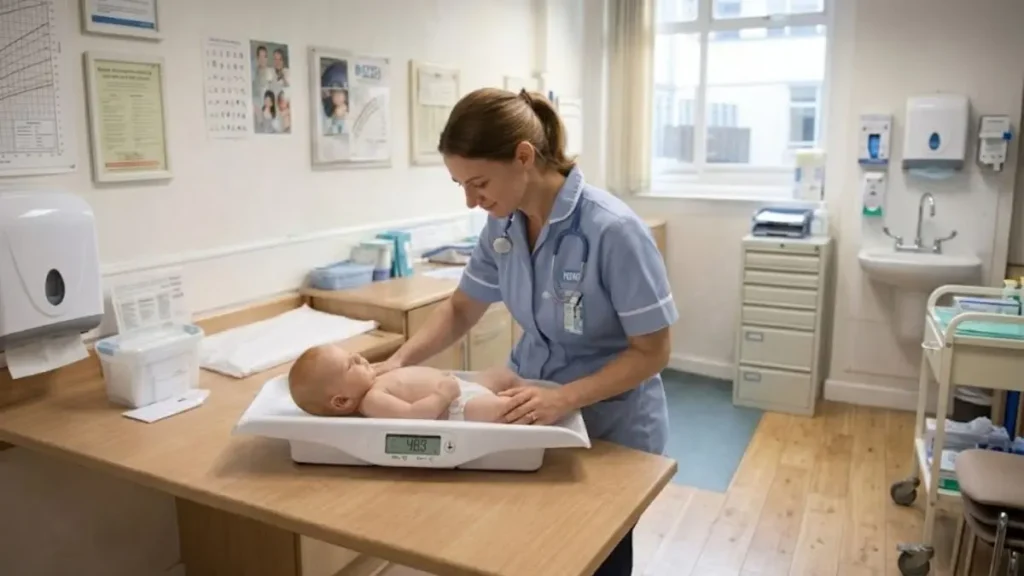
It can be worrying when your baby’s weight gain doesn’t seem to match what you expected. It is easy to assume something is wrong. In many cases, though, slower weight gain is still completely healthy, and the key is understanding the pattern over time and knowing when it is worth getting reassurance.
Quick summary
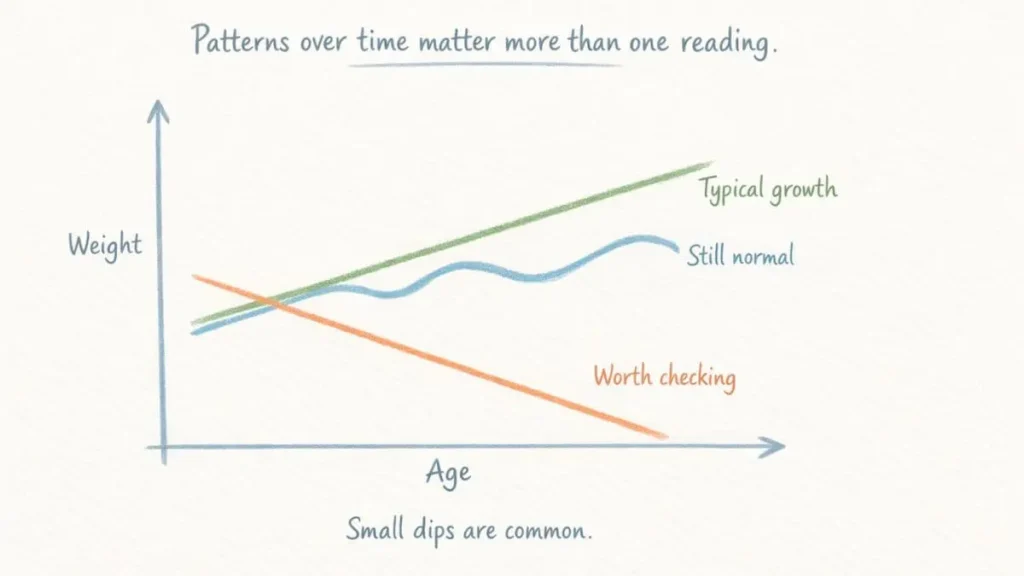
If you are unsure about your baby’s weight, it often helps to zoom out and look at the bigger picture. But baby growth is rarely a straight line, and small fluctuations are very common. Looking at patterns over time, alongside feeding and behaviour, usually gives a much clearer and more reassuring picture:
- Many babies gain weight at different rates, especially after the early weeks
- “Slow” weight gain is usually about patterns over time, not one reading
- Feeding, growth spurts, and illness can all affect weight temporarily
- Health visitors track growth on charts, not single numbers
- Speak to a GP or health visitor if weight gain drops across centile lines or feeding becomes difficult
This article is for / not for
This article is for:
- Parents worried their baby is not gaining weight quickly enough
- Those comparing their baby to charts or other children
- Parents wanting to know when to seek reassurance
This article is not for:
- Babies with diagnosed feeding or medical conditions
- Situations where a professional has already advised urgent care
Medical disclaimer
This article is for general reassurance and awareness only. It cannot assess your baby’s health or provide a diagnosis. If you are concerned about your baby’s growth, feeding, or behaviour, speak to a GP, midwife, or health visitor. For guidance, you can refer to NHS resources on baby weight and growth.
What counts as slow weight gain?
Weight gain in babies is not linear. In the first few days after birth, many babies lose a small amount of weight, which is expected. Most then regain their birth weight within the first couple of weeks and go on to gain steadily. After that, the pace can vary quite a bit.
Health visitors usually look at growth charts, which track your baby’s weight over time. These charts use centile lines rather than one “correct” number. A baby staying roughly on the same centile is usually a reassuring sign, even if they are on a lower line.
So how do professionals actually define “slow”? Slow weight gain is usually considered when there is a noticeable pattern over time rather than a single reading. For example, this might mean your baby drops across two or more centile lines, shows very little gain over several weeks, or feeding becomes difficult or reduced.
A single low weigh-in is rarely enough to mean there is a problem. What matters more is the overall trend.
Common reasons weight gain can slow down
There are several everyday reasons why weight gain might dip or look slower for a while.
Feeding changes are one of the most common. Babies may feed less during growth transitions, teething, or when they are more distracted by the world around them.
Illness and growth changes often overlap. Even a mild cold or tummy upset can temporarily affect appetite, and growth spurts can feel confusing at the same time. Some babies eat more and gain quickly, while others stretch out and seem to pause on weight for a short time. As babies become more active, especially when they start rolling or crawling, weight gain can also slow slightly as energy is used differently.
Another factor is how often your baby is weighed. If weigh-ins are very close together, changes can look smaller than they really are.
A simple insight that catches many parents out is that babies do not follow a smooth upward line. They often grow in small bursts with pauses in between, which can look like slowing down when it is actually normal variation.
When to speak to a GP or health visitor
It is always okay to ask for reassurance, even if things turn out to be fine.
You may want to speak to a professional if you notice a clear change in your baby’s pattern, such as dropping on their growth chart, feeding becoming shorter or less frequent, or your baby seeming unusually sleepy, unsettled, or not themselves. Changes in nappies, such as fewer wet or dirty ones than expected, can also be a useful signal. As a rough guide, many babies will have around 6 or more wet nappies a day, but this can vary.
Health visitors are usually the first point of contact in the UK. They can check feeding, review growth patterns, and help you decide if anything needs further investigation.
In most cases, these checks lead to reassurance rather than concern.
How growth is usually assessed in the UK
In the UK, baby weight is tracked using growth charts based on large population data. These charts are designed to show patterns over time rather than judge a single measurement.
Your baby’s centile shows how their weight compares to other babies of the same age. Being on a lower centile is not a problem in itself. What matters is whether your baby continues along a similar path.
This approach can feel counterintuitive at first, especially if you are focused on individual numbers. Over time, it becomes clearer that consistency matters more than speed. If you want a clearer sense of typical ranges and how centiles work in practice, our guide to Average baby weight and height (UK guide) explains this in more detail.
When slower gain is still normal
Some babies are naturally smaller or gain weight more gradually. This can reflect family traits, feeding style, or individual differences.
If your baby is feeding well, alert and responsive, and producing regular wet and dirty nappies, then slower weight gain is often just part of their natural pattern.
Comparisons with other babies can make this harder. Two babies the same age can grow at very different rates and both be completely healthy.
Related reading that can help you see the bigger picture
If you want to understand how growth fits into wider development, these may help:
- 28 baby milestones by age (UK): what to expect – shows how development and growth link together over time
- Baby growth spurts: why feeding and sleep change – explains why weight and feeding can feel unpredictable
- Baby development 0–12 months: milestones at a glance – a simple overview of what changes to expect in the first year
For further guidance, you can also read the NHS advice on baby reviews and growth.
- NHS baby reviews and growth guidance – explains how your baby’s weight is monitored over time in the UK
What matters most
It is easy to focus on the scale, especially when you are tired and looking for reassurance. In reality, your baby’s overall pattern matters far more than any single number.
If something feels off, it is worth checking. Most of the time, you will be told things are on track, even if the pace is different from what you expected.
You are not expected to figure this out alone. A quick conversation with a health visitor can often bring clarity and peace of mind. If you are unsure, booking a routine weigh-in or speaking to your health visitor is a simple next step that can give you a clearer picture.
FAQ
Is it normal for a baby to stop gaining weight for a short time?
Yes, short pauses can happen, especially around illness, growth changes, or feeding shifts. What matters is the longer-term trend.
Should I weigh my baby regularly at home?
Frequent weighing can increase anxiety and does not always give a clear picture. Health visitors usually space weigh-ins for a reason.
What if my baby is happy but gaining weight slowly?
If your baby is feeding, alert, and producing nappies as expected, slower gain is often not a concern. A professional can confirm this.