
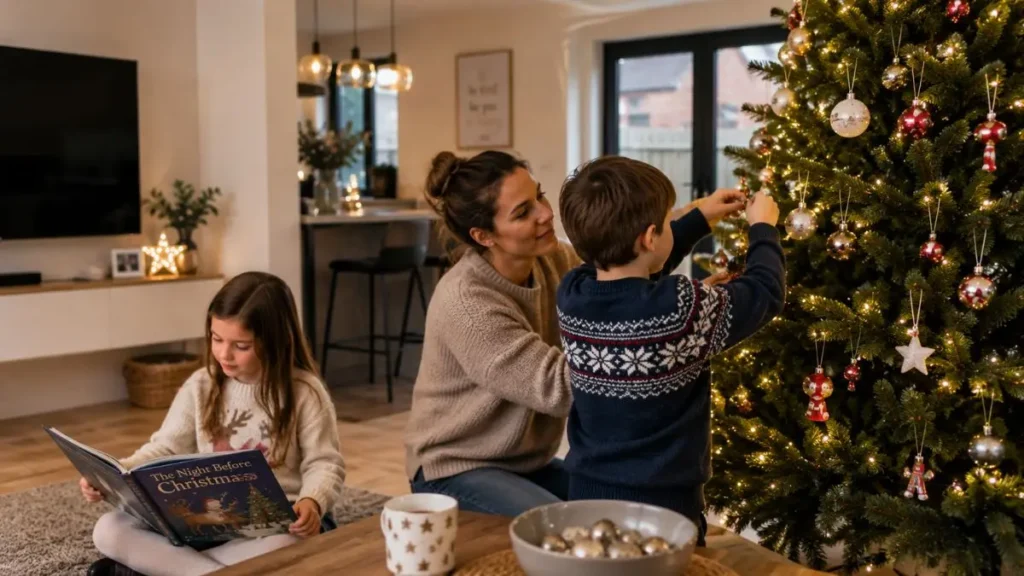
Family Christmas traditions do not need to be magical in a big, expensive, Instagram-ready way to matter. In most homes, the traditions that stick are the ones that feel easy enough to repeat, comforting enough to look forward to, and flexible enough to work when children are tired, parents are stretched, or life does not look especially festive on paper. This guide is here to help you choose a few Christmas traditions that feel special without turning December into another job.
Quick summary
The best family Christmas traditions are usually the ones you can repeat without too much effort, cost or pressure. A few simple rituals often do more than a long list of festive plans:
- The strongest family Christmas traditions are usually small, repeatable and easy to adapt as children grow.
- You do not need lots of traditions. One or two done every year can be enough to make Christmas feel like your family’s Christmas.
- Evening routines, baking moments, decorating rituals, kindness traditions and simple memory-making ideas all work well.
- Babies often respond more to atmosphere, music, lights and repeated cosy moments than to bigger festive plans.
- Toddlers usually enjoy repetition, simple rituals and joining in with small jobs.
- Older children often like traditions that give them a role, a choice or something to look forward to each year.
This article is for / not for
This article is for:
- parents who want simple family Christmas traditions they can actually keep up
- families trying to make Christmas feel special without spending heavily
- parents of babies, toddlers and older children who want meaningful but manageable festive rituals
- anyone who wants a calmer starting point than a huge “magic Christmas” list
This article may not be for you if:
- you are mainly looking for one-off Christmas activities rather than repeatable traditions
- you are mainly looking for detailed gift ideas rather than simple family traditions
Simple family Christmas traditions to start this year
One thing that makes Christmas feel harder than it needs to is assuming traditions have to be elaborate before they count. In real family life, they usually work best when they slot into something you were already likely to do. A special breakfast on Christmas morning, one festive book at bedtime, a yearly lights walk, or letting children put one decoration on the tree can all become “what we do” without much effort.
That matters because traditions only become traditions if they happen again. It is much easier to repeat something low-pressure than something that needs loads of shopping, planning or energy every year.
Our broader guide, Christmas activities and ideas for kids, covers the wider festive picture, but this article stays focused on repeatable rituals that can grow with your family instead of becoming another December to-do list.
Christmas traditions that work well for babies, toddlers and children
A lot of parents worry that traditions need to wait until children are old enough to remember them properly. That is not really how family rituals work. Babies may not remember a first Christmas film night or bedtime song, but you will, and the rhythm of those moments can still become part of family life.
With babies, traditions often work best when they are sensory and gentle. Tree lights, a Christmas bedtime story, the same seasonal music, a festive morning walk wrapped up in the pushchair, or a family photo in the same spot each year can all work well.
With toddlers, repetition tends to matter more than novelty. Decorating the tree in stages, putting out one special decoration, stirring cake mixture, choosing a Christmas book, or helping carry mince pies to the table can all feel exciting because they happen every year.
With older children, traditions often get stronger once they have a role in them. They might choose the film for family movie night, help make Christmas breakfast, take charge of the playlist, or be the one who hangs a particular decoration first. A tradition does not need to stay identical forever. It just needs enough of the same shape to still feel familiar.
Low-cost Christmas traditions that still feel special
One of the most useful things to remember is that traditions are not the same as treats. They do not need to cost much to feel meaningful. In fact, some of the best ones are built around timing and repetition rather than money.
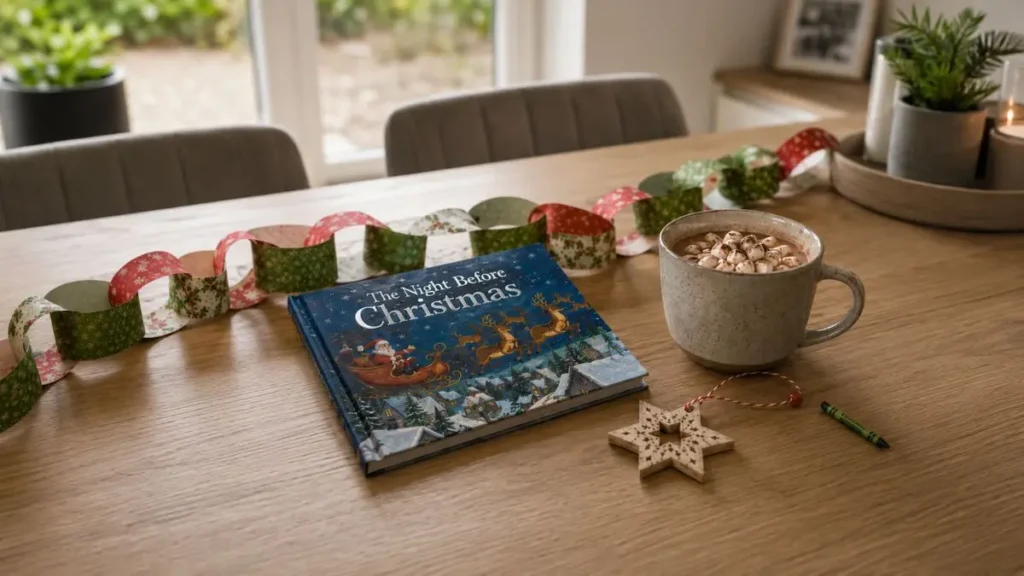
A lights walk after dinner, hot chocolate and a Christmas story, a Christmas film night with snacks and blankets, a family buffet tea, a yearly paper chain, or pyjamas and a film on the same evening each year can all feel special without asking much of your budget.
The reason these work is that they create expectation. Children start to recognise them as part of the season. That sense of “this is what we do at Christmas” often matters more than whether the tradition was expensive.
If cost is one of the biggest pressures this year, it may help to choose traditions that use things you already have at home or things you would be doing anyway. That makes them more sustainable and takes some of the pressure out of repeating them next year.
Something that has become a tradition for us, which you may want to try, is a Christmas morning parkrun/parkwalk. It feels properly festive, it is free, and it does not need much planning. There is usually a cheerful mix of Santa hats, Christmas costumes and people starting the day in good spirits, and it can be a fun way to get some fresh air before the rest of Christmas begins. It is also a cheerful way to “earn” the roast potatoes. It is worth checking the parkrun website first to make sure your local event is running on Christmas Day, and whether the course is suitable for buggies if you are planning to use one.
Evening routines that become part of Christmas
Evening traditions are often some of the easiest to keep because they fit into the part of the day when most families are already slowing down. They can also help Christmas feel cosy without adding much planning.
That might mean reading one Christmas book each evening in December, turning off the main light and using tree lights for a bedtime story, having one weekly Christmas film night, listening to the same festive playlist during bath or pyjama time, or doing a short lights walk before bed once a week.
What helps is choosing something that feels genuinely manageable on a tired evening. It is better to have one tradition that happens four times every December than five traditions that feel so idealistic they disappear after a year or two.
A calm evening tradition can also work well when the rest of Christmas feels loud or overstimulating. It gives children something predictable to come back to, and it gives parents a slightly easier way to create a festive feeling without having to perform it.
Food and baking traditions families can repeat
What this can look like in real life is something as simple as saying, “We always decorate biscuits on the first Sunday in December.”
Food traditions work well because they are easy to anchor to a particular time. They also tend to evolve naturally as children get older.
For some families, that will be decorating biscuits, making one simple cake, or baking something small together every December. For others, it might be croissants or pancakes on Christmas morning, a simple Christmas Eve buffet or letting children help with one job every year, such as putting marshmallows on hot chocolates or adding sprinkles to cakes.
The key is not whether the food is impressive. It is whether the ritual feels repeatable. A tradition can be as simple as “we always have this after the school nativity” or “we always bake something on the first weekend in December”. That is often enough to make it stick.
If your children are very young, the food tradition may be more about joining in than producing something edible and beautiful. That still counts. A toddler stirring cake mixture or sprinkling icing sugar is already part of the memory.
Giving and kindness traditions that do not feel performative
Not every family Christmas tradition needs to centre on getting things. Some of the traditions people keep most happily are the ones that build a small habit of giving, helping or noticing other people.
That could mean donating a toy before Christmas, choosing one item for a food bank collection, making a card for an elderly relative, leaving a kind note for someone, or letting children pick a small act of kindness each year.
These traditions work best when they stay simple and matter-of-fact. They do not need a big speech attached to them. They can simply become part of what your family does in December.
This is also one of the easiest areas to adapt over time. A baby may simply be nearby while older siblings help. A toddler might choose which tin or packet goes in a donation bag. An older child may start to understand more about why the tradition matters. The same ritual can grow with them.
Decorating and memory-making ideas that do not become pressure
A lot of Christmas traditions live in decorating and memory-making, but this is also where families can accidentally create pressure for themselves. Matching everything, taking the perfect photo, or trying to make every decorating session feel magical can turn a nice ritual into hard work.
Usually the better route is to keep one or two memory-making traditions and let the rest stay loose. That might be one family photo in the same place every year, each child hanging one decoration first, making one decoration by hand, or putting on the same music when the tree goes up.
One thing that helps here is separating the tradition from the ideal result. The tradition is “we take the photo”, not “the photo turns out beautifully and everyone smiles”. The tradition is “we decorate the tree together”, not “the room looks perfect afterwards”. That small mindset shift can make traditions much easier to keep.
How to start family Christmas traditions without adding pressure
It can help to choose from the kinds of traditions you have already seen here, such as evening routines, food moments, memory-making or giving, rather than feeling you need to invent something completely new.
The easiest mistake is starting too many at once. It is very tempting, especially after reading articles full of festive ideas, to try to build your entire family Christmas in one December. In practice, that often means nothing feels settled enough to last.
A better approach is to choose one tradition from home life, one from food or baking, and maybe one from memory-making or giving if it still feels manageable. That is already enough.
A good test is this: can you imagine doing it next year if you are tired, the house is messy and money is tighter than you hoped? If the answer is yes, it is probably a stronger tradition than something that sounds magical but already feels like work.
Where to go next
If you want to build on this without losing the realistic, low-pressure feel, these are the most useful next reads:
- Family Christmas ideas: the Christmas topic page, where you can browse more traditions, activities and calmer Christmas ideas.
- Free or low-cost Christmas activities for kids at home: useful if you want easy festive things to do without drifting too far into gifts, outings or bigger planning.
- A calm Christmas with kids: How to avoid overwhelm: a good next step if the bigger issue is not choosing traditions but keeping December manageable for you and your children.
A couple of useful UK resources
If the emotional or financial side of Christmas feels heavier than expected, these can help:
- MoneyHelper: practical help with budgeting and difficult conversations about christmas
- Mind – Christmas and mental health: useful support if Christmas brings stress, loneliness, overwhelm or difficult family dynamics.
What matters most
The best family Christmas traditions are not usually the most elaborate ones. They are the ones that fit your family well enough to happen again.
If you only take one thing from this article, let it be this: choose the traditions that feel easy to keep, not the ones that sound most magical on paper. One bedtime ritual, one food tradition and one small memory-making moment can be more than enough to make Christmas feel like yours.
FAQ
What are simple family Christmas traditions to start?
Simple family Christmas traditions can include a yearly lights walk, one Christmas book at bedtime, a festive film night, a special breakfast, decorating the tree together, or taking one family photo in the same place each year. The best ones are usually the easiest to repeat.
What Christmas traditions work well for young children?
Young children often enjoy traditions built around repetition, music, lights, books and helping with small jobs. Babies may enjoy the atmosphere and routine, while toddlers often like doing the same simple festive things each year.
How can I make Christmas special without spending much?
Low-cost traditions often work best because they are easier to repeat. A Christmas story, a family film night, hot chocolate after a lights walk, simple baking, or one decorating tradition can all make Christmas feel special without costing much.
What are good Christmas Eve traditions for families?
Good Christmas Eve traditions are usually calm and easy to repeat, such as a buffet tea, a festive film, one bedtime story, leaving out snacks, or putting on pyjamas and listening to Christmas music. The best choice depends on your children’s age and energy.
How do I start family traditions without pressure?
Start with one or two, not ten. Choose traditions that feel realistic on an ordinary tired December evening, because those are the ones you are most likely to keep next year as well.
End of article