

Worrying about your child’s mental health is natural. Knowing how to respond without panicking, overreacting, or doing too much can feel much harder. This article is about finding that calm middle ground.
TL;DR
Supporting your child’s mental health often starts with staying calm and observant rather than trying to fix everything straight away. It is about responding thoughtfully over time, not reacting to every difficult moment, which often means you:
- Notice patterns rather than reacting to one-off moments
- Stay curious and open instead of alarmed
- Keep everyday routines steady and predictable
- Talk little and listen more than you think you need to
- Get extra support when worries persist or start to affect daily life
This article is for / not for
This article is for:
- Parents who feel worried but unsure whether their concern is ‘serious enough’
- Parents who do not want to ignore things, but also do not want to overreact
- Parents noticing changes in mood, behaviour, or confidence
This article is not for:
- Emergency situations or immediate risk
- Parents seeking a diagnosis or treatment plan
- Situations where a child is unsafe right now
Medical disclaimer
This article is for general guidance and reassurance only. It does not provide medical advice, diagnosis, or treatment. Children’s mental health can be complex, and concerns should always be discussed with a qualified professional if they persist or worsen.
If a child is in immediate danger, call 999 straight away. If you need urgent advice but it is not an emergency, you can call NHS 111 for guidance on what to do next.
For ongoing concerns, you can also speak to your GP, school, or a recognised UK support service such as the NHS or Mind.
When something feels ‘off’, but you are not sure why
Many parents notice small changes long before anything feels like a ‘problem’.
It might be more tears than usual. A child who suddenly does not want to go to school. More meltdowns, more withdrawal, or a shorter fuse at home.
The tricky part is that children change all the time. Growth spurts, friendships, tiredness, hormones, and everyday stress all show up in behaviour.
Noticing these changes does not automatically mean there is a long-term problem.
What helped us was learning to pause before reacting. Not to ignore it, but to give ourselves a little space to observe.
Look for patterns, not moments
One bad day rarely tells you much.
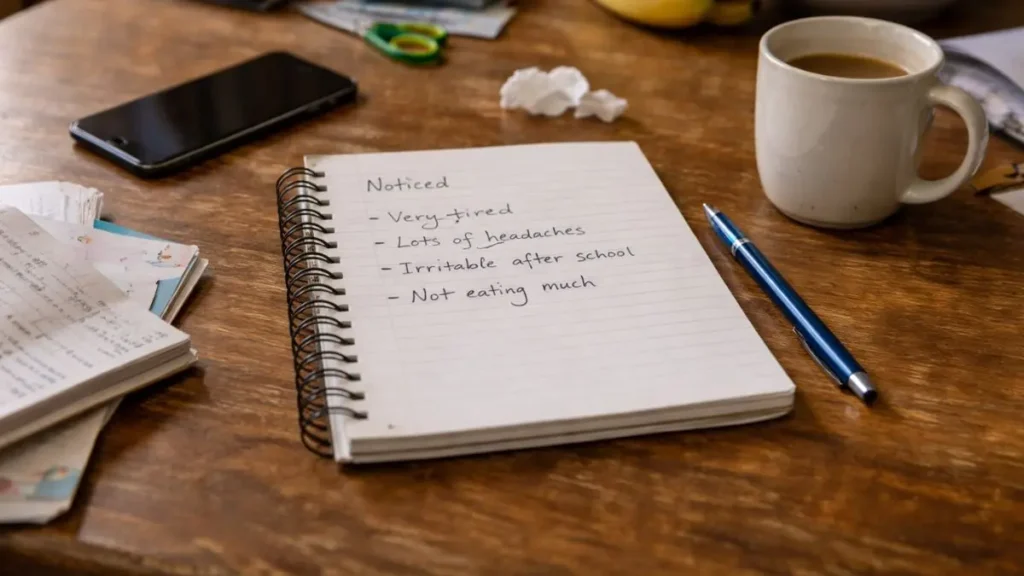
A pattern over time usually does. This can be a series of behaviours that happen frequently over time, and some parents find it helpful to make a brief note of these moments to help spot patterns more clearly.
If you do this, it is usually best to keep notes private and out of sight, so a child does not feel watched, labelled, or worried if they come across them.
You might notice:
- Low mood or irritability most days for several weeks
- Avoiding things they previously enjoyed
- Physical complaints like headaches or tummy aches with no clear cause
- Changes in sleep, appetite, or confidence
Seeing patterns does not mean something is ‘wrong’. It simply helps you respond more calmly and appropriately.
Why overreacting can sometimes make things harder
When we panic, children often pick up on it.
Sudden big reactions, lots of questioning, or rushing to fix things can accidentally send the message that something is seriously wrong with them.
This can increase anxiety, especially for sensitive or neurodivergent children.
A calmer response often helps children feel safer to talk, rather than shutting down or masking how they feel.
Talk less, listen more
This was one of the hardest lessons for us.
Parents often feel pressure to ask the perfect question or give the right advice. In reality, children often open up more when they are not being pushed.
As the saying goes, we have two ears and one mouth, and it usually helps to use them in that proportion.
Simple phrases can help:
- “I’ve noticed you seem a bit quieter lately.”
- “You don’t have to talk now, but I’m here.”
- “That sounds hard.”
Silence can feel uncomfortable, but it often gives children space to find their own words.
Keep everyday life steady
When emotions feel wobbly, predictability helps. This helps a child feel safe, supported, and comfortable, and makes it easier for them to open up.
You do not need a special plan or new routine. Small anchors often matter more:
- Regular mealtimes
- A familiar bedtime routine
- Ordinary connection, like walking together or sitting side by side
Stability sends a quiet message that life is still manageable.
When it is time to get extra support
Trust your instincts, especially if concerns do not ease over time.
It may be time to seek support if:
- Changes last several weeks or more
- School, sleep, or friendships are affected
- Your child seems overwhelmed or distressed most days
- You feel stuck or unsure what to do next
Reaching out does not mean you have failed. It often means you are responding early and thoughtfully.
If this has raised questions or helped you pause and reflect, you may find these related articles helpful:
- A realistic reset for parents after a hard year
- Mental load isn’t just a mum issue, dads feel it too
- Neurodiversity is not a parenting failure
If you need trusted, UK-based guidance or support, these organisations are a good place to start:
- NHS: Children’s mental health
- Barnardos: Mental health services – Support for parents and carers
- YoungMinds: Advice for supporting children and teenagers
A calm way forward
You do not need to have all the answers.
Supporting a child’s mental health is often about staying present, noticing gently, and responding without panic. Most of the time, small, steady support makes a bigger difference than big reactions.
If something continues to worry you, taking a next step with support is a sign of care, not overreaction.