

Most parenting advice isn’t written for how you actually feel when you’re reading it. It’s written for calm moments that rarely exist. This article is about what genuinely helps when you’re tired, overloaded, and just trying to get through the day.
Quick summary
When you’re exhausted, parenting advice needs to do less, not more. These are the things that make advice feel manageable rather than overwhelming:
- Clear answers up front, not a long build-up – a Quick summary helps
- Reassurance before instruction
- Fewer rules, more permission to adapt
- Honesty about what might not work
- Writing that sounds like a parent, not a handbook
- More white space and shorter paragraphs so it’s easier to read on a phone
This article is for / not for
This article is for:
- Parents who open advice articles late at night or mid-meltdown
- Anyone who feels worse after reading “expert” parenting tips
- Parents who want reassurance as much as ideas
This article is not for:
- Parents looking for strict systems or guaranteed outcomes
- Anyone wanting one-size-fits-all solutions
- People who enjoy dense, research-heavy parenting content
- Parents who have read, memorised, and fully assimilated the parenting manual
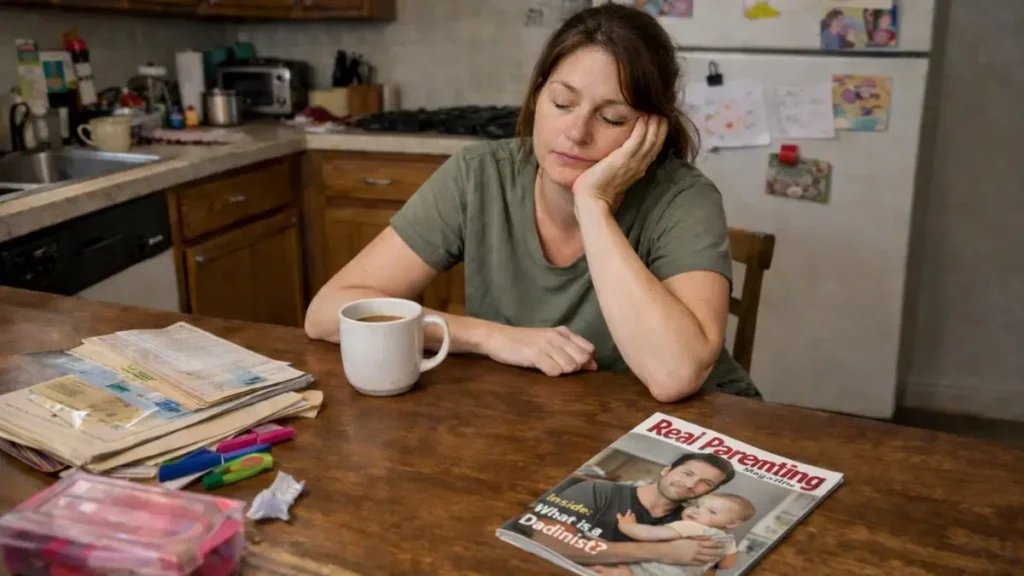
Why most advice articles miss the mark
Most parenting advice assumes you have time, energy, and headspace.
In reality, many of us are reading while tired, during naps, or emotionally full. When advice ignores that, it can feel overwhelming rather than helpful.
Long introductions, heavy explanations, and endless “tips” all add to the load. Even good advice can land badly if it arrives in the wrong shape.
Some advice was written to be found online, rather than to be read in real life. That often meant longer articles, more explanation, and fewer pauses.
When you’re tired, that kind of structure can feel like work instead of support.
What tired parents actually need first
Before advice, you need to know you’re not doing things wrong.
That knowledge helps you relax and takes some of the anxiety out of parenting.
That means:
- Being told it’s normal to find things hard
- Seeing your situation reflected, not idealised
- Knowing there isn’t a single right way to do this
Reassurance does not mean lowering standards. It means removing unnecessary pressure so parents can think clearly again.
Less instruction, more permission
Many advice articles focus on what you should do.
What often helps more is permission.
Permission to:
- Try something and stop if it makes things worse
- Adapt ideas to fit your child and family
- Decide that “good enough for today” really is enough
This kind of advice feels lighter because it hands control back to the parent.
It reminds you that you’re allowed to judge what fits your child, your day, and your energy, rather than trying to measure yourself against someone else’s system.
Clear structure beats clever writing
When you’re tired, clarity matters more than style.
Helpful articles tend to:
- Say what they’re about early
- Use short sections and plain language
- Avoid burying the useful part at the end
- Leave more white space so sentences can breathe, especially on a phone
Writing does not need to be clever to be effective. It needs to be kind to a tired brain.
Honesty builds trust faster than confidence
You can sense overconfidence a mile away.
A lot of parenting advice is written as if it works for every child, in every situation. It’s presented as a kind of cure-all, when most parents know real life is messier than that.
Advice that admits limits often feels safer than advice that sounds certain.
Simple phrases like:
- “This may not work for every child”
- “This surprised us”
- “We found this helped, but it wasn’t a fix”
These don’t weaken an article. They make it believable.
The advice we needed was different to what we expected
One thing that surprised me was realising we didn’t need better advice.
We needed advice that made us feel less alone.
The most helpful pieces weren’t the ones with the most information.
They were the ones that helped us exhale and think, “Okay, maybe we’re not failing.”
That shift matters.
You may also want to read
If this way of thinking about parenting advice resonates, you may also find these helpful:
- A realistic reset for parents after a hard year
- Why parenting advice often leaves dads out
- What is neurodiversity? A simple, reassuring guide for parents
If parenting advice often feels overwhelming, organisations like Family Lives focus on everyday family pressures and practical support, rather than perfect solutions:
A gentle close
Good parenting advice should leave you feeling steadier, not smaller.
If an article makes you feel worse, it is okay to close it and move on. The right support meets you where you are, not where you’re told you should be.
Sometimes the most helpful next step is simply choosing advice that feels human.
FAQ
Do tired parents need less advice?
Not less support, but less noise. Clear, reassuring guidance tends to help more than long lists of instructions.
Is it okay to ignore advice that doesn’t feel right?
Yes. Parenting advice should be optional, not a test you can fail.