
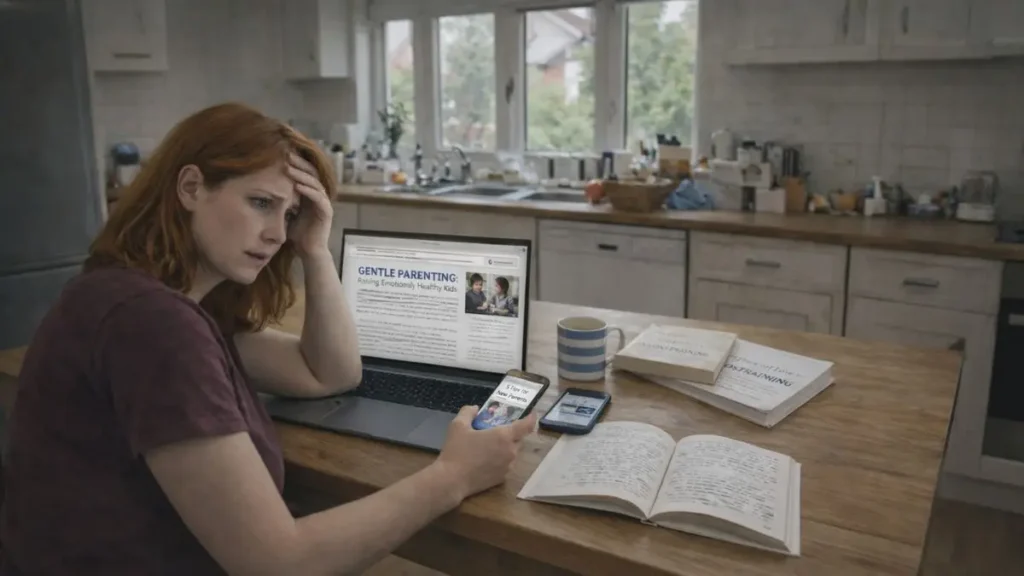
Many parents begin searching for help and quickly find themselves drowning in parenting advice. Articles, videos, social media posts, books, and well‑meaning comments can pile up so quickly that instead of helping, they leave parents feeling more confused and overwhelmed than before. If you have ever felt this way, you are far from alone.
Quick summary
If parenting advice has ever left you feeling more confused than supported, a few common patterns often explain why it happens:
- Parenting advice often appears all at once from many different sources
- Much of the advice assumes parents have more time and energy than they actually do
- Conflicting opinions can make parents doubt their instincts
- Social media often amplifies extreme or idealised advice
- Stepping back and simplifying what you listen to can reduce the pressure
This article is for / not for
This article is for:
- Parents who feel overwhelmed by parenting advice
- Parents who find themselves constantly searching for the “right” way to parent
- Families feeling pressure from advice online or from others
This article is not for:
- Parents seeking specific behavioural strategies for a current crisis
- Situations involving serious safeguarding concerns
Medical disclaimer
This article discusses the emotional experience of parenting pressure and overwhelm. It is not intended to diagnose or treat any mental health condition. If parenting stress is affecting your wellbeing or family life, it may help to speak to a GP or a qualified professional. UK organisations such as the NHS or Family Lives can also offer support and guidance.

When advice starts to feel like noise
Many parents begin looking for advice for a very reasonable reason. Something feels difficult, confusing, or uncertain, and they want to understand it better.
Sometimes this happens late at night after a long day, when a parent quickly searches a question on their phone while the house is finally quiet.
A quick search can produce hundreds of answers.
Articles suggest one approach. A podcast recommends something different. Social media offers quick tips, strong opinions, and sometimes dramatic warnings about doing things “wrong”.
Instead of clarity, parents often end up with too many voices competing for attention.
When that happens, parenting advice can stop feeling supportive and start feeling like pressure.
Why parenting advice multiplies so quickly
Access to parenting information has also brought many benefits. Parents can now learn from a wide range of perspectives and find support much more easily than in the past.
One reason advice becomes overwhelming is simply how much of it now exists.
Previous generations usually received parenting guidance from a smaller circle of people: family members, health visitors, teachers, and perhaps a few books.
Today, parents can access thousands of perspectives instantly.
Each one may contain something useful, but taken together they can create an impossible expectation that parents should understand everything immediately.
The result is a constant sense that there is always more to read, more to learn, and more that might be missing.
When advice starts to contradict itself
Another reason parenting advice becomes overwhelming is that much of it conflicts.
One article may encourage parents to be very structured and consistent. Another might suggest a flexible, child‑led approach.
Some advice focuses heavily on emotional development. Other guidance emphasises boundaries and routines.
None of these perspectives are necessarily wrong. They simply reflect different philosophies about parenting.
But when parents encounter them all at once, it can create an uncomfortable question:
Am I choosing the right approach?
That question alone can add a surprising amount of pressure to everyday parenting decisions.
The role social media plays
Social media can intensify this feeling.
Many posts highlight strong opinions or dramatic claims because they attract attention. Advice presented in a calm, balanced way is less likely to spread widely.
Parents scrolling late at night while tired or worried may encounter:
- strict rules presented as universal truths
- idealised examples of calm, perfect parenting
- warnings about long‑term consequences of everyday decisions
Even when those posts are well‑intentioned, seeing many of them together can make parenting feel like a test that must constantly be passed.
Why good parents often feel the pressure most
Interestingly, the parents most affected by overwhelming advice are often the ones who care the most.
Parents who want to do a good job naturally look for information. They want to understand their child better and support them well.
That curiosity is a strength.
But it can also lead to a constant search for improvement, where every new piece of advice feels like something important that must be applied immediately.
Over time, this can turn parenting into something that feels more like a project than a relationship.
What can help when advice becomes overwhelming
When parenting advice begins to feel heavy rather than helpful, many parents find relief by simplifying what they take in.
That might mean limiting the number of sources they follow, or allowing themselves to ignore advice that does not fit their child or family.
Some parents find it helpful to focus on just a few trusted voices instead of many different ones.
Others step back from advice entirely for a while and simply observe their child more closely.
A few gentle shifts can help restore perspective:
- remembering that children vary widely in temperament and development
- recognising that no single parenting approach fits every family
- allowing time for trial, learning, and adjustment
Parenting often becomes calmer when parents trust that understanding their own child is just as valuable as reading about general advice.
Related reading
If parenting pressure or doubt has been weighing on you, these articles may also help put some of those feelings into perspective:
- When parenting feels harder than you expected explores why many parents quietly struggle with the reality of family life.
- Why comparison parenting makes everything harder looks at how comparing ourselves with other families can increase pressure.
External links
If parenting stress is building, it can help to know support exists outside advice articles. These UK organisations offer practical support for parents:
What matters most
Parenting advice is meant to help parents feel supported.
If it begins to make you feel more anxious, more doubtful, or more overwhelmed, it may simply mean there is too much of it in your life at the moment. Sometimes the most helpful step is simply to stop reading advice for a while and give yourself space to parent in your own way.
Children grow within relationships, not perfect systems.
Often the most valuable guidance comes from watching your child closely, learning what helps them feel safe and understood, and allowing your parenting to grow gradually with them. In many ways, you already know more about your own child than any article ever could.