
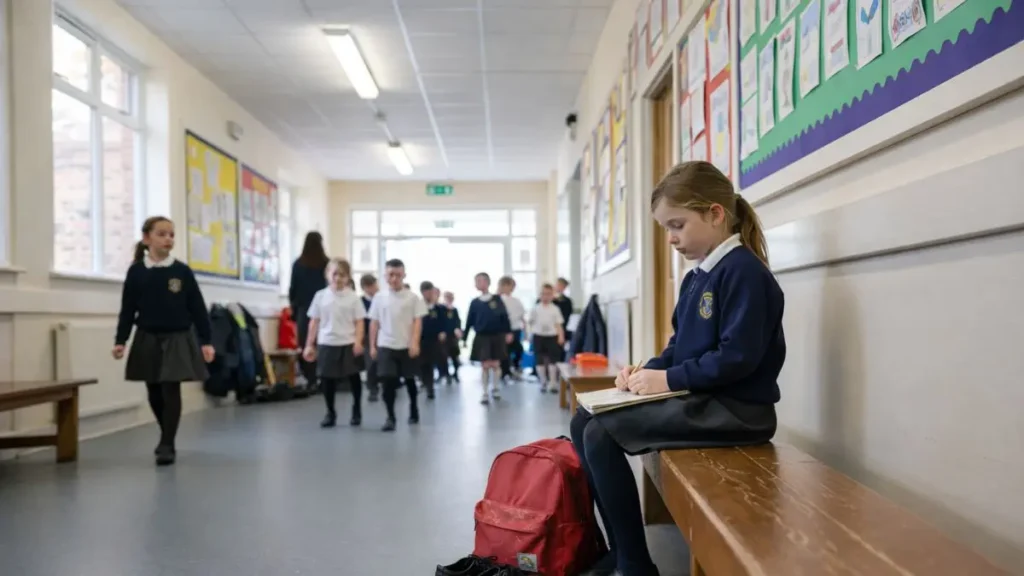
School can look fine on the surface, yet leave some children completely exhausted by the end of the day. For neurodivergent children, the school environment often requires constant effort that others may not even notice. This article explains why school can be so draining, in a calm, practical way, and what parents are often seeing at home.
Quick summary
In short, school can drain neurodivergent children even when everything appears to be going well. The key reasons this article explains are:
- Neurodivergent brains often have to work harder all day to process sensory input, instructions, and social expectations
- Concentration and self-control use more energy when background noise and distractions are harder to filter out
- Many children mask at school to fit in and be accepted, which quietly uses up emotional and mental energy
- Exhaustion often shows up at home, where it finally feels safe to release that effort
This article is for / not for
This article is for:
- Parents of neurodivergent children who come home exhausted or dysregulated
- Families noticing meltdowns or shutdowns after school
- Parents whose child appears to cope at school but struggles at home
This article is not for:
- Judging schools or teachers
- Assuming all neurodivergent children have the same needs
- Replacing professional advice or assessment
Medical disclaimer
This article is for general information and parental understanding only. It does not diagnose neurodivergence or provide medical or educational advice. If you have concerns about your child’s development, wellbeing, or support needs, a qualified professional or recognised UK guidance such as the NHS may be helpful.
If this isn’t quite right for you
You might find these articles more helpful:
- After-school meltdowns: what’s actually going on
- How to calm an overstimulated child at home (Step by Step)
Or you can browse all our Neurodiversity articles.
If this article feels relevant for you, read on.
Why school can feel so tiring
School asks children to do a lot, all day, every day. For some children, those demands align well with how their brain works. For others, especially neurodivergent children, the effort required is much higher, even when they appear to be managing.
By the time the school day ends, their energy can be completely used up.
Sensory overload adds up
Classrooms are busy places. There is noise, movement, bright lights, smells, and constant visual information. For children with sensory sensitivities, their nervous system may be working hard just to stay regulated.
That effort often goes unnoticed because it happens quietly, internally, and continuously throughout the day.
The effort of concentration and self-control
School requires long periods of focus, sitting still, listening, waiting, and following instructions. For neurodivergent children, especially those with ADHD or Autistic traits, this can take far more mental energy than it appears to.
Neurotypical brains tend to filter out background noise, movement, and irrelevant information automatically. Many neurodivergent children do not get that same filtering for free, so they may be consciously or unconsciously processing far more stimuli at once.
Even children who are trying their best can feel mentally exhausted by the end of the day because they are using extra energy to concentrate, filter distractions, manage impulses, and stay regulated for long periods without a break.
Masking and fitting in
Many neurodivergent children work hard to hide differences, suppress natural responses, or copy others in order to fit in socially. This is not usually a conscious choice, but a natural response to expectations and social pressure.
Masking can help a child get through the school day, but it comes at a cost. Holding everything together all day can leave very little energy for after-school time.
A common example of masking at school is a child staying very quiet and carefully copying how other children behave so they are less likely to be noticed, corrected, or singled out. They may suppress discomfort or confusion in order to fit in and be accepted. From the outside, this can look like good behaviour or coping well, even though it may take a great deal of effort internally.
Transitions and unpredictability
School days are full of transitions. Moving between lessons, lining up, changes to routine, unexpected instructions, or substitute teachers can all require extra mental adjustment.
For children who rely on predictability, this constant switching can be draining, even if no single moment feels overwhelming on its own.
Why exhaustion often shows up at home
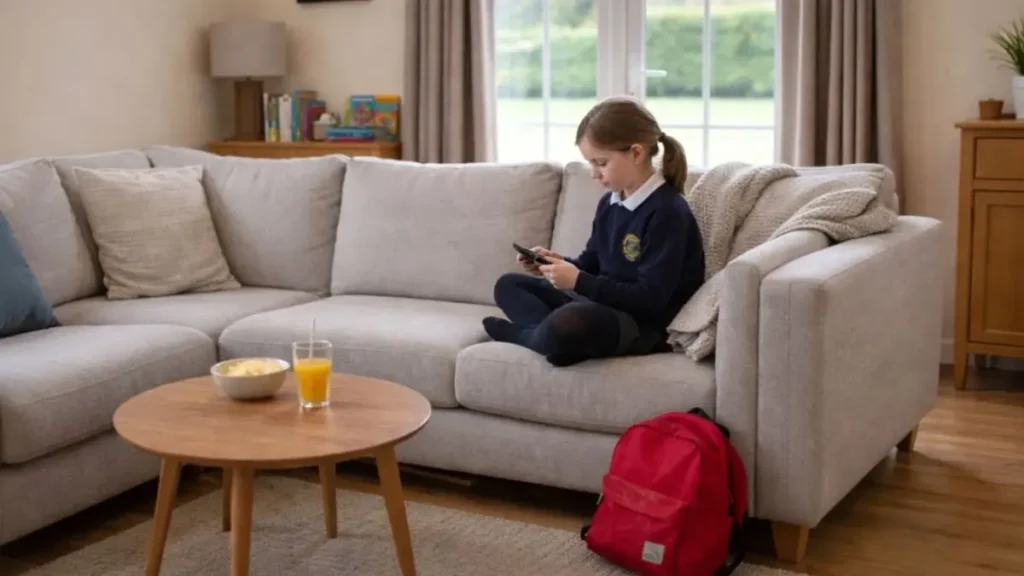
Many parents notice that their child seems fine at school, but falls apart once they get home. This does not mean school is not going well. It often means home is the place where it finally feels safe to release the built-up stress of the day.
After-school meltdowns, shutdowns, irritability, or withdrawal can all be signs of a nervous system that has reached its limit.
What this means for parents
Seeing your child exhausted, withdrawn, or unusually quiet after school can be worrying. It is easy to wonder if something is wrong, or if they should simply be coping better.
In many cases, it helps to see exhaustion as information rather than a problem to fix. It tells you how much effort your child is putting in to get through the school day.
For many families, one helpful next step is to build a gentle wind-down routine after school. This is not about adding more structure or demands, but about giving the nervous system time to settle.
That might look like quiet play, time alone, familiar TV, a snack, movement, or simply doing nothing for a while. Having a predictable, low-demand transition from school to home can help children release the pressure of the day and begin to regulate again.
Related reading you may find helpful
If your child’s exhaustion tends to spill over into behaviour or big emotions once they get home, these related articles go into more detail about what that can look like and how parents can respond supportively:
- After-school meltdowns: what’s actually going on – explores why children often unravel after school and how exhaustion, not defiance, is usually the cause.
- Dyslexia explained for parents (and why it’s often missed) – looks at how dyslexia can be overlooked in school, especially when children are trying hard to cope, and how the extra effort involved can also contribute to fatigue and frustration.
Further information
For more information about neurodiversity and support in the UK, these sources may be helpful:
Final thoughts
School exhaustion does not mean your child is failing, and it does not mean you are doing something wrong. Often, it reflects how much effort your child is putting in to meet expectations that do not always match how their brain works.
Noticing this is the first step. Creating space to recover, decompress, and feel safe at home can make a real difference.