
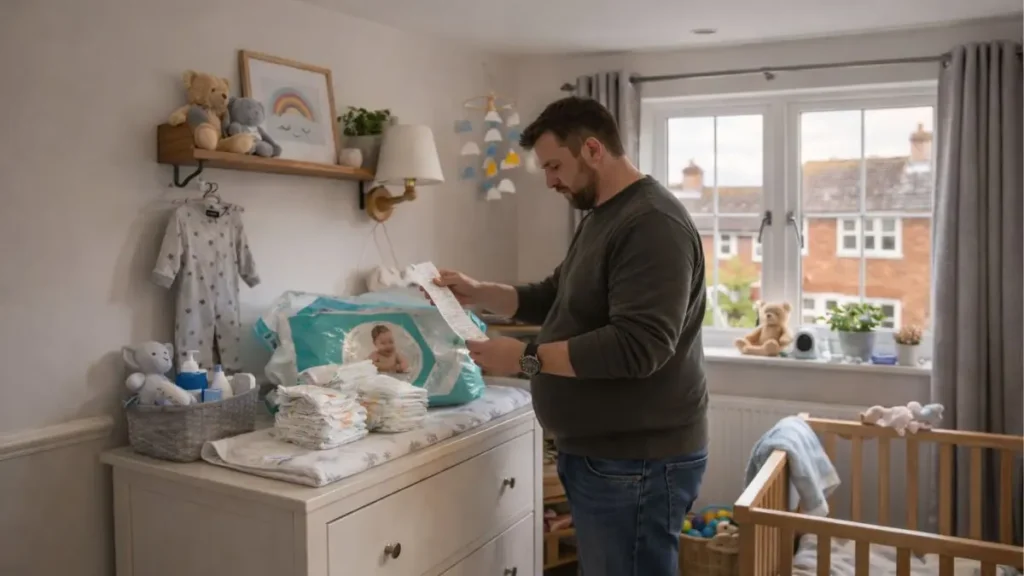
Nappies are one of those quiet, constant expenses that add up without you really noticing. If you’re wondering how much you’ll actually spend and whether there’s a realistic way to reduce that cost, this breaks it down in simple terms.
Last reviewed: 28 February 2026
Quick summary
Before we go into the detail, here’s the honest picture in 2026:
- Most UK nappies cost between 4p and 25p per nappy, depending on brand and offers
- A newborn using 8 nappies per day typically costs £4.48 to £11.20 per week
- Over the full nappy‑wearing years, many families spend roughly £350 to £900 in total
- Own‑brand nappies and buying in larger packs usually make the biggest difference
The exact figure depends on your baby, the brand you choose and how often you shop around.
This article is for / not for
This article is for:
- Parents expecting a baby and budgeting ahead
- Families trying to trim regular monthly costs
- Anyone wondering if premium brands are worth it
This article is not for:
- Detailed medical advice about nappy rash or skin conditions
- Specific brand reviews or product comparisons
What this really looks like in real life
When we first looked at nappy costs, it didn’t feel dramatic. It’s just a pack here and there in the trolley.
But when you multiply it by every day, every week, every size change, it becomes one of the most consistent baby expenses in the early years.
So let’s look at it calmly and realistically.
How many nappies does a baby use per day?
A newborn is usually changed around 8 to 10 times per day.
As babies get older, that drops. By the time they are closer to potty training, many children are using around 4 nappies per day.
Across the whole nappy‑wearing period, it is common for a child to go through roughly 4,000 to 4,500 nappies.
That sounds like a lot because it is.
The cost of baby nappies in 2026
In UK supermarkets in 2026, a typical price range looks like this:
- Budget supermarket own brand: around 4p to 12p per nappy
- Mid‑range or supermarket premium ranges: around 10p to 18p per nappy
- Well‑known branded nappies: around 13p to 25p per nappy, depending on pack size and offers
Prices change regularly with promotions, so using a range is more realistic than one fixed number.
What that means per week
If your newborn uses 8 nappies per day:
- At 8p per nappy: about 64p per day or £4.48 per week
- At 20p per nappy: about £1.60 per day or £11.20 per week
When your child is older and using around 4 nappies per day:
- At 8p per nappy: about 32p per day or £2.24 per week
- At 20p per nappy: about 80p per day or £5.60 per week
Over the full nappy‑wearing years, many families end up spending somewhere in the region of £350 to £900, depending on brand choice and how often they shop on offer.
That range is wide, but that is the reality.
Ways to reduce the cost of nappies
There isn’t one perfect solution, but these are the approaches that tend to make the biggest difference.
Buy larger packs where practical
Buying the largest pack available often reduces the price per nappy.
The one thing to be careful about is sizing. Babies can jump up a size faster than you expect, so it is usually safer to stock up when you know the current size still fits well.
Try supermarket own brands
Own‑brand nappies can be significantly cheaper than well‑known brands.
Some families find no noticeable difference. Others notice more leaks with certain ranges.
In our experience, it sometimes takes trying one or two before finding one that works well for your baby. The cheapest option is not always the best value if it means more outfit changes.
Shop around for offers
Supermarkets regularly rotate promotions.
If you are already doing a weekly shop online, it can be worth a quick comparison before you check out. Small differences in price add up over months.
Potty training and cost
It is tempting to think the fastest way to save money is to potty train earlier.
Most children are developmentally ready somewhere around 2 to 3 years old, although it varies widely.
Trying to rush potty training purely for cost reasons can sometimes backfire and lead to more stress, so it is usually better to follow your child’s readiness signs rather than the price of nappies alone.
Reusable nappies and environmental impact
Disposable nappies contribute millions of items to UK landfill each day, and they can take a very long time to break down.
Reusable nappies involve a higher upfront cost but can reduce overall spending, especially if used for more than one child.
There is still the cost of washing, including water and electricity, and the time involved.
Some families use a mix, such as reusable at home and disposable overnight or when out. That balance can feel more manageable than switching fully one way or the other.
If you do choose reusable nappies and keep them in good condition, they can often be sold on afterwards to recover some of the initial cost.
If you’re budgeting for a baby
If you are planning ahead financially, you might also find these helpful:
- How much does a baby cost: If you want a wider view of the bigger financial picture beyond nappies, this breaks down the other regular and one‑off costs many UK parents face in the first year.
- What helps when nothing settles your baby: If you are in the early weeks where nappies, feeds and sleep all blur together, this looks at gentle, realistic approaches when your baby seems unsettled and nothing appears to work.
What matters most
Nappies are a steady, predictable cost rather than a sudden shock.
The main factors that change what you spend are brand choice, how often you buy on offer, and how long your child remains in nappies.
You do not need the most expensive option to keep your baby comfortable, and you do not need to choose the absolute cheapest either.
A balanced, realistic approach usually works best for most families.