
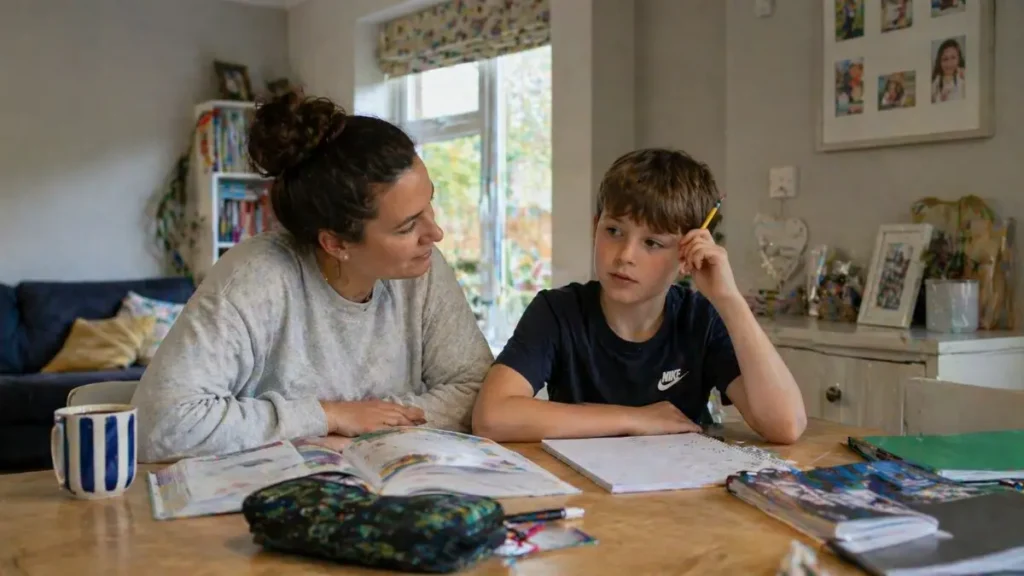
If you’ve noticed your child struggling with reading, focus, or schoolwork, it can be hard to tell what’s really going on. You might wonder if it’s Dyslexia, ADHD, or something else entirely. This guide explains why Dyslexia and ADHD often overlap, what that can look like in everyday life, and what it might mean for your child. At first, it can look like separate issues, when actually they’re connected.
Quick summary
A child can have both Dyslexia and ADHD, and this is more common than many parents realise. They often overlap because both affect how a child processes information. In everyday life, this can look like:
- Difficulties with reading or spelling, alongside trouble focusing
- Knowing answers but struggling to complete work
- Losing track of tasks or instructions
- Frustration with schoolwork despite a good understanding
- Behaviour that can look like inattention or avoidance
- Next step: notice patterns and speak to your child’s school if you’re unsure
This article is for / not for
This article is for:
- Parents who feel unsure whether their child may have Dyslexia, ADHD, or both
- Parents noticing a mix of learning and attention difficulties
- Anyone trying to understand how these overlap in real life
This article is not for:
- A formal diagnosis
- A detailed clinical breakdown of conditions
Medical disclaimer
This article is for general understanding only and does not diagnose Dyslexia or ADHD. If you are concerned about your child’s development, speak to your child’s school, GP, or a qualified professional. You can also refer to NHS guidance for ADHD and learning differences.
Why Dyslexia and ADHD often overlap
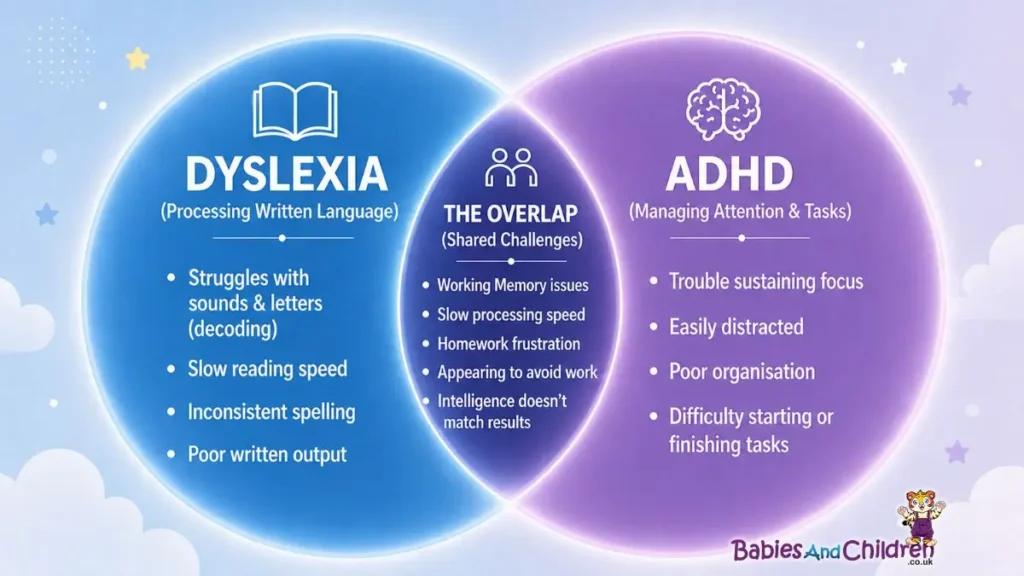
Dyslexia and ADHD are different, but they can affect similar areas of learning.
One reason they overlap is that both involve differences in how the brain processes and manages information, particularly when it comes to language, attention, and working memory.
Dyslexia mainly affects reading, spelling, and how written language is processed. ADHD mainly affects attention, focus, and how tasks are managed. But both can make schoolwork feel harder than it should.
Because of this, it’s quite common for children to show traits of both. This doesn’t mean one causes the other, but they can appear together in ways that are easy to miss or misinterpret.
What parents often notice first.
In real life, it’s usually not labels that stand out first, but patterns.
You might notice that your child understands things when you talk them through, but struggles more when reading or writing is involved. At the same time, they may find it hard to stay focused, lose track of tasks, or seem easily distracted.
For example, your child might start a piece of homework, get stuck on reading part of it, then lose focus altogether. Or they may know the answer verbally but struggle to write it down and then drift away from the task.
These mixed patterns can make it harder to work out what’s going on.
How Dyslexia and ADHD can look similar
Some traits can overlap, which can make it difficult for adults to work out what’s driving a child’s difficulties at first
A child may avoid reading tasks, lose their place when reading, seem distracted during work, or take longer to complete tasks. This can look like a focus issue, a reading issue, or both at the same time.
In reality, the difficulty might be coming from more than one place. This is why it can be hard to tell them apart at first.
How Dyslexia and ADHD are different
Although they overlap, there are differences.
Dyslexia is more specific to reading, spelling, and written language. ADHD is more about attention, organisation, and staying on task.
A simple way to think about it is that Dyslexia affects how information is processed, while ADHD affects how attention and tasks are managed. But for many children, these differences blur in everyday situations.
What this can look like at school
At school, the overlap often becomes clearer.
A child might understand lessons but struggle to complete written work, start tasks but not finish them, or get distracted more easily during reading or writing. They may also feel frustrated because work takes longer than expected. Teachers may notice that the child’s ability does not match their output, especially in written tasks. This is often where Dyslexia and ADHD overlap becomes more noticeable.
Why this can feel confusing for parents
When Dyslexia and ADHD overlap, it can feel like things don’t quite add up.
Your child might be bright and capable, but still struggle with everyday school tasks. Some days may seem better than others, which can make patterns harder to spot.
It can also be unclear whether the main difficulty is reading, attention, or both.
This uncertainty is very common. Some overlap is common, but ongoing frustration or a clear gap between understanding and output is worth noticing.
What this means for your child
If your child shows signs of both Dyslexia and ADHD, it doesn’t mean something is “worse” or more serious.
It means they may need support in more than one area.
A child can have strong understanding and ideas, but still find reading, writing, and focus more effortful. With the right support, they can build strategies that work for them.
Sometimes it helps to reduce one difficulty at a time. For example, using an audiobook can take away the reading barrier, while a short timer can help with focus. Small adjustments like this can make things feel more manageable.
If you want to understand how Dyslexia is often explained more broadly, Dyslexia film: what it gets right (and what parents should know) can help give that context.
Where to go next
If this feels familiar, you don’t need to work out whether it’s Dyslexia, ADHD, or both before taking the next step.
The most helpful thing now is simply to keep noticing patterns over time and build a clearer picture of what your child finds easier or harder.
If you decide to speak with your child’s school, this can make any conversation feel more focused and less overwhelming.
More that can help you understand this
If you’re trying to make sense of mixed patterns like this, it can help to look at the picture from a few angles: what Dyslexia looks like on its own, how ADHD shows up day to day, and how schools support children in practice. These guides build on what you’ve just read and help you go a step deeper without becoming overwhelming:
- How schools support Dyslexia in the UK (and what to expect) – a clear, practical look at what support actually looks like in the classroom, including how teachers adapt work and what help your child might receive day to day
- Signs of Dyslexia in children: what parents often notice first – helps you recognise early patterns with real-life examples, especially if you’re still unsure what you’re seeing at home or in school
- Signs of ADHD in children parents miss – focuses on the attention and behaviour side, including subtle signs that don’t always look like typical ADHD, which can help you separate or spot overlap more clearly
For further trusted UK guidance, you can also refer to:
- NHS – ADHD in children and young people overview
What matters most
Dyslexia and ADHD can overlap, but both are manageable with the right support.
What matters most is understanding how your child experiences learning, rather than focusing on labels.
FAQ
Can a child have both Dyslexia and ADHD at the same time?
Yes, it is quite common for children to show traits of both. They affect different areas but can overlap in everyday behaviour.
What are the signs of Dyslexia and ADHD together?
You may notice a mix of reading or writing difficulties alongside problems with focus, organisation, or finishing tasks.
How do you tell the difference between Dyslexia and ADHD?
Dyslexia mainly affects reading and written language, while ADHD affects attention and task management, although they can overlap.
Should I be worried if my child shows both?
Not necessarily. Many children show overlapping traits, and support can help them manage learning successfully.
Can a child have both Dyslexia and ADHD at the same time?
Yes, it is quite common for children to show traits of both. They affect different areas but can overlap in everyday behaviour.
What are the signs of Dyslexia and ADHD together?
You may notice a mix of reading or writing difficulties alongside problems with focus, organisation, or finishing tasks.
How do you tell the difference between Dyslexia and ADHD?
Dyslexia mainly affects reading and written language, while ADHD affects attention and task management, although they can overlap.
Should I be worried if my child shows both Dyslexia and ADHD?
Not necessarily. Many children show overlapping traits, and support can help them manage learning successfully.