

It’s one of the most common questions with formula feeding: how much is actually enough? You might find yourself watching how much your baby drinks, comparing it to charts, or worrying about overfeeding or underfeeding. There are typical ranges that can guide you, but your baby’s cues and overall pattern matter just as much. This can feel confusing, especially when your baby doesn’t match the charts exactly. This guide shows you what’s typical, what to look for, and how to feel more confident in what you’re seeing.
Quick summary
If you’re wondering how much formula your baby should drink in the UK, here is a simple starting point:
Here is the simple answer first:
Most babies need around 150–200 ml per kg per day, split across feeds. Some drink more or less and are still fine, patterns over a few days matter more than exact amounts.
- This is usually spread across several feeds depending on age
- Some babies naturally drink more or less than averages and are still fine
- Hunger and fullness cues matter just as much as volume
- Look at patterns over a few days, not a single feed
This gives you a starting point, but your baby’s behaviour and growth are just as important as the numbers.
A common worry is that your baby isn’t drinking exactly the “right” amount, but most babies don’t follow exact numbers day to day.
If your baby is feeding regularly, has wet nappies, and seems generally content, they are usually getting enough.
This article is for / not for
This article is for:
- Parents using formula or combination feeding
- Families unsure how much their baby should be drinking
- Anyone worried about underfeeding or overfeeding
This article is not for:
- Babies with specific feeding or medical conditions
- Situations needing personalised feeding plans
Medical disclaimer
This article offers general guidance only and is not a substitute for medical advice. If you have concerns about feeding amounts, weight gain, or your baby’s health, speak to a health visitor, midwife, or GP. NHS guidance can also provide further reassurance.
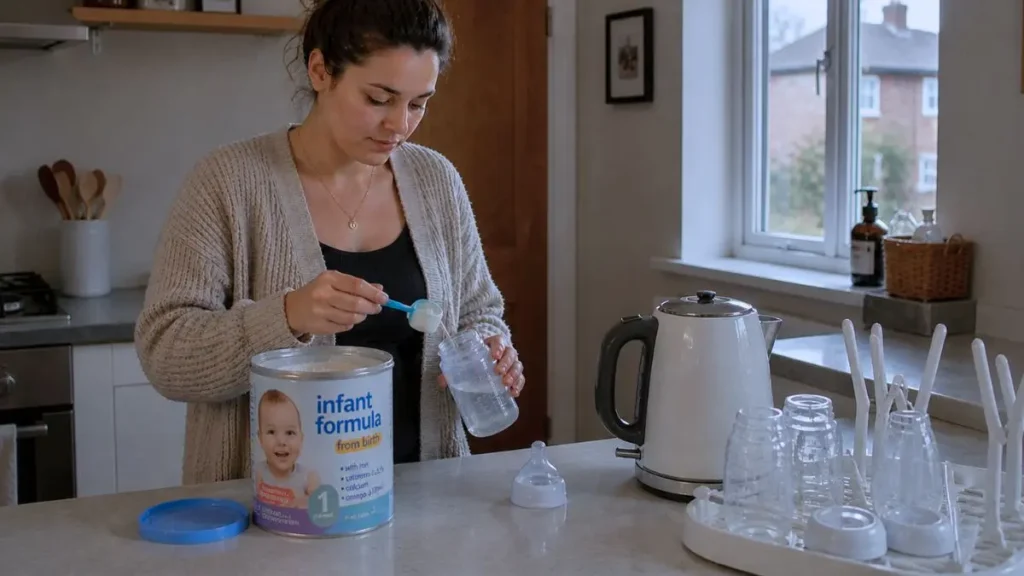
How much formula does a baby need by age?
Most guidance is based on a rough amount per kilogram of body weight across a day, rather than a fixed amount per feed.
As a general guide, many babies need around 150–200 ml of formula per kilogram of body weight per day (for example, a 4 kg baby would typically need around 600–800 ml across the day).
At a glance (typical ranges)
| Age | Typical amount per feed | Notes |
|---|---|---|
| Newborn | 30–90 ml (1–3 oz) | Small, frequent feeds |
| Around 1 month | 90–150 ml (3–5 oz) | Feeding starts to space out slightly |
| 3–6 months | 120–210 ml (4–7 oz) | Larger feeds, fewer times per day |
| 6+ months | Varies more | Solids begin to affect intake |
These are only guides. It’s very common for babies to fall outside these ranges on some days. What matters more is the overall pattern across a few days, not hitting a number exactly.
If you are trying to plan for the cost side of formula feeding, our guide on Cost of baby formula (UK): what parents actually spend breaks this down in more detail.
Why formula intake can vary (and still be normal)
Two babies the same age can drink very different amounts and both be completely fine, and this is very normal. A big part of the worry at this stage comes from comparison, but feeding is not a fixed pattern that every baby follows.
Formula intake varies for several everyday reasons. Growth, appetite, sleep patterns, and how efficiently your baby feeds all play a role. Some babies are naturally more efficient feeders and take larger feeds less often, while others prefer smaller, more frequent feeds.
You may also notice intake increases during growth spurts and then settle again. This rise and fall is typical and doesn’t mean something is wrong. In fact, one of the most common worries is trying to increase the intake of every bottle steadily, when intake often changes naturally from day to day.
Rather than focusing on individual feeds, it helps to look at the overall pattern across a few days. That gives a much clearer and more reassuring picture of how your baby is feeding.
Signs your baby is full or still hungry
Watching your baby’s cues can tell you more than the bottle alone. You might notice:
Signs your baby may still be hungry include:
- Continuing to suck eagerly after finishing a bottle
- Becoming unsettled soon after a feed
- Showing rooting or sucking behaviours
Signs your baby is full can include:
- Slowing down or stopping feeding
- Turning their head away from the bottle
- Relaxing their body or becoming sleepy
These cues can vary between babies, but over time, you will start to recognise your baby’s patterns.
Avoiding overfeeding and underfeeding
It is easy to worry about giving too much or too little.
Overfeeding is less common than many parents think, as babies usually regulate their intake. Trying to encourage a baby to finish a bottle when they are showing fullness cues can lead to discomfort.
Underfeeding is also unlikely if your baby is feeding regularly, producing wet nappies, and growing over time. For example, one baby might drink 120 ml per feed but feed more often, while another takes 180 ml less frequently. Both can be completely normal.
Focusing on cues alongside general intake ranges is usually the most helpful approach.
How solids change things
From around 6 months, solid foods start to play a role.
Formula remains an important part of your baby’s nutrition, but intake may begin to vary more from day to day as solids are introduced.
Some days your baby may drink less milk and eat more solids, and other days the opposite. This is a normal part of the transition.
If you want a broader view of how feeding changes over time, our baby feeding guide (breast, bottle, solids) brings everything together.
When to check with a professional
Most variation in feeding amounts is completely normal, but there are times when it is worth getting reassurance. These are less about exact amounts and more about changes in your baby’s usual pattern.
It’s worth getting advice if you notice things like:
- Your baby is consistently drinking much less or much more than expected
- Fewer wet nappies than usual
- Repeated vomiting after feeds
- Your baby seems unusually sleepy, floppy, or hard to wake
- Feeding becomes stressful or difficult over several days
- You have concerns about weight gain
Reaching out does not mean something is wrong. It often just helps you feel more confident about what you are seeing.
Helpful reads if you are figuring out feeding
If you’re still piecing things together, these guides can help you go a step further — whether you want to understand the basics of bottle feeding, feel more confident about intake, or see how different feeding approaches fit together in real life.
- Bottle feeding: how to start – A simple, practical walkthrough of preparing feeds, choosing bottles, and getting into a comfortable routine from the start.
- Is my baby feeding enough? (signs that help) – A reassurance-focused guide that shows you how to read your baby’s cues and patterns, not just the numbers.
- Combination feeding: combine breast and bottle – Useful if you’re balancing feeding methods and want to understand how intake and routines can overlap.
For further guidance, the NHS also provides advice on formula feeding and typical intake ranges.
What matters most
There is no exact “right” amount of formula that every baby should drink.
What matters most is the overall pattern: regular feeding, clear cues, and steady growth over time.
If your baby seems content, produces wet nappies, and is growing as expected, these are all reassuring signs.
FAQ
How do I know if my baby is drinking too much formula?
If your baby regularly finishes bottles but seems uncomfortable, sick, or unsettled, it may be worth checking feeding pace and cues. In most cases, babies regulate their intake well, so focus on patterns rather than a single feed.
What if my baby doesn’t finish their bottle?
This is very common. Babies do not need to finish every bottle, and stopping part way through is often a sign they are full.
Should I increase the amount every feed?
Amounts usually increase gradually over time, but they don’t go up in a straight line. Following your baby’s cues is more important than sticking to fixed increases.
Can I keep leftover formula if my baby doesn’t finish the bottle?
Once your baby has started a bottle, it’s best to use it within 1–2 hours and then discard any leftover formula. This helps reduce the risk of bacteria growing in the milk.
How much formula should a newborn drink per feed?
Newborns usually take around 30–90 ml (1–3 oz) per feed, often feeding little and often. This can vary depending on your baby’s size, appetite, and stage in the first few weeks.