
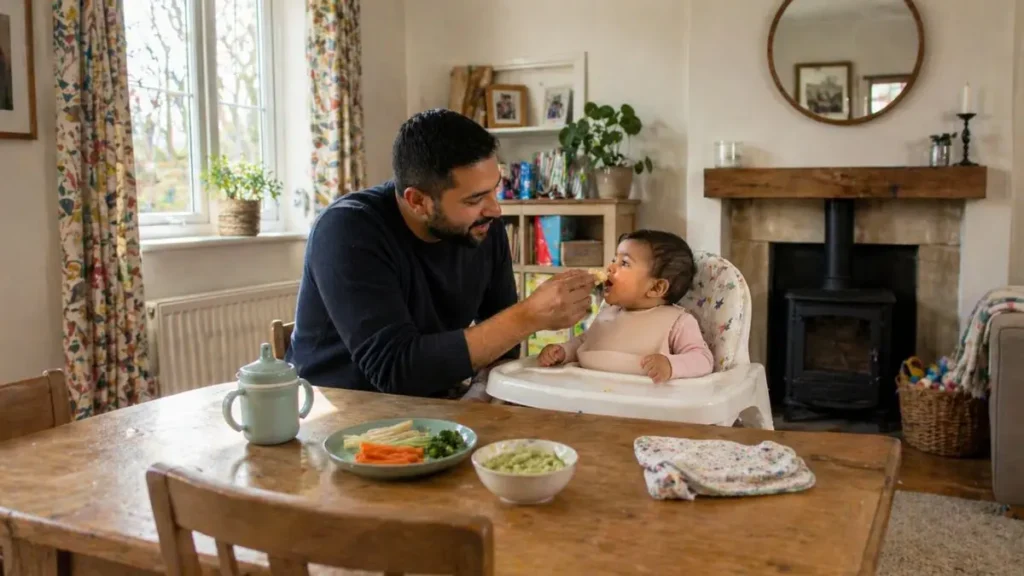
Starting solids can feel like a big step. You might be wondering if your baby is ready, what foods to begin with, or whether you’re doing it at the “right” time. There are clear signs to look for and simple ways to get started without overcomplicating it. This guide shows you when to start, what signs to look for, and how to begin without overthinking it.
Quick summary
If you are trying to work out when and how to start solids, it helps to focus on readiness rather than the calendar. These key points give you a clear starting place, even if you’re feeling unsure:
- Most babies are ready at around 6 months (UK guidance)
- Look for signs of readiness, not just age
- Start with simple, soft foods your baby can handle easily
- Keep milk (breast or formula) as the main nutrition
- Go slowly and follow your baby’s pace
This article is for / not for
This article is for:
- Parents approaching the stage of introducing solids
- Families unsure about timing or readiness
- Anyone wanting simple, practical guidance
This article is not for:
- Babies with feeding or medical complications
- Situations needing specialist weaning advice
Medical disclaimer
This article offers general guidance only and is not a substitute for medical advice. If you have concerns about your baby’s readiness, feeding, or development, speak to a health visitor, midwife, or GP. NHS guidance on starting solids provides further trusted support.
When do babies usually start solids?
In the UK, guidance is to start solids at around 6 months.
This timing is based on development rather than just age. Before this point, most babies are not quite ready to handle solid food safely.
It can be tempting to start earlier, especially during phases like growth spurts when your baby seems hungrier or feeds more often, but offering more milk is usually the better step at this stage.
It’s also okay if your baby isn’t quite ready right at 6 months. Some babies take a little longer to show the signs, and continuing with breast milk or formula in the meantime is appropriate.
Most babies begin solids somewhere between about 6 and 7 months. A short delay while you wait for clear readiness signs is usually fine. If your baby is not showing signs or starting solids after 7 months, it’s worth checking in with a health visitor for reassurance.
Signs your baby is ready
Rather than focusing only on age, it helps to look for a combination of readiness signs. Looking at how your baby moves, sits, and handles food gives a clearer, more reliable picture than the calendar alone.
You might notice:
- Sitting up with minimal support and holding their head steady
- Coordinating eyes, hands, and mouth (e.g. picking up food and bringing it to their mouth)
- Swallowing food rather than pushing it out with their tongue
These signs together give a clearer picture than any single one on its own.
First foods: keeping it simple
When you first start, simple is best.
Soft, easy-to-handle foods help your baby explore without overwhelming them, such as mashed banana or soft cooked carrot sticks. This might include mashed vegetables, soft fruit, or finger foods depending on your approach.
From around 6 months, it is also helpful to start including some iron-rich foods, such as fortified baby cereals, lentils, beans, or soft meat, as babies’ iron needs increase at this stage.
There is no single “right” first food. What matters more is texture, safety, and giving your baby the chance to explore.
If you are spoon feeding, you can mash or purée foods to a smooth or slightly textured consistency to make them easier for your baby to manage. As your baby gets more confident, you can gradually make textures thicker or lumpier.
At this stage, solids are about learning and experience rather than replacing milk feeds.
Safety basics to keep in mind
It is completely normal to feel a bit anxious about safety when you first start solids. Many parents worry about choking or whether they are doing things correctly. In reality, once you understand a few key principles, feeding can feel much more relaxed and manageable.
Starting solids safely is more about a few key habits than strict rules.
It helps to:
- Make sure your baby is sitting upright during meals
- Stay with your baby while they are eating
- Offer foods in safe shapes and sizes to reduce choking risk
Choking and gagging are different. Gagging is common when babies learn to handle food and can look alarming, but it is part of the process. Gagging often looks like coughing, tongue thrusting, a red face, or pushing food forward, and babies usually make noise. Choking is typically silent and requires immediate help.
It is also worth introducing common allergens (such as peanuts, eggs, and dairy) one at a time in small amounts, so you can notice any reactions. Start with a very small amount, such as a tiny spoonful or a thin smear, rather than a full portion.
Most reactions are mild, but if you notice swelling of the lips, face or eyes, breathing changes, repeated vomiting, or your baby becoming very unwell, seek urgent help. Introducing one food at a time and earlier in the day can make it easier to spot any reactions.
This approach helps build tolerance and is part of current UK guidance.
How milk feeds fit in
Even after starting solids, milk remains the main source of nutrition for a while.
Breast milk or formula should continue alongside solids, with solids gradually increasing over time.
This transition is gradual. Some days your baby may eat very little solid food, and that is completely normal.
You can also start offering small sips of water from a cup with meals once solids begin, which helps your baby get used to drinking.
If you want a broader view of how feeding changes over time, our baby feeding guide (breast, bottle, solids) brings everything together in one place.
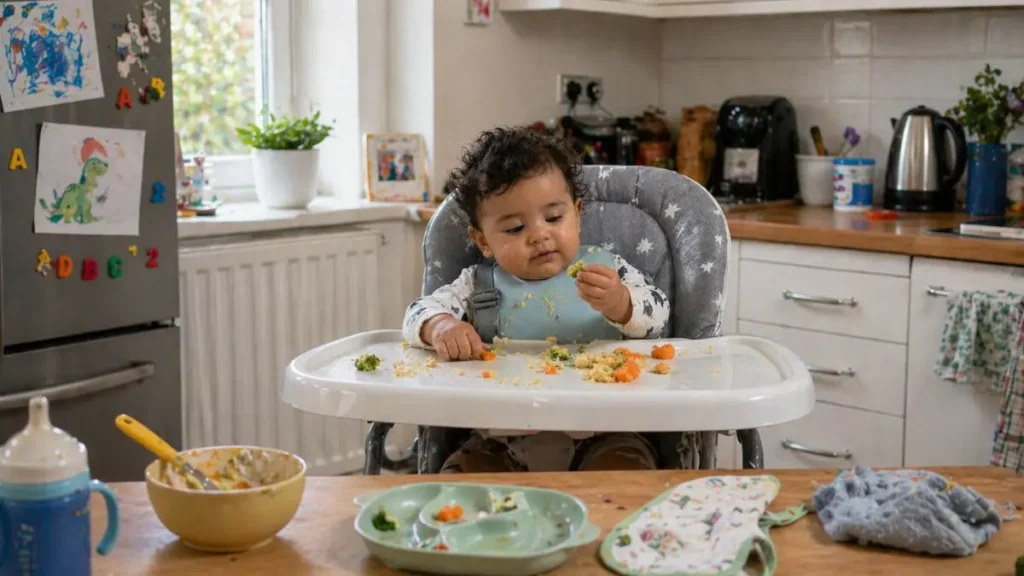
What starting solids really looks like
In real life, starting solids is often less structured than it sounds.
Some days your baby might show lots of interest. Other days they may refuse food completely.
Mess is part of the process, and progress is rarely linear.
Looking at patterns over a week or two gives a much better sense of how things are going than focusing on a single meal.
A simple way this might look in the early days is offering one small meal a day, such as a few spoonfuls or soft finger foods, while keeping milk feeds the same.
For example, in the first week you might offer a small amount once a day, perhaps at a time when your baby is calm and not overly hungry or tired. One day it might be mashed banana, another day a soft vegetable, and some days your baby may not eat much at all.
Over time, this can gradually build into more meals, but there is no rush and no fixed plan to follow.
When to seek support
Most of the time, starting solids settles into a natural rhythm without too many concerns. But it is also very common to have moments where something does not feel quite right or you just want a bit of reassurance.
While most babies transition to solids without issues, there are times when it is worth getting advice.
You might want to speak to a health visitor or GP if:
- Your baby is not showing signs of readiness by around 6 months
- Feeding feels consistently stressful or difficult
- You are concerned about choking or swallowing
- Your baby is not gaining weight as expected
Getting support early can help you feel more confident and make small adjustments if needed.
Spoon-fed or baby-led weaning?
You may come across different approaches to starting solids, including spoon feeding and baby-led weaning.
Spoon feeding usually involves offering puréed or mashed foods, while baby-led weaning focuses more on finger foods your baby can pick up themselves.
Both approaches can work well, and many families end up using a mix of both. What matters most is choosing what feels manageable for you and safe for your baby.
Helpful reads as you start solids
If you want to explore feeding more broadly as you move into this stage, these can help:
- Combination feeding: combine breast and bottle – Useful if you are balancing milk feeding alongside solids
- Is my baby feeding enough? (signs that help) – Helps you stay confident about intake as feeding changes
- Breastfeeding: getting started (what helps early on) – Supports understanding of milk feeding alongside solids
For more detailed guidance, these trusted UK resources can help:
- St John Ambulance – Baby choking advice – Clear, practical steps on what to do if your baby is choking
What matters most
Starting solids is a transition, not a switch.
There is a wide range of what is typical, and most babies find their rhythm over time.
Focusing on readiness, safety, and your baby’s pace helps things feel much more manageable.
FAQ
Do I have to start exactly at 6 months?
Around 6 months is the general guide, but a small amount of variation either side can be normal if your baby is showing readiness signs.
What if my baby doesn’t eat much at first?
This is very common. Early on, solids are about learning rather than nutrition.
Should I follow a strict feeding schedule?
Not usually. Following your baby’s cues tends to work better than strict routines at this stage.