
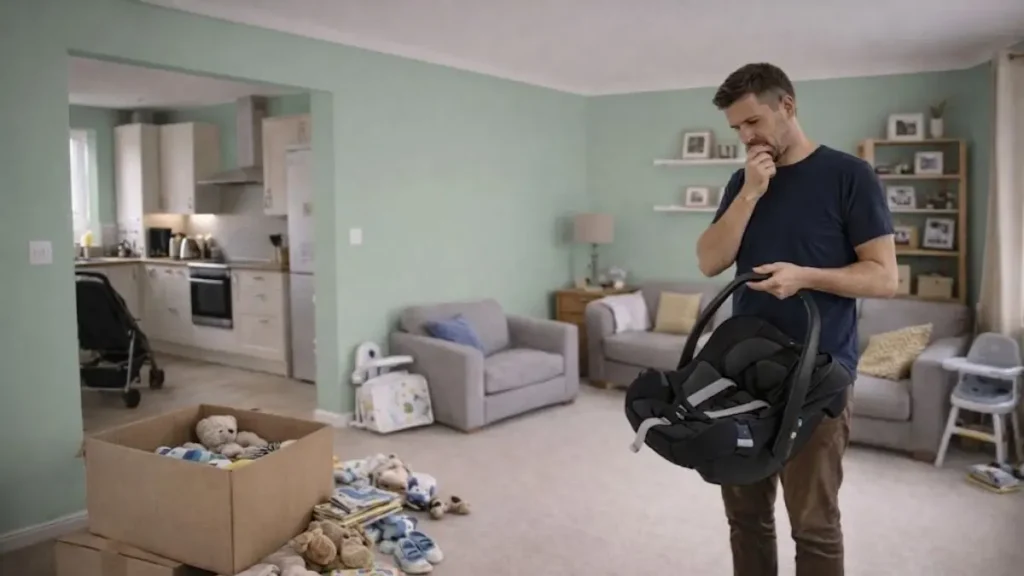
If you are about to list a pile of baby items and want to avoid wasting time, this is the quick filter to use. A small number of items are better not sold second-hand because of safety, hygiene, or low resale value. This guide helps you spot them fast so you can focus on what is actually worth listing and clear the rest without hassle.
Quick summary
If you want a fast yes-or-no filter before you start listing, this is what to check first. The aim is not to overthink every item, but to spot the few that are likely to cause issues or waste your time. If something falls into one of these, it is easier to move it on another way and focus your effort elsewhere:
- Avoid selling items where safety depends on full history (even if it’s yours, buyers can’t verify it) (e.g. car seats)
- Be cautious with anything that cannot be cleaned properly
- Some items are fine to sell but still not worth the time or effort in practice
- If something feels questionable, it is usually not worth listing
- Not everything needs to be sold to be worth clearing
This article is for / not for
This article is for:
- Parents clearing out baby items and unsure what is safe to sell
- Anyone wanting to avoid listing items that may cause issues later
- People trying to save time by filtering before they list
This article is not for:
- Detailed legal advice
- Selling specialist or collectible items
- Running a resale business
If this isn’t quite right for you
You might find these more helpful:
- The best place to sell baby items – helps you decide where to list the items that are worth selling
- Why saving money as a parent can feel surprisingly difficult – a useful read if money decisions feel harder than they should right now, helping you understand why it can feel that way without adding pressure to do more
Or browse all our Money articles.
If this article feels relevant for you, read on.
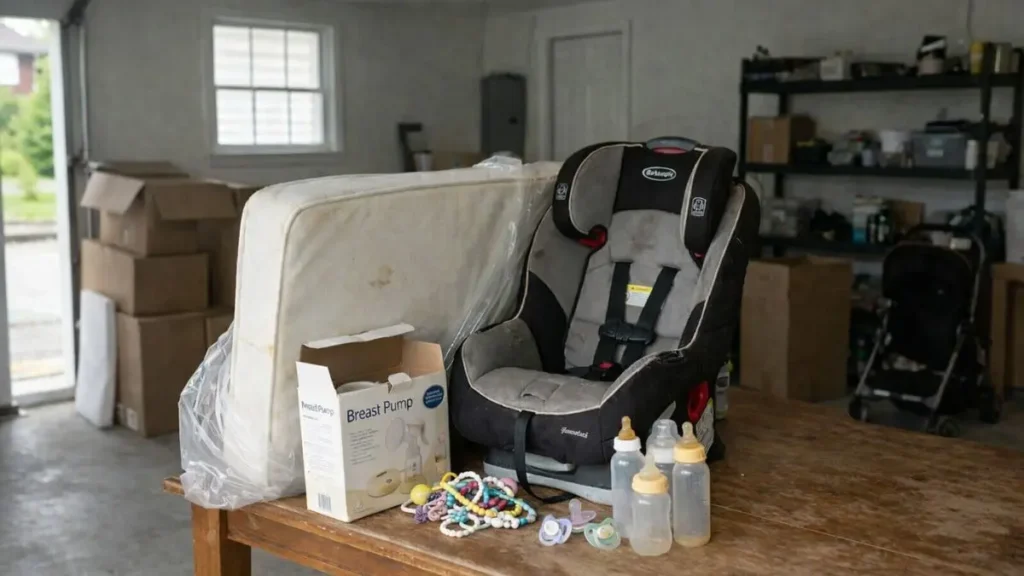
Baby items that are usually better not sold second-hand
In practice, most items are fine to resell, but a few categories come up again and again where it is usually better not to.
These are not strict rules, but common-sense filters. They help you quickly spot items that are more likely to cause problems, attract hesitation from buyers, or simply not be worth the effort of listing.
Car seats
Car seats are one of the most commonly mentioned items to avoid selling.
Even if a seat looks fine, you often cannot be sure of its full history. It may have been involved in a minor accident or stored incorrectly, which can affect safety in ways that are not visible.
Because of this, many parents choose not to buy second-hand car seats unless they fully trust the source.
It is also worth knowing that most car seats have an expiry date (often around 6–10 years), which can further limit whether they are suitable to pass on.
Mattresses (especially cot mattresses)
Mattresses can be difficult to clean thoroughly, and hygiene is a common concern.
For baby sleep items, many parents prefer to buy new for peace of mind. Even if your mattress is in good condition, it may be harder to sell and can lead to more questions or hesitation.
Safety equipment with wear or missing parts
Items like stair gates, high chairs, or bouncers can be safe to sell if complete and in good condition. However, if anything is missing, worn, or not functioning as intended, it is usually better not to list it.
Buyers are relying on these items for safety, so anything uncertain can quickly become a problem.
A quick sense-check before listing:
- Check straps and fixings for any fraying or damage
- Make sure all parts are present and working
- Check it locks or secures properly without looseness
Personal care and hygiene items
Things like breast pumps, sterilisers, or items used for feeding can fall into a grey area.
Some can be sold if thoroughly cleaned and with new parts where appropriate, but many buyers will be cautious.
Closed-system breast pumps are generally considered safer to resell, while open-system pumps are often avoided for hygiene reasons. In practice, these items often sell slowly or not at all.
Items that are technically sellable but often not worth it
Some items are fine to sell, but in real life they can be more effort than they are worth, even if they seem like they should sell easily.
This includes heavily worn clothing, low-value toys, or items that are widely available and cheap to buy new.
From experience, these tend to attract low offers, lots of messages, or simply sit unsold. In those cases, it can be easier to bundle them, give them away, or donate them.
Why some items are better avoided
There are a few consistent reasons why certain items are not worth selling.
Sometimes it is about safety, where the item’s history matters more than its appearance.
Other times it is about hygiene, where buyers are understandably cautious.
And in many cases, it simply comes down to practicality. If an item is unlikely to sell or will take a lot of effort to shift, it may not be worth listing at all.
This is why filtering early can save a lot of time.
What to do instead of selling
If an item is not suitable for selling, you still have a few simple options.
Donating is often the easiest route, especially for items that are still usable but not worth listing.
Some items can be recycled through local schemes or council services.
For very low-value items, giving them away locally can also be a quick way to clear space without extra effort.
Reassurance: you do not need to sell everything
It is easy to feel like every item should be sold to “make it worth it.”
In reality, trying to sell everything can create more work than it saves.
Focusing on the items that are genuinely worth selling, and letting the rest go in a simpler way, usually makes the whole process feel more manageable.
Where to go next
If you want help deciding what to do with the items that are worth selling, these can help:
- What baby items sell best second-hand – helps you focus on items that are more likely to sell quickly
- How to sell bulky baby items locally – useful for larger items that are difficult to post
- When donating baby items makes more sense than selling – helps you decide when it is easier to move on without the hassle
What to take away
Most baby items can be sold second-hand, but a small number are better avoided.
If something depends on unknown history, is difficult to clean, or feels like more effort than it is worth, it is usually not worth listing.
Filtering these out early saves time and makes the whole process simpler.
FAQ
Is it illegal to sell second-hand baby items?
No, it is not illegal to sell baby items second-hand. However, it becomes illegal if you sell something that is unsafe, misdescribed, counterfeit, or known to be faulty (for example, a recalled or damaged item) without clearly stating this. In practice, the focus is on safety, condition, and accurate description rather than specific banned items.
Why are car seats often not recommended second-hand?
Because you cannot always verify their history, and safety may be affected in ways that are not visible. For example, a seat might have been dropped, exposed to extreme heat (e.g. left in a hot car), cleaned with unsuitable products, or have small missing parts. These can all affect performance without obvious signs.
Can you sell used baby mattresses?
You can, but they are widely recommended to be bought new rather than second-hand. This is mainly for hygiene reasons and because it is difficult to fully clean a mattress or know how it has been used or stored. There are also safety considerations, as guidance around infant sleep often recommends a firm, well-maintained mattress with no hidden wear. In practice, many buyers will avoid second-hand mattresses altogether, which makes them harder to sell.