
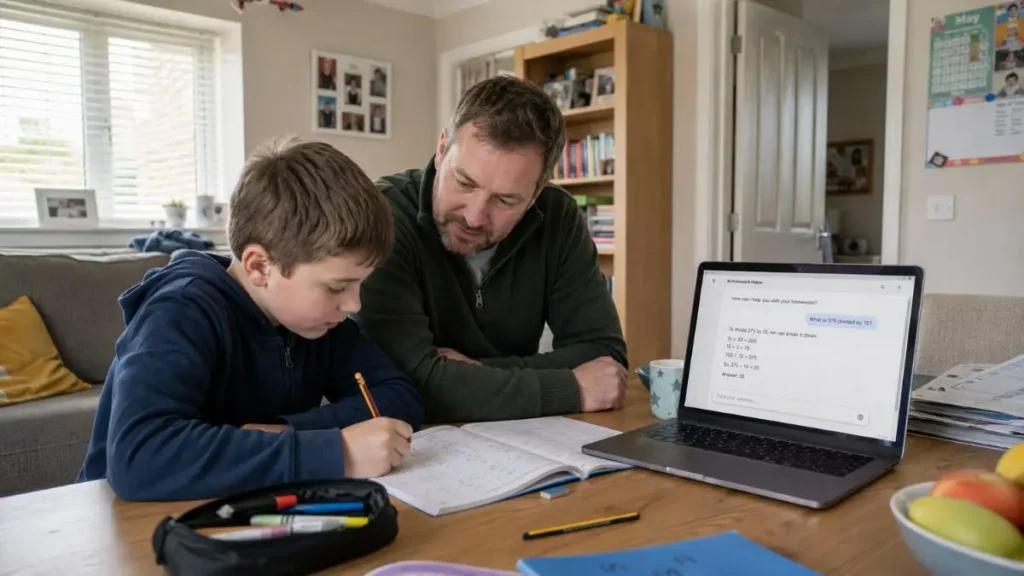
Primary school homework is one of those areas where AI can be genuinely useful, but only up to a point. A lot of parents are not asking whether it can do the work faster. They are asking whether it can help without turning into cheating, spoon-feeding or one more thing to supervise badly. Used carefully, it can support learning. Used carelessly, it can get in the way of it.
Quick summary
If you are wondering whether AI can help with primary school homework and revision, the honest answer is yes, but only when it supports the child’s thinking rather than replacing it.
For most families, the useful middle ground looks like this:
- AI can be helpful for explaining something in simpler language, creating a quick quiz, testing spellings, or helping a parent think of revision questions.
- It can also help children brainstorm ideas for a project or understand where to start, as long as the child still does the actual thinking and writing.
- It becomes risky when AI starts giving full answers, writing chunks of work, or doing the part the child is meant to practise.
- The younger the child, the more this works best as a parent-led tool rather than something they use independently.
- A good rule is that AI should help the child understand the work better, not help them avoid doing it.
This article is for / not for
This article is for:
- Parents of mainly primary-age children who want sensible boundaries around AI and schoolwork
- Families who want help with spellings, revision, homework or explaining tricky bits without doing the work for the child
- Parents who feel unsure where support ends and cheating starts
- Adults who want a realistic, calm way to think about AI and homework at home
This article is not for:
- Parents looking for AI to complete schoolwork for their child
- Families wanting exam-focused or secondary-school advice
- Anyone looking for a technical guide to AI tools
- Parents wanting medical, SEND or safeguarding advice from a chatbot
What can AI help with in primary homework and revision?
The most useful homework uses are usually the ones where AI acts like a study helper, not a substitute pupil.
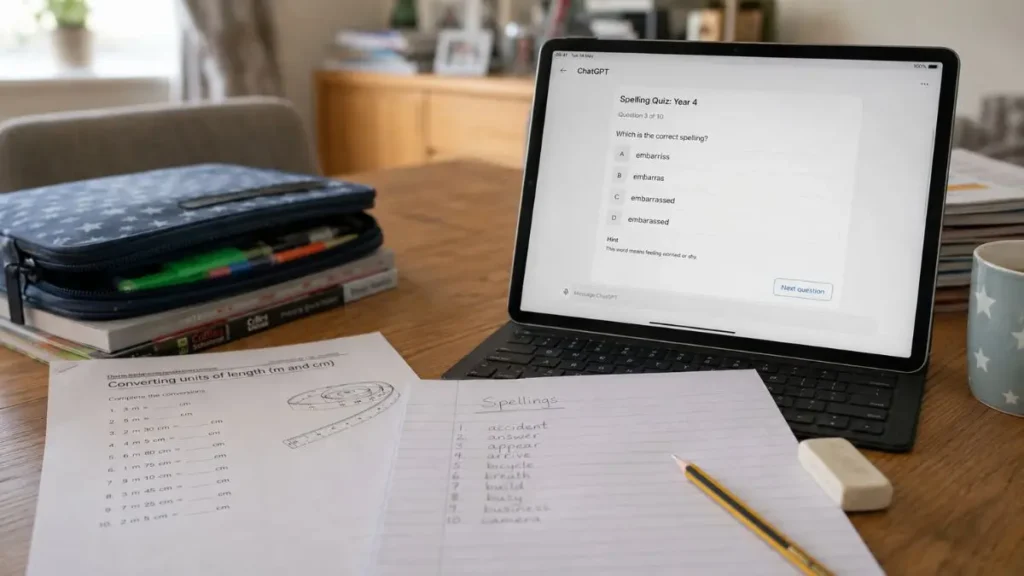
That might mean helping a child understand instructions, explaining a topic in simpler words, creating practice questions, or testing something like spellings, times tables or key topic facts. It can also be useful when a child is stuck on how to begin a piece of work and needs a few starting ideas rather than a finished answer.
For example, AI can be helpful for things like:
- turning a homework task into simpler steps
- explaining one part of a maths method in a plainer way
- making a short spelling quiz
- creating flashcard questions for a topic test
- suggesting a few ideas for how to start a poster or project
That is very different from asking it to answer the worksheet, write the paragraph, or solve the whole problem while the child copies it out.
If you want the broader picture of where AI fits into family life beyond homework, AI for parents: practical ways to use AI in everyday family life gives that overview without going too technical.
Where the line is between help and cheating
This is the part most parents are really trying to work out.
A helpful rule is to ask whether the child is still doing the thinking. If AI is helping them understand, remember, revise or organise, that is one thing. If AI is producing the answer they are meant to come up with themselves, that is something else.
In practice, it often looks like this:
Good use:
- “Explain this in simpler language for a Year 5 child.”
- “Give me five quick questions to test these spellings.”
- “Help me think of three ideas for my project on the Romans.”
Risky use:
- “Write my paragraph about the water cycle.”
- “Answer these comprehension questions for me.”
- “Solve these maths problems and show the final answers.”
Not for this:
- letting a child copy AI-written homework as their own work
- using AI to write project text that the child has not understood
- using it as a shortcut around the part they actually need to practise
That does not mean AI has no place in homework. It just means the goal is support, not substitution.
Using AI for quick revision, spellings and quizzes
If you want a low-drama way to try this, revision is often the safest place.
That is because revision is already about recall, repetition and understanding. AI can help generate quick questions, mini quizzes, practice spellings or simple explanations without taking over the actual learning.
For example, you might ask:
“Give me a short five-question quiz for a Year 4 child on the water cycle.”
Or:
“Test these spellings in a fun way for a primary-age child who gets bored easily.”
Or:
“Explain equivalent fractions in a simple way for a child who is getting frustrated.”
That kind of use can be genuinely helpful, especially when your own brain is tired and you just need a quick way to keep things moving. The child is still answering, recalling, practising and thinking. AI is just helping set the task up.
Google NotebookLM: A controlled way to support learning
One tool I’ve found that can be especially useful here is Google’s NotebookLM. It works differently from a normal chatbot because you build a notebook around the material your child actually needs to learn from. That can make it a more controlled way to support revision, homework and project prep, especially when you want the help to stay close to the worksheet, handout or video you are already using.
In practice, you start by:
- creating a notebook
- adding source material such as PDFs, photos of handouts from your phone, links to websites or YouTube videos
- using the chat to ask for something, such as:
“Act as a friendly space expert. Based only on the sources provided, give me the top 5 most amazing, mind-blowing facts about the solar system that an 8-year-old would love. Keep the descriptions short and fun!”
Your child can then ask questions and NotebookLM can generate things like flashcards, quizzes, study guides and Audio Overviews, which can make learning feel more interactive, fun and more tailored to what your child actually needs to cover.
It still needs the same common sense as any other AI tool. Keep sensitive information out where you can, stay involved if your child is young, and use it to support understanding rather than replace the part they are meant to think through themselves.
Quick note: Because NotebookLM requires an adult account, it’s best to load this up on your own device and explore the prompts together with your child.
Projects and research need more caution
This is where AI can slide from support into over-helping much more quickly.
If a child has a project on something like volcanoes, Ancient Egypt or the Romans, AI can be useful for brainstorming headings, giving a simple overview, or suggesting questions the child could research further. It becomes much less useful if it starts producing polished facts, paragraphs or poster text that the child does not really understand.
That matters because project homework is often as much about sorting information, choosing what matters and putting it into their own words as it is about finding the information in the first place.
A sensible starting prompt might be:
“Give me five simple questions a Year 5 child could research for a project on the Romans. Keep them broad enough to explore in books or trusted websites, and do not write the answers.”
That is a better use than asking AI to produce the project itself.
A worse use would be:
“Write my Romans homework for me.”
If facts are involved, it is also worth checking them against the original school material, a trusted book, or a reliable source. AI can sound confident even when it has got something wrong or oversimplified it.
How to supervise AI use for primary school homework
For most primary-age children, this works best when the adult stays involved.
That does not mean you need to hover over every word, but it does mean AI is probably more useful as something you use with your child than something you hand over and trust them to manage alone.
A sensible approach is to:
- keep the task visible so you both know what the child is actually meant to do
- use AI for one clear purpose, such as explaining, quizzing or brainstorming
- ask the child to explain the answer back in their own words
- check facts if the answer includes dates, topic information or specific claims
- stop if the tool starts doing the work instead of supporting it
This also helps with honesty. If the child understands that AI is there to help them learn rather than help them get round the work, the whole thing feels less slippery.
A simple way to use AI without making homework feel worse
The best starting point is not to use AI for everything. It is to choose one small, low-risk homework task and see whether it genuinely helps.
That might be using it to quiz spellings, explain one part of a maths topic more simply, or turn a topic brief into three clear starting ideas. If it helps the child feel less stuck and still leaves the real thinking with them, that is usually a good sign.
If it turns into a battle, an argument about copying, or a slick answer no one really understands, that is usually your signal to pull it back.
The aim is not to make homework perfect. It is to make it a bit more manageable without losing the learning part.
More help if you are setting sensible boundaries
If you want to build on this without turning it into a bigger AI debate at home, these are the most useful next steps:
- How to explain AI to children in simple, age-appropriate ways: useful if your child is curious about what AI actually is and you want a calmer, simpler explanation.
- How to fact-check AI answers when you’re using them for parenting questions: useful if your bigger worry is whether the answer sounds polished but may still be wrong.
For grounded UK guidance beyond this site, these are worth keeping open in another tab:
- Department for Education guidance on generative artificial intelligence in education: for the wider school-context view on safe and sensible use.
- ICO guidance on personal information and AI: for a practical reminder about privacy and what not to type into prompts.
What matters most
AI can help with primary school homework and revision, but only when it supports the child’s learning instead of stepping in for it.
That means explanation, revision help, quizzes and idea-generation can all be useful. What matters is that the child is still thinking, still answering and still building understanding.
So the goal is not to ban it or lean on it too heavily. It is to use it carefully, honestly and in a way that still leaves the learning where it belongs.
FAQ
Can AI help with primary school homework?
Yes, it can help with explanations, quizzes, spellings, revision questions and brainstorming, as long as it is not doing the actual work the child is meant to practise.
When does AI homework help become cheating?
It becomes cheating, or at least crosses into the wrong territory, when it starts giving the child answers to copy rather than helping them understand or work things out for themselves.
What can AI help with in primary homework and revision?
It can help with things like simplifying instructions, explaining tricky topics, creating practice questions, testing spellings and giving project starting ideas. It is less suitable for writing answers or completing tasks in the child’s place.
How should parents supervise AI use for schoolwork?
For most primary-age children, it works best when a parent stays involved, uses AI for one clear job, and checks that the child still understands the work in their own words.