
AI can be genuinely useful in family life, but it tends to help most when you use it as a shortcut for thinking, drafting and organising, not as a replacement for judgement. If you are curious about AI but tired of the mixed messages about it, this guide is here to show where it actually earns its place, where it can create new problems, and how to stay in charge of it. For most parents, the real win is not “using AI more”. It is using it carefully for the small jobs that drain your time and headspace.
Quick summary
AI can help parents with things like school admin, meal planning and first drafts, but it works best as a helper, not a decision-maker.
If you are wondering whether AI is actually useful in family life, the honest answer is that it can help, but only in the right jobs.
For most parents, it is less about doing something clever and more about taking a bit of pressure off the small tasks that pile up:
- AI is often most useful when you are tired, your head is full, and you just need a bit of help getting started on a small family task.
- In ordinary family life, it can take some pressure off things like school emails, meal ideas, routine tweaks, activity planning and other small jobs that keep cluttering your head.
- It tends to work best as a helper for first drafts and starting points, not as something that understands your child or makes good parenting decisions for you.
- If a question involves deadlines, school rules, safety, benefits, health or anything that could matter in a bigger way, it is worth checking the answer properly rather than trusting the first reply.
- A good way to think about it is this: let AI help with the rough draft, but keep the judgement, context and final call with you.
This article is for / not for
This article is for:
- Parents who are curious about AI but do not want a tech-heavy explanation
- Families who want practical help with admin, routines, meals or homework support
- Parents who want to save time without sounding robotic or handing over too much control
- Adults who want a calm starting point before deciding which AI tasks are worth using
This article is not for:
- Parents looking for a deep technical guide to how AI models work
- Families wanting AI to make important decisions for them
- Anyone looking for medical, legal or crisis advice from a chatbot
- Parents who mainly need one very specific answer, such as homework boundaries or school email help
What AI means for parents in plain English
For most parents, the easiest way to think about AI is this: it is a tool that can take a prompt (the question or instruction you type in) and produce a reply that sounds useful, fluent and often impressively quick. It can draft text, summarise information, suggest ideas and reorganise a messy thought into something more usable.
What it is not doing is “knowing” your family in the way you do. It does not understand your child, your school, your budget or the tone of that teacher who sends three paragraphs to say one thing. It is predicting a plausible answer based on patterns, not thinking like a parent who knows your family.
That matters because AI often feels more capable than it really is. One of the biggest traps is mistaking a polished answer for a reliable one. A chatbot can sound certain while getting details wrong, oversimplifying a problem or missing the bit of context that changes everything. I have even found that if you challenge an answer, it can sometimes repeat the same mistake more confidently instead of correcting itself properly.
The most useful mindset is to treat AI like a fast, helpful assistant for first drafts and starting points. That is a very different job from “expert”, and once you make that shift, it becomes much easier to use well. If you later want a child-friendly version of the same idea, a simpler way to explain AI to children takes that one step further.
Where AI can help parents in everyday family life
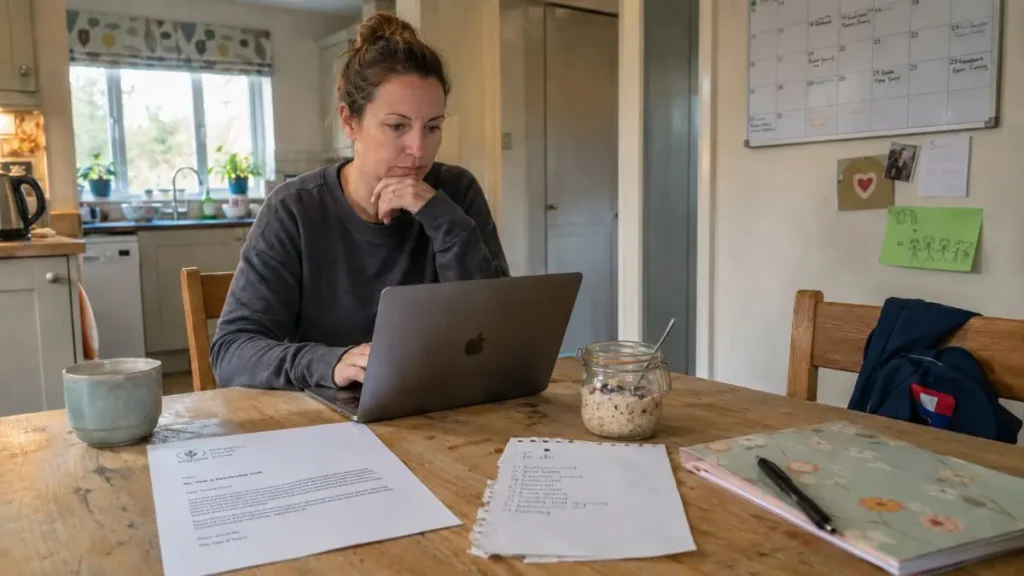
A simple example is a school email you have been putting off all evening.
You might type a messy note into AI saying that your child has been anxious about PE, forgot their kit twice, and you want to ask for a quick conversation with the teacher without sounding defensive.
Your rough prompt to AI might be something like, “My child is getting anxious about PE and forgot their kit again. I want to mention it without making a fuss, but I’m not sure how to word it.”
AI can turn that into a calmer, clearer draft asking for a quick conversation, but the important bit is what happens next: you cut anything that sounds too formal, add the detail that actually matters, and make sure it still sounds like you.
That is often where AI is at its best. It helps you get started, then you take back over.
The strongest use cases are usually the boring, repetitive, head-cluttering jobs that still need a human final check. If you are staring at a school letter, trying to reply without sounding sharp, or attempting to turn “we have random fridge food” into three workable dinners, AI can be surprisingly handy.
A lot of the value is in those small moments when your brain has gone a bit flat. It is less about asking profound questions and more about getting a workable first draft at 5:18 pm when you still need to send the email, plan dinner, or think of something for a rainy Saturday.
For example, it can help you:
- turn a rambling thought into a polite school email
- summarise a long school letter into the few points you actually need
- suggest some meal ideas from ingredients you already have
- turn “bedtime is chaos” into a few calmer routine ideas to try
- give you activity ideas for a rainy Saturday when everyone is bored and slightly fed up
These are the kinds of jobs where AI can genuinely save time because the task is mostly about getting started or organising your thoughts, not making a sensitive judgement call.
School admin is one of the clearest wins because it often needs wording help more than deep thinking. I have found AI helps me put my response across more clearly and saves me time thinking or worrying about what to say. If that is your main pain point, a deeper look at AI for school emails and admin explores how to keep messages clear, personal and appropriate.
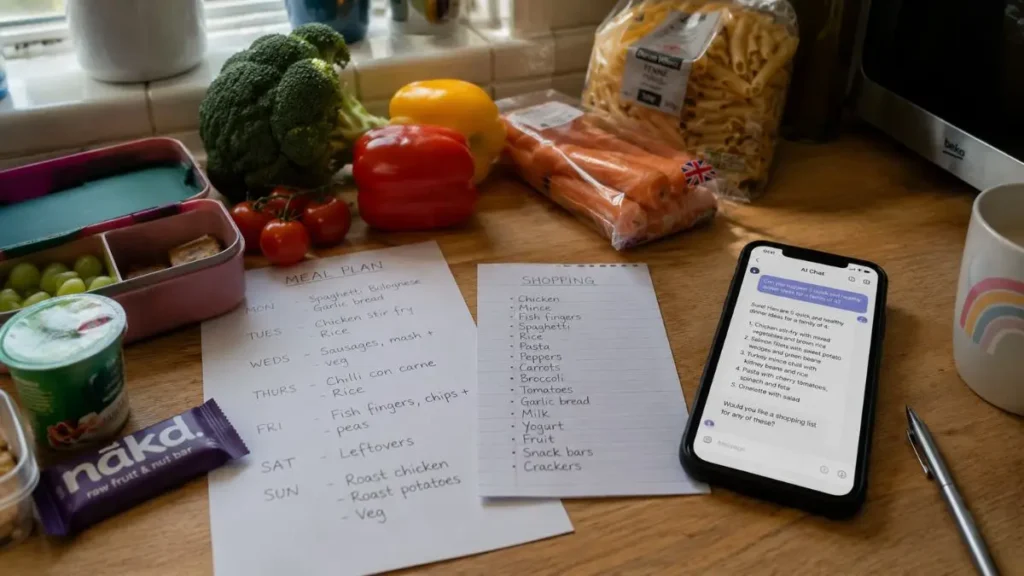
Meal planning is another good example of AI being helpful but not magical. I often just take a clear picture of the ingredients we have and share it with AI and see what it suggests. It can suggest combinations, shopping lists and ideas for picky phases, but it still needs you to overrule it when a suggestion is unrealistic, too expensive, or obviously not getting past your child. That is exactly where a closer look at AI and family meal planning becomes useful.
Creative use can help too, especially when you need quick activity ideas, story starters or a spark for a tired evening. The trick is using it as support, not as a replacement for the part that still needs you.
Where AI is less helpful than it sounds
A lot of AI marketing makes it seem as though it can “simplify family life” in one sweep. In practice, it tends to help in fragments. It is good at helping you get unstuck. It is less good at understanding the emotional reality of a situation.
If your child is anxious about school, struggling with friendships or pushing back on everything, AI can suggest wording, routines or questions to think about. What it cannot do is read the room, notice the expression on your child’s face, or understand the pattern you have been living with for months. It is not there at 7:42 am when the shoe drama starts and one sibling is already crying.
The same goes for nuanced decisions that depend on history, temperament, timing and what you already know. That includes decisions such as whether to push a child through discomfort, back off from a club, raise something with school, or change a family rule. AI can help you brainstorm, but it is much weaker when the real task is judgement.
It is also less helpful when the output creates extra work. If the reply is generic, overlong or slightly off, you then have to spend time correcting it. That can still be worth it if you were stuck to begin with, but it is not the same as true automation.
A useful test is to ask yourself, “Do I need a rough draft, or do I need judgement?” If it is judgement, AI is probably better kept in a supporting role.
Where parents should be more cautious with AI
There are some areas where a safety-aware mindset matters much more.
The first is privacy. Avoid dropping in personal, sensitive or identifying details about your child, especially anything you would not be comfortable sharing more widely. That includes full names, school names, addresses, dates of birth, medical details, safeguarding concerns or detailed family information. Even if a tool feels private, it is sensible to assume you should keep prompts as anonymous as possible.
Privacy is also worth thinking about more practically. Some consumer AI tools may use chats to improve their models unless you change the settings, and some providers say a limited number of reviewers or service providers may access content for safety, support or improvement.
Even where chats are separated from your account, that does not remove personal details you type into the chat itself, so it is still sensible to avoid names, schools, dates of birth, medical details or anything else you would not want visible to a reviewer. If a tool offers settings such as turning off model improvement or using temporary or incognito chats, it is worth using them.
The second is anything high-stakes. Do not rely on AI alone for health questions, legal issues, benefits decisions, urgent safeguarding worries or serious emotional concerns. It may give you a starting point for what to ask next, but it should not be the final word.
The third is children using AI without much structure around it. Recent UK research from Ofcom shows AI is already part of many children’s online lives, especially for learning, creativity and everyday tasks. That makes calm house rules more useful than pretending the topic can wait. If your child is starting to ask about chatbots, a clearer look at what to say and what rules to set helps you think through supervision, privacy and boundaries before it becomes a muddle.
Homework is another area where the line matters. AI can be useful for quizzing, explaining, generating practice questions or helping a parent break down a topic. It becomes much less useful when it starts doing the thinking for the child.
How to fact-check AI without turning it into another job
One reason this part gets skipped is that “check everything carefully” sounds like yet another task. For some parents that may put them off using AI at all, while for others it just means they are less likely to check answers properly. In reality, a quick sense-check is usually enough for most low-stakes uses.
A simple approach looks like this:
- check names, dates, deadlines and factual claims against the original source
- be wary if the answer sounds oddly certain, vague or full of invented references
- compare important information with a trusted source such as GOV.UK, your school, the NHS, or a known organisation in that field
- trust your own context when something sounds technically tidy but practically wrong
A very ordinary example would be asking AI to summarise a school letter and mention the reply deadline. Instead of trusting the date it gives you, glance back at the original letter or the school website and make sure the deadline, event time or uniform rule actually matches.
This matters most for school admin, forms, homework facts and any parenting question that sounds bigger than a simple wording problem. AI tools are better than they were a year or two ago, but improvement is not the same as reliability. Confident mistakes, fake citations and over-neat summaries still happen.
If you want a fuller version of that process, read a fuller guide to fact-checking AI answers. That article is designed to give you a repeatable way to check an answer without disappearing into a research spiral.
A sensible way to start using AI at home
You do not need a grand family AI strategy. A much better starting point is to pick one low-risk job that already irritates you and test whether AI helps.
That might be drafting a school email you keep putting off, asking for three packed lunch ideas from what is already in the kitchen, or getting five low-cost activity ideas for a wet afternoon. Keep the prompt specific. Keep personal details light. Edit the result into your own voice. Then decide honestly whether it saved you time or just looked clever.
If you want examples you can actually copy and adapt, some practical prompt ideas for parents are the most useful next read because they turn the broad ideas in this article into practical starting points.
For many families, the sweet spot is using AI in a parent-led way rather than making it a child tool first. In other words, use it behind the scenes to support your planning, wording and organisation before deciding whether it has any place in your child’s direct use.
That parent-first approach also fits the current UK school picture. The Department for Education accepts that generative AI can be used in education settings, but with human judgement, checking and safety still in place. That is a sensible principle for home use too. Let the tool help with the draft. You keep the responsibility.
Where to go next if you want more practical help
If you want to go a bit further without reading the whole cluster at once, these are good next steps:
- AI bedtime stories for kids: helpful shortcut or bad habit?: useful if you are weighing up convenience against connection at bedtime.
- Can AI help with primary school homework and revision?: a good next read if you want support with schoolwork without drifting into over-helping or doing the thinking for your child.
- Browse all our AI for Parents articles: useful if you want to explore the topic more widely and choose the next article based on what your family needs most.
For grounded UK guidance beyond this site, these are worth keeping open in another tab:
- Department for Education guidance on generative artificial intelligence in education: for the current school-context view on safe and effective use.
- ICO guidance on personal information and AI: for a sensible reminder about privacy and what not to share.
What matters most
AI can lighten family admin, help you get started and reduce some of the blank-page feeling that makes everyday tasks drag. That is the useful part.
The less useful part is the fantasy that it can replace judgement, context or connection. It cannot know your child the way you do. It cannot weigh up a school situation with the same nuance you can. It cannot tell when a technically neat answer is completely wrong for your family.
So the goal is not to hand too much of parenting over to AI. It is simply to use a new tool in a way that makes ordinary family life a bit easier without giving away the parts that still need a real adult. If you keep that balance, AI can be a decent helper. It just should not be in charge.
FAQ
How can parents use AI safely in everyday family life?
Parents can use AI most safely for low-stakes tasks such as drafting, summarising and idea generation, while keeping personal details light and checking anything important. It works best as a helper, not as something making decisions for your family.
Can I use AI for school emails?
Yes, as a drafting tool. It can help you get started, soften tone or tighten a rambling message, but it still needs your final edit so it sounds like you and reflects the real situation.
Should children use AI on their own?
That depends on age, maturity and the tool involved. For most families, starting with parent-led use works better than open-ended child use, especially while children are still learning what AI gets wrong and what should stay private.
What should I avoid putting into AI tools?
Avoid personal or sensitive details such as full names, addresses, school names, dates of birth, medical details, safeguarding worries or anything you would be uncomfortable sharing more widely.
Is AI okay for homework help?
It can be useful for explanations, quizzes and practice questions, but it is less useful when it starts producing the actual answers or doing the thinking your child is meant to practise.