
Children are already coming across AI in ways that do not always look obvious at first. It might be a chatbot, a voice assistant, a search result, a recommendation, or something that suddenly seems to “talk back”. Most parents do not need a technical explanation ready. They just need a calm, simple way to answer the question in front of them.
There is no single age when children suddenly become aware of AI, but many are already encountering it in everyday digital life by primary-school age, and some are using AI features as young as 5 to 8.
Quick summary
You can explain AI to a child simply without sounding technical. The aim is just to help them understand that AI is a tool, not a person, and that it can get things wrong.
If you want the short version before you try to explain it out loud, it is this:
- AI is a computer tool that looks at lots of information and gives an answer, suggestion or response.
- A simple way to explain it to a child is to say that AI can sound clever, but it is not a person, and it does not think or feel the way people do.
- Children usually do not need a big lesson about AI. They just need a few simple truths they can understand and come back to later.
- Good examples are things they already notice, such as voice assistants, TV recommendations, chatbots or tools that help create pictures, stories or answers.
- It also helps to explain that AI can get things wrong, make things up or sound more sure than it should.
This article is for / not for
This article is for:
- Parents of younger children and primary-age children, roughly aged 4 to 11, who want simple words they can actually say out loud
- Families whose children have started noticing chatbots, voice assistants or AI tools online or at school
- Parents who want to explain AI without making it sound scary or overly technical
- Adults who want a calm starting point rather than a full lesson on digital literacy
This article is not for:
- Parents looking for detailed rules about AI use at home
- Families who mainly need homework boundaries or school policy guidance
- Anyone wanting a technical explanation of how AI models work
- Parents looking for product-by-product reviews of AI tools
How can you explain AI to a child in simple terms?
The easiest place to start is with a sentence that is clear, ordinary and not too clever.
You could say something like:
“AI is a computer tool that looks at lots of information and tries to help by giving an answer, making a suggestion or creating something.”
For a younger child, you could make it even simpler:
“AI is a kind of computer helper. It can answer questions and do things like make pictures or stories, but it is not a real person.”
That is usually enough for a first explanation. Most children do not need more than that straight away. They tend to ask the next question from there, and that is often the best way in. If they ask whether it is like a robot, you can say sometimes it is part of a robot, but often it is just software on a phone, tablet or computer.
The main thing is not to over-explain. A short, calm answer is usually much easier for a child to take in than a big speech about technology.
If you want the wider picture of how AI fits into family life, AI for parents: practical ways to use AI in everyday family life gives that overview without getting too technical.
What do children actually need to know about AI?
Children do not need a full theory of artificial intelligence. What they need is a few simple ideas they can hold on to.
The most useful ones are:
- AI is made by people.
- It is not a real person.
- It can be helpful, but it can also be wrong.
- It should not be trusted just because it sounds confident.
People still need to think, choose and check. That gives a child a much better foundation than trying to explain data models, algorithms or machine learning in language that is too technical to mean much to them.
You can build on that in very ordinary language. For example, if a child asks whether AI knows everything, you can say that it does not. It is good at guessing what kind of answer might fit, but it can still get things wrong. If they ask whether it is alive, you can say no. It does not have feelings, beliefs or intentions, even if it sounds friendly or uses words that make it seem like it does.
Where do children already notice AI in everyday life?
This is often the easiest way to make the explanation click. Most children will understand AI better if you connect it to something they already see or use, rather than trying to define it like a school lesson. Once they realise they have already noticed AI in everyday life, the whole thing usually feels less mysterious.
A child may already have seen AI in:
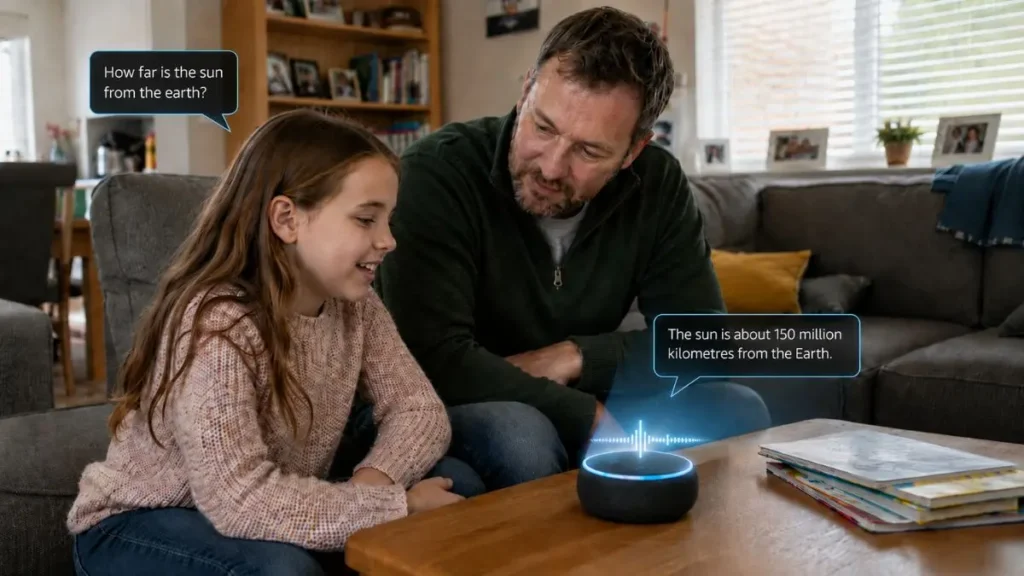
- voice assistants answering questions
- video or music recommendations
- search tools that summarise answers
- chatbots in apps or games
- tools that generate pictures, stories or quizzes
For many children, the easiest examples are things like YouTube suggesting the next video, Netflix showing programmes it thinks they might like, or a phone answering a question out loud.
You do not need to prove a perfect technical line between every tool and every kind of AI. The point is simply to help them notice that AI is already part of everyday digital life.
You could say:
“You know how sometimes a phone or computer seems to suggest something, answer a question or make a picture? That can be AI.”
Using examples they already recognise makes the conversation feel much more normal. It stops AI sounding like some huge mysterious thing that has suddenly arrived from nowhere.
How can you explain that AI is not a real person?
This matters because younger children, especially, can slide into treating a chatbot as if it is a person who knows things, likes them or means well.
A simple way to explain it is:
“AI can sound like a person when it writes or talks, but it is not a person. It does not think, care or understand in the way a real person does.”
That usually works better than saying something more abstract like “AI is non-human”. The goal is to help the child separate the voice from the reality.
You can also compare it to something simpler. For example, you might say it is a bit like a talking book or a character in a game. It can sound friendly and say lots of words, but that does not mean it is a real person or understands things the way people do.
That distinction becomes even more useful later if a child starts using AI for homework, questions or creative play.
What can AI get wrong?
This is one of the most important things for children to understand early. A child does not need a long warning here, but it does help if they understand that AI can sound convincing without always being right. Once they know that, they are much less likely to treat every answer like a fact.
AI can:
- get facts wrong
- make things up
- miss important context
- sound sure even when it is mistaken
- give answers that are only partly right
You do not need technical words here. It is enough to say that AI sometimes guesses badly, mixes things up or says something that sounds right but is not.
A useful phrase here is:
“AI can be helpful, but it can also be wrong, so it is something we should think about, not just believe.”
That gives children a practical mindset rather than just a warning. The aim is not to scare them off. It is to teach them not to hand over all their judgement.
Phrases you could use tonight
Sometimes the hardest part is not the idea. It is finding words that sound natural when your child asks something out of the blue and you are trying to answer without overcomplicating it. A few simple phrases can make that much easier, especially if you want to sound calm, clear and not overly technical.
Here are a few simple phrases that work well:
- “AI is a computer tool that tries to help by giving answers or making things.”
- “It can sound like a person, but it is not a real person.”
- “It can be useful, but it can also get things wrong.”
- “People still need to check what it says.”
- “It is there to help you think, not to do all the thinking for you.”
You do not need to say them all at once. Usually, one or two are enough, depending on what your child has actually asked.
A calm way to handle follow-up questions
Most children will not stop at “What is AI?” Once they hear the basic answer, the next questions are often things like “Is it real?”, “Does it know me?”, “Is it smarter than people?” or “Can I use it for homework?”
You do not need perfect answers. It is fine to keep them short.
For example:
- Is it real? It is real as a tool, but it is not a real person.
- Does it know me? Not in the way a person knows you.
- Is it always right? No, it can get things wrong.
- Can it do my homework? It can help with some things, but it is not there to do the work for you.
That kind of calm, matter-of-fact answer usually works better than a dramatic one. Children tend to take their emotional tone from us.
More help if the conversation is moving on
If your child’s questions are starting to move beyond a simple explanation, these are the most useful next reads:
- When children ask about using AI: what parents need to say and what rules to set: useful if the conversation is shifting from “what is AI?” to “what are the rules around it at home?”
- Can AI help with primary school homework and revision?: useful if the next question is really about schoolwork, support and where the line is.
- How to fact-check AI answers when you’re using them for parenting questions: useful if you want a simple way to explain why confident answers still need checking.
For grounded UK guidance beyond this site, these are worth keeping open in another tab:
- Department for Education guidance on generative artificial intelligence in education: for the wider school context view on safe and sensible use.
- Education Hub: AI in schools and colleges: what you need to know: for a straightforward UK overview of how AI is being used in education and the safeguards schools still need to follow.
What matters most
You do not need to sound technical to explain AI well to a child. In most cases, the best explanation is the simplest one.
If a child understands that AI is a helpful computer tool, not a real person, and that it can sometimes get things wrong, that is already a strong starting point.
The aim is not to give them a perfect lesson in technology. It is to give them enough understanding to stay curious, ask questions and keep their common sense switched on.
FAQ
How do you explain AI to a child in simple terms?
A simple way is to say that AI is a computer tool that tries to help by answering questions, making suggestions or creating things. Then add that it is not a real person and it can still get things wrong.
What does a child need to know about AI?
Most children only need a few simple truths to begin with: AI is made by people, it is not a person, it can be useful, and it can also be wrong.
Where do children already notice AI in everyday life?
They may notice it in voice assistants, search tools, recommendations, chatbots, games, picture generators or other apps that seem to respond in a clever way.
How can you explain that AI is not human?
You can say that AI may sound like a person when it writes or talks, but it does not think, feel or understand the way a real person does.