

Christmas with children can be lovely, but it can also get loud, messy, pressured and far more full-on than people admit. This article is for parents who want Christmas to feel calmer without making it joyless. The aim is not to create a perfectly stress-free Christmas. It is to lower the pressure enough that you and your children can actually enjoy the parts that matter.
Quick summary
If you are searching for how to have a stress-free Christmas with kids, the most realistic answer is usually to lower the pressure rather than try to manage every festive moment perfectly. A calmer Christmas usually comes from doing less, planning a bit more, and protecting everyone’s regulation:
- Christmas often feels harder when routines disappear, plans multiply and everyone gets overexcited and overtired at the same time.
- A calmer Christmas does not mean a dull one. It means protecting the parts that feel good and dropping the parts that only add pressure.
- The quickest ways to reduce overwhelm are usually fewer plans, clearer expectations, quieter spaces and more downtime.
- Children often cope better when the day still has a few predictable anchors, such as breakfast, rest, quiet time or bedtime.
- Sensory overload matters. Lights, noise, scratchy clothes, crowded rooms, strong smells and too many surprises can all add up.
- It helps to plan ahead, say no earlier, and stop treating every festive idea as equally important.
- Parents’ stress matters too. Christmas is usually calmer when you are not trying to carry every part of it at once.
This article is for / not for
This article is for:
- parents who find Christmas overstimulating, pressured or emotionally draining
- families with children who get overwhelmed by noise, routine changes or too much excitement
- anyone trying to make Christmas feel calmer without losing the nice parts
- parents who want practical reassurance rather than a huge festive to-do list
This article may not be for you if:
- you are mainly looking for Christmas activity ideas or gift suggestions
- you want a traditions article more than a guide to reducing stress and overwhelm
Medical disclaimer
This article is about reducing festive stress and overwhelm in family life. It is not a diagnosis or a substitute for medical or mental health support. If you are worried about your child’s anxiety, behaviour or wellbeing, or about your own mental health, it is important to speak to a GP or another professional you trust.
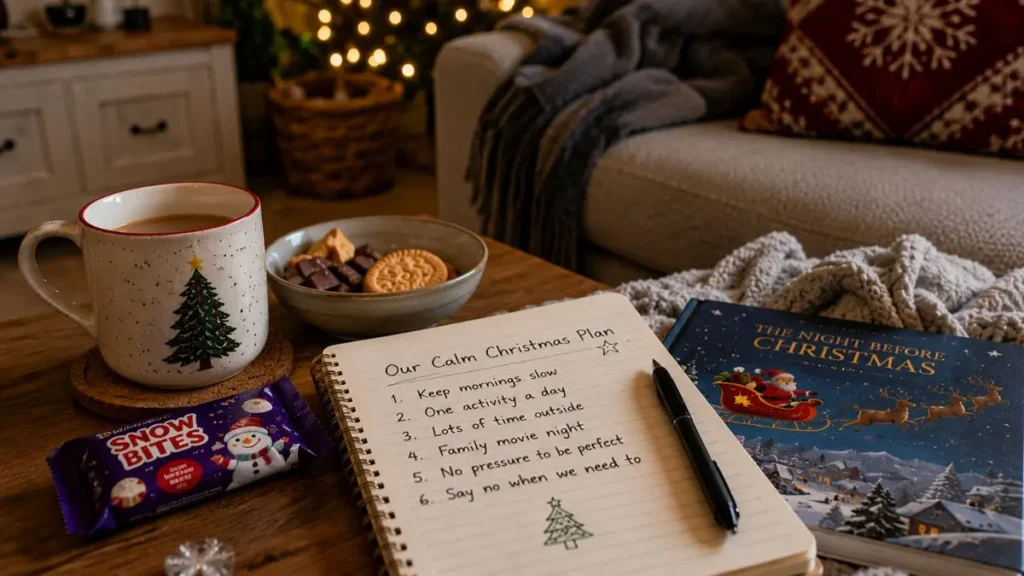
How to have a calmer Christmas with kids
The biggest shift is often this: calmer does not come from doing Christmas better. It usually comes from asking less of the day.
A lot of festive stress builds because people try to hold on to every possible version of Christmas at once. Home activities, class events, travelling, visits, matching outfits, Christmas Eve plans, traditions, gifts, baking, family expectations and the pressure to make it all feel magical can pile up very quickly.
What helped me see this differently was realising that children usually notice the emotional temperature of Christmas before they notice how much was packed into it. They notice whether the day felt fun, safe, rushed, noisy, cosy or tense. That means a calmer Christmas often starts with the overall feel, not the number of festive extras.
Our broader guide, Christmas activities and ideas for kids, covers the wider festive picture. This article stays focused on pressure, regulation and practical ways to make Christmas easier on the whole family.
Why Christmas can feel overwhelming for children
Christmas can be overwhelming because several stressors tend to land at once. There is usually more noise, more waiting, more sugar, more people, more change, more excitement and less recovery time.
Some children find the build-up harder than the day itself. The uncertainty, the counting down, the disrupted routines, the school events and the social expectations can all keep them slightly on edge. Others manage the build-up well but unravel when the day becomes too full.
This is not only about one kind of child. It can be especially noticeable for Autistic children, children with ADHD, anxious children or children with sensory sensitivities, but plenty of other children struggle too. Christmas asks a lot of everyone.
It also helps to remember that excitement and dysregulation can look very similar. A child may seem hyper, silly, emotional, rude or impossible when they are actually tired, overloaded or struggling to cope with too much happening around them.
How to reduce sensory overload at Christmas
Sensory overload is one of the fastest ways for Christmas to tip from exciting into miserable. The tricky part is that festive environments are often built around extra stimulation: twinkly lights, loud music, busy decorations, strong food smells, fancy clothes and crowded houses.
You do not need to strip everything back to make it calmer. Small adjustments can make a big difference: dimming some lights, lowering the volume, skipping scratchy outfits, keeping one room quieter, serving familiar food alongside festive food, or letting children step away for a few minutes can all help.
A quiet space is worth thinking about before you need it. That might be a bedroom, a corner with blankets, a calmer room at a relative’s house, or even just a place where one parent can sit with a child for ten minutes without conversation or demands.
What helps most is spotting the build-up before everything tips over. If your child tends to go silly, shouty, tearful, clingy or oppositional when overwhelmed, that is often the moment to reduce input rather than add another festive thing.
How to handle Christmas routine changes without chaos
Routine changes are a big part of why Christmas can feel wobbly. Even children who are generally flexible can find it hard when normal meals, sleep, travel, social contact and expectations all shift at once.
The goal does not need to be keeping everything exactly the same. It is more about keeping a few anchors in place so the day still has a shape. Breakfast at a normalish time, a rest after lunch, familiar snacks, an early bath, one quiet part of the afternoon or a recognisable bedtime rhythm can all help.
Visual planning can be useful too, especially for children who do better when they know what is coming. A simple spoken plan, a phone note, a handwritten list or a few words like “breakfast, presents, rest, lunch, visit, home” can be enough. It does not need to be elaborate to be helpful.
One thing that often helps is spreading excitement out a bit. If everything big happens on one morning and then the day becomes noisy and unstructured, the crash can come quickly. Keeping one or two quieter parts of the day intact often makes the whole thing easier.
Ways to reduce Christmas stress for the whole family
A calmer Christmas is rarely only about the children. Parents’ emotional load matters just as much. If you are trying to remember everything, carry the planning, absorb the family politics and keep the day cheerful at all costs, Christmas will feel heavier no matter how many calming tips you use.
It helps to ask what can be made easier before the busiest days arrive. That might mean writing down the rough plan, choosing easier food, setting things out the night before, saying no to one visit, or deciding that some things are simply not happening this year.
Saying no earlier is usually kinder than saying yes resentfully and then regretting it. The same goes for scaling things back. You do not need to justify every choice if what you are protecting is your family’s capacity.
What I have noticed is that Christmas is often easier when there is one adult paying some attention to regulation rather than only to logistics. That could mean noticing hunger, tiredness, sensory load, rising tension or when a child really needs a quiet reset more than another “special” moment.
Simplifying traditions and keeping Christmas Eve manageable
One of the most useful things you can do is stop treating every festive idea as equally important. Some traditions genuinely matter. Others are only being carried because they feel expected.
A calmer Christmas often comes from keeping the bits that create connection and quietly dropping the bits that create extra work. That might mean one or two traditions instead of five, one social plan instead of three, or a very simple Christmas Eve instead of trying to make Christmas Eve feel like another main event.
Calmer does not mean boring. It means leaving enough space for the good bits to land.
Where to go next
If you want to build on this without piling more pressure onto December, these are the most useful next reads:
- Family Christmas traditions to start this year: useful if you want a few traditions that feel special without becoming one more source of stress.
- Christmas Eve box ideas for kids: simple, budget-friendly ideas that do not go overboard: a good next step if 24 December tends to grow bigger than you want it to.
- Family Christmas ideas: the Christmas topic page, where you can browse the wider set of festive articles and choose what actually fits your family.
A couple of useful UK resources
If Christmas stress is affecting your family more than usual, these are sensible places to look for extra support:
- Mind – Christmas and mental health: practical support if Christmas brings stress, overwhelm, loneliness or difficult family dynamics.
- GOV.WALES – Tips for coping with Christmas: practical family guidance around routines, quiet time, planning ahead and keeping festive pressure manageable. Although it is a Welsh government resource, the same principles are useful right across the UK.
What matters most
A calmer Christmas with kids usually comes from lowering pressure, not raising standards. You do not need to make the season perfect to make it meaningful.
If you only take one thing from this article, let it be this: protect the regulation of the people in the room before you protect the plan. Fewer plans, clearer expectations and more breathing space often do more for Christmas than one more activity, one more visit or one more tradition squeezed in at the last minute.
FAQ
How can I have a calmer Christmas with kids?
The most realistic way to have a calmer Christmas with kids is to lower the pressure on the day. Fewer plans, simpler expectations, quieter spaces and a few predictable routines usually help more than trying to make everything perfect.
Why do children get overwhelmed at Christmas?
Children can get overwhelmed at Christmas because there is often more noise, excitement, waiting, sugar, social contact and routine change than usual. Even happy excitement can tip into dysregulation when there is not enough quiet time or recovery.
How do I manage sensory overload at Christmas?
It helps to lower the volume where you can, keep some clothes and food familiar, and make sure there is a quieter space to step into. Small changes often work better than trying to control every part of the environment.
How can I keep Christmas routine changes manageable?
You do not need to keep the whole day identical. It is usually enough to protect a few anchors such as breakfast, rest, snacks, quiet time or bedtime so the day still has some shape.
How do I reduce Christmas stress for the whole family?
Reduce the number of things that feel compulsory. Plan ahead where you can, say no earlier, keep some downtime, and let go of the bits that add more stress than joy. That is often what makes Christmas feel calmer for everyone, not just children.