
You might have heard Dyslexia described as a “superpower” and wondered whether that’s helpful or just confusing, especially if it doesn’t quite match what you’re seeing day to day. It can sound reassuring at first, particularly if your child is struggling. But many parents are left wondering what it really means in real life, and whether it reflects their child’s actual experience.
Quick summary
Dyslexia isn’t simply a “superpower” — it’s a mix of strengths and challenges. The idea of Dyslexia as a “superpower” is meant to be positive, but it can feel unrealistic or unhelpful depending on your child’s experience. In simple terms:
- Dyslexia can come with strengths, but also real challenges
- Not every child experiences clear “advantages”
- Daily school tasks can still feel hard and frustrating
- Positive language can help confidence, but only if it feels true
- What matters most is understanding your child, not the label
This article is for / not for
This article is for:
- Parents unsure how to feel about the “superpower” idea
- Parents trying to balance encouragement with realism
- Anyone wanting a clearer, more honest perspective
This article is not for:
- A clinical explanation of Dyslexia
- A diagnostic guide
Medical disclaimer
This article is for general understanding only and does not diagnose Dyslexia. If you are concerned about your child’s development, speak to your child’s school, GP, or a qualified professional. You can also refer to NHS guidance on learning differences.
Why people call dyslexia a ‘superpower’
The idea usually comes from a good place.
People want to shift the focus away from difficulty and highlight that Dyslexia can be linked to strengths like creativity, problem-solving, or big-picture thinking. You’ll often hear stories about thinking differently leading to success.
For some children, this framing can feel encouraging. It can help move the conversation away from “what’s wrong” and towards “what’s different”.
But this is only part of the picture.
Where the ‘superpower’ idea can fall short
For many families, the word “superpower” doesn’t match what daily life feels like.
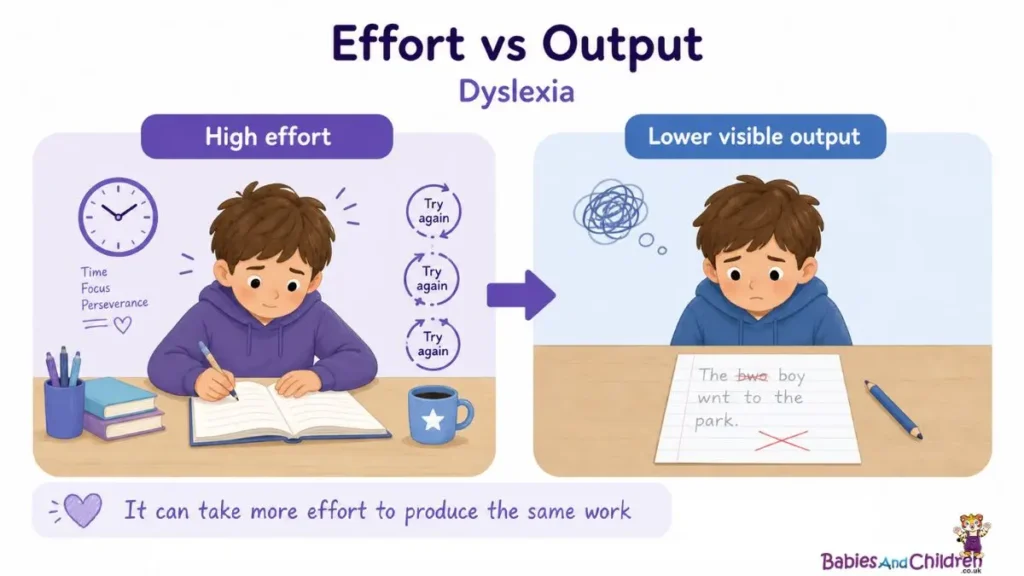
A child might be working twice as hard just to keep up with reading or writing. For example, they might spend 20 minutes trying to read a short homework paragraph, lose their place several times, and then feel too frustrated to continue. In those moments, being told it’s a “gift” can feel out of sync with reality.
It can also create pressure. If something is framed as a strength, a child might feel confused or even discouraged if they don’t feel that strength themselves.
This doesn’t mean the positive intention is wrong. It just means the language doesn’t always land the way people expect. There can also be a risk that others underestimate the support a child needs if Dyslexia is only framed as a strength.
What Dyslexia can look like in real life
In everyday situations, Dyslexia often shows up in small but persistent ways.
At school, a child might understand a topic but struggle to show that understanding in written work. They may lose their place when reading, avoid certain tasks, or feel slower than their peers.
At home, this can look like tiredness after school, reluctance to start homework, or frustration with tasks that seem simple to others.
These experiences are real, and they matter just as much as any potential strengths.
Are there strengths linked to Dyslexia?
This is where the “superpower” idea partly comes from.
There can be, but they are not guaranteed and they don’t replace the challenges.
Some children with Dyslexia do show strengths in areas like creative thinking, storytelling, problem-solving, or seeing connections between ideas. For example, they might be brilliant at building something complex from LEGO by instinct, but struggle to follow the written instructions step by step. These strengths often develop over time and in the right environment.
But they are not automatic, and they don’t cancel out the effort required for reading, writing, or structured school tasks.
It’s more helpful to think in terms of a different way of processing information, rather than a built-in advantage.
How to talk about Dyslexia with your child
This is where the “superpower” idea can be used carefully, or not at all.
What tends to help most is language that feels honest and supportive at the same time.
You might frame it as:
- “Your brain works a bit differently, and that can make some things harder and some things easier.”
- “You might need different ways to learn, and that’s okay.”
This avoids dismissing the difficulty, while still leaving space for confidence and growth.
The goal isn’t to label Dyslexia as good or bad, but to help your child understand themselves in a way that feels real.
What matters more than the label
If you want to understand where this messaging comes from and how Dyslexia is often portrayed more broadly, Dyslexia film: what it gets right (and what parents should know) helps put that into context.
Whether Dyslexia is described as a challenge, a difference, or a “superpower”, the label itself is less important than what happens next.
What really helps is support that matches your child’s needs, understanding from school and home, and time to build confidence in their own way.
Some children will relate to the “superpower” idea. Others won’t. Both are completely fine.
A more balanced way to think about it
It may be more helpful to think of Dyslexia as a different way of learning, with both strengths and challenges.
That keeps expectations realistic while still allowing for confidence to grow over time.
It also gives your child permission to find what works for them, rather than trying to fit into a label that may not feel right.
You might find these helpful
If you want to explore this further, these articles build on what you’ve just read and help you see the bigger picture from different angles:
- Dyslexia explained for parents (and why it’s often missed) – a clearer understanding of what Dyslexia actually is and how it shows up in everyday life
- Dyslexia and ADHD: why they often overlap (and what it means for your child) – helps make sense of mixed patterns and overlapping traits
- How schools support Dyslexia in the UK (and what to expect) – explains what support actually looks like in school and how teachers help children day to day
For further trusted UK guidance, you can also refer to:
- British Dyslexia Association (BDA) – practical advice, support, and information for parents
What matters most
The idea of Dyslexia as a “superpower” can be helpful for some children, but it doesn’t fit every experience. What matters most is helping your child feel understood, supported, and confident in their own way.
You don’t need a perfect label—just the right support and a realistic understanding of how they learn.
FAQ
Is Dyslexia really a superpower?
For some people, Dyslexia is linked to strengths, but for many children it also involves real challenges. It’s not a simple “yes or no” answer.
Is calling Dyslexia a gift helpful?
It can be, but only if it matches the child’s experience. If it feels unrealistic, it may be less helpful than honest, balanced language.
What are the strengths of Dyslexia?
Some children show strengths in creativity, problem-solving, or big-picture thinking, but this varies and develops over time.
What are the disadvantages of Dyslexia?
Difficulties with reading, spelling, and written work are common, and these can affect confidence if not supported.