
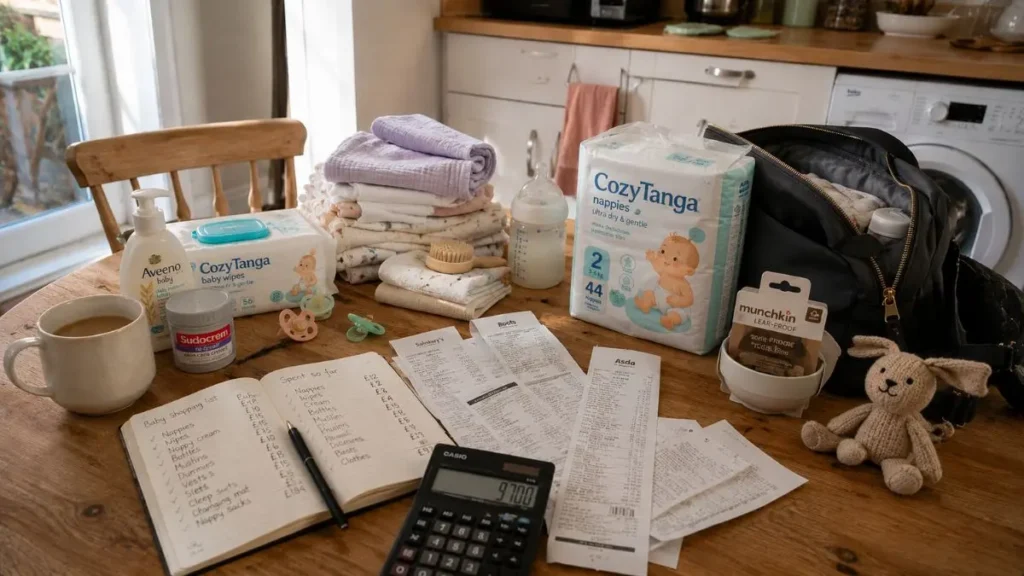
Trying to work out what a baby actually costs each month can feel confusing very quickly. Most guides either give big averages or long lists, but neither really shows what real life spending looks like once you are in it.
In reality, the monthly cost of a baby in the UK varies a lot depending on feeding, childcare, lifestyle, and how you choose to spend. The most useful way to understand it is to look at realistic examples rather than one fixed number. That is why the numbers can feel unclear at first.
Quick summary
Most UK parents spend between £200 and £800 per month on a baby, although costs can be lower or much higher depending on feeding, childcare, and lifestyle.
Most families fall somewhere between a few hundred pounds and over £1,000 per month depending on their situation. A simple way to think about it is:
- Lower-cost setups may stay around £200–£400 per month
- Mid-range spending often sits around £400–£800 per month
- Higher-cost setups (especially with childcare) can exceed £1,000+ per month
- Feeding choices, childcare, and lifestyle are the biggest cost drivers
- Everyday repeat costs like nappies, wipes, and clothes add up consistently
- Occasional costs still affect monthly budgets, even if they are not paid every month
This article is for / not for
This article is for you if:
- You want a realistic idea of monthly baby costs in the UK
- You are trying to plan your spending without relying on averages
- You want to see how different choices affect monthly costs
- You prefer practical examples rather than theory
This article is not for you if:
- You want full first-year baby cost totals
- You are looking for detailed product comparisons
- You want a full budgeting system

A realistic example monthly baby budget (UK)
Instead of starting with averages, it is often easier to picture what a real monthly budget might look like.
This is not a perfect or fixed budget, just a realistic snapshot of how costs often show up once everyday life settles into a routine.
For most parents, spending does not arrive neatly as a monthly figure. It tends to show up in bits across the week, which is why seeing it grouped together like this can make it feel clearer and more manageable.
Here is a simple mid-range example based on common spending patterns most parents tend to fall into once everyday routines settle in the first year:
| Category | Monthly cost |
|---|---|
| Nappies and wipes | £40–£80 |
| Feeding (formula or mixed) | £60–£150 |
| Clothing | £20–£60 |
| Toiletries and medicines | £10–£30 |
| Travel (fuel, parking, small extras) | £40–£120 |
| Activities / small purchases | £20–£80 |
Estimated monthly total: £200–£520 (excluding childcare)
This example focuses on everyday costs and excludes childcare and larger lifestyle spending, which can significantly increase monthly totals once they apply.
It also does not include any increase in household bills such as heating, water, or laundry, which often rise during the first year. This is not a fixed number. It is simply a realistic picture of how everyday costs might look once the initial purchases are already done.
If you want to zoom out and see how these monthly costs fit into the bigger picture, our article How much does a baby cost (UK)? looks at the full first-year costs in more detail.
What affects the monthly cost of a baby the most
These factors also explain why the example budgets can look so different from one family to another, which becomes clearer when you look at the scenarios below.
The reason the monthly cost of a baby can vary so much is that a few key decisions have a big impact.
Feeding choices
Feeding is one of the biggest variables.
Breastfeeding can keep monthly costs lower, but many parents still buy pumps, pads, or other extras. Formula feeding adds a regular ongoing cost that can easily become one of the largest monthly expenses.
Childcare
Childcare is often the single biggest cost once it begins.
Even part-time nursery can significantly increase monthly spending, while full-time childcare can push total costs well beyond £1,000 per month.
Lifestyle and travel
How often you are out and about also changes spending.
More travel usually means more fuel, more parking, more snacks and drinks, and more small convenience purchases. These costs tend to build gradually rather than appearing as one large expense.
How you buy
Second-hand buying, hand-me-downs, and supermarket brands can reduce monthly costs noticeably.
Buying everything new, choosing premium brands, or prioritising convenience can increase spending just as quickly.
Low, mid and higher-cost monthly scenarios
To make this more practical, it helps to see how the monthly cost of a baby changes depending on your situation.
Lower-cost example
A lower-cost setup might include breastfeeding, second-hand clothes, and minimal travel spending.
Monthly costs may look like nappies and wipes at £30–£60, clothing at £10–£40, toiletries and medicines at £10–£20, and travel and small extras at £20–£80.
Estimated total: £100–£250 per month
Mid-range example
This is closer to the earlier example and reflects a mix of new and second-hand items with moderate spending.
This might include some formula or combination feeding, regular clothing top-ups, and moderate travel or convenience spending alongside everyday essentials.
Estimated total: £200–£500 per month
Higher-cost example
Higher-cost setups often include formula feeding, more frequent spending, and childcare.
Monthly costs may include feeding at £100–£200, nappies and essentials at £60–£120, clothing at £40–£100, travel and lifestyle at £80–£200, and childcare at £500–£1,200+.
Estimated total: £800–£1,500+ per month
It is also worth knowing that the first month of childcare can sometimes be higher due to deposits or registration fees.
The difference between these scenarios shows how much flexibility there is depending on your situation.
Regular costs vs occasional costs
One reason monthly budgets can feel unpredictable is that not all costs happen evenly.
Regular costs are the ones that happen every week or month, such as nappies and wipes, feeding, toiletries, and small top-up purchases.
Occasional costs are less frequent but still affect your monthly spending when spread out, including replacing clothes as sizes change, buying larger sleeping bags, new bottles or feeding equipment, and seasonal clothing.
When you spread occasional costs across the year, they still form part of your monthly budget.
Where parents can adjust spending
One of the most useful things about understanding monthly costs is seeing where there is flexibility.
Parents often adjust spending by using supermarket own-brand nappies and wipes, buying clothes in bundles or second-hand, spacing out non-essential purchases, and limiting convenience spending where possible.
These changes do not remove costs completely, but they can make monthly spending feel more manageable.
Why monthly baby costs can feel higher than expected
For example, a typical week might include £8 on wipes, a £12 pharmacy top-up, and a £15 clothing purchase, which feels small at the time but quickly adds up over a month. A lot of the extra spending comes from how often small purchases happen rather than one large cost.
This is where the “top-up effect” becomes noticeable. A few extra items each week may not seem significant at the time, but over a month they can noticeably increase overall spending. Changes in routine, growth spurts, and day-to-day life with a baby all contribute to this pattern.
This is also why many parents find it helpful to allow a small £20–£50 buffer each month for these kinds of surprise costs.
Helpful next reads on baby costs
If you are trying to turn these numbers into something that actually works day to day, it often helps to look at how different parts of baby spending break down in more detail. These guides go a bit deeper into the areas that tend to have the biggest impact on your monthly budget.
- How to budget for a baby (simple plan) – Useful if you want to take these rough monthly costs and turn them into something more structured that fits your own income and situation
- Cost of baby formula (UK): what parents actually spend – Helps if feeding is likely to be a major part of your monthly costs, with a clearer look at how those expenses build over time
- The realistic cost of baby nappies in the UK (what parents spend) – Breaks down one of the most consistent repeat costs so you can see what it actually looks like week to week
For UK-specific support and guidance, it can also help to sense-check your situation against official information rather than relying on estimates alone.
- GOV.UK: Child Benefit – Useful for checking current eligibility and payment information and how this might offset some monthly costs
- Citizens Advice: help with costs if you have a child – Useful if you want to explore what financial help, grants, or support you may be entitled to as a parent, especially if monthly costs are feeling difficult to manage
What matters most
There is no single “correct” monthly cost for a baby.
Some families spend very little and still meet all their baby’s needs, while others choose to spend more for convenience, time, or lifestyle reasons.
The most useful thing is understanding where your costs are likely to come from and how they might change over time.
A simple, flexible view of your monthly spending is usually more helpful than trying to match a perfect number.
FAQ
What is the monthly cost of a baby in the UK?
Monthly baby costs typically range from around £200 to £800 for many families, but can be lower or much higher depending on feeding choices, childcare, and lifestyle.
What is the biggest monthly cost for a baby?
For many families, childcare becomes the largest monthly cost once it starts. Before that, feeding and everyday essentials are usually the biggest regular expenses.
Can you reduce monthly baby costs?
Yes. Many parents reduce costs by buying second-hand, using supermarket brands, and limiting convenience spending where possible.
Do baby costs change month to month?
Yes. Costs often vary due to growth spurts, changing routines, and occasional purchases such as clothing or equipment.