

The third trimester can make everything feel suddenly real. You might be close to your due date, still working through practical jobs, or wondering whether you have missed something important. This checklist is here to help you focus on what is genuinely worth sorting in the final weeks before birth, without turning preparation into another pressure-filled list.
Quick summary
A third trimester checklist should focus on the things that help if labour starts soon: notes, numbers, hospital bag, safe sleep, transport home, newborn basics and support for the first few days. Anything decorative or non-urgent can usually wait.
The third trimester is not the time to aim for a perfect house, a perfect nursery or a perfect birth plan. It is the time to make sure the few practical things that matter most are easy to find, easy to use and ready enough.
If you only have limited energy, focus on these first:
- Keep your maternity notes and key labour numbers somewhere obvious.
- Pack a simple hospital bag, even if it is not perfect.
- Set up a safe sleep space for your baby.
- Sort how your baby will get home, including a newborn car seat if travelling by car.
- Have enough nappies, clothes and feeding basics for the first few days.
- Make a simple plan for food, older children, pets and support.
- Leave nursery details, routines and most extras until after birth.
This article is for / not for
This article is for you if:
- You are in the third trimester and want a realistic UK checklist.
- You are close to birth and want to know what matters most now.
- You feel a bit behind and need a calm, practical order of priorities.
- You want final-weeks preparation rather than a huge baby shopping list.
This article is not for you if:
- You need urgent medical advice about your pregnancy.
- You want a detailed week-by-week guide to third-trimester symptoms.
- You are looking for medical guidance about labour, complications or treatment decisions.
Medical disclaimer
This article is general preparation information for UK parents. It is not medical advice and does not replace guidance from your midwife, GP, consultant, maternity triage, hospital or birth centre. If you are worried about your baby’s movements, bleeding, pain, waters breaking, severe headache, visual changes, swelling, feeling very unwell or anything that feels wrong, contact your maternity unit, midwife or NHS 111 for advice. If you think it is an emergency, call 999.
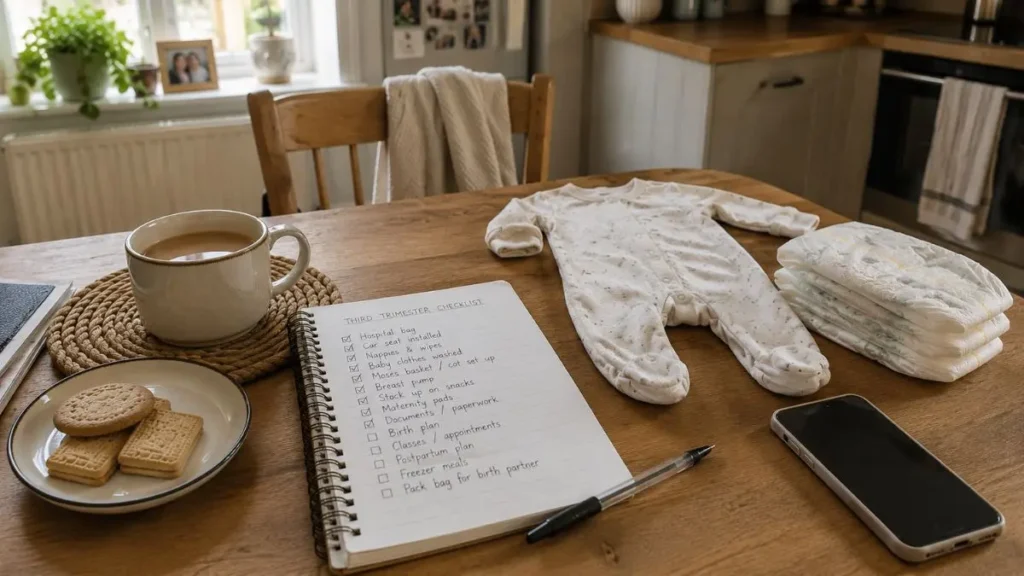
What counts as the third trimester?
The third trimester usually means pregnancy from around 28 weeks until birth. In real life, though, many people start thinking about the final practical jobs much later than that, often when the due date suddenly feels close.
If you want the full getting-ready-for-baby guide, start with Preparing for a baby: a practical UK checklist. This article is for the final weeks, when you mainly need to know what to sort now, what can wait and what will make the first few days easier.
A useful way to think about the third trimester is not “have I done everything?” but “could we manage if the baby arrived sooner than expected?” That makes the list much simpler.
What matters most in the final weeks
The most useful final-weeks preparation is the kind that helps if labour starts, if you need advice quickly, or if you come home with a newborn and very little sleep.
That means practical things come before decorative things. Your maternity notes matter more than a finished nursery. A safe sleep space matters more than colour-coded drawers. Knowing who will look after an older child or pet matters more than having every possible baby gadget ready.
This is also where a lot of parents accidentally overdo it. The third trimester can trigger a strong urge to sort everything, especially if you feel the baby could arrive at any moment. Some nesting is lovely and useful. But if the list starts making you feel worse, it is worth shrinking it back down to the jobs that would actually help in the first few days.
The five jobs to do first if you’re overwhelmed
Start with the five jobs that give you the most practical security.
First, keep your maternity notes and key numbers easy to grab. If you need to call triage or leave for hospital, you do not want to be searching through bags, apps or letters.
Second, pack a basic hospital bag. It does not have to include every comfort item you have seen online. It just needs the things you are likely to need for labour, after birth and your baby’s first outfit.
Third, set up a safe sleep space. Your baby does not need a perfect nursery, but they do need somewhere suitable to sleep.
Fourth, sort the journey home. If you are travelling by car, check the baby car seat before the day. If you are not driving, think through the actual journey and what you will need.
Fifth, have enough newborn basics for the first few days. That means nappies, clothes, feeding supplies and simple household essentials, not every product people recommend.
Sort the birth practicalities first
This is the kind of boring prep that only feels important when you suddenly need it. The birth practicalities are the things that help when the day starts moving quickly. They are not glamorous, but they reduce the number of decisions you have to make when you are tired, uncomfortable or trying to work out whether labour has properly started.
Start with your maternity notes. If you have paper notes, keep them somewhere obvious. If your area uses digital notes, check you can access what you need before you need it. It may also help to save or screenshot key pages, such as your maternity unit number, appointment details and any birth preferences, so you are not relying on signal, Wi-Fi or remembering a login when you are in labour. It also helps to save the maternity triage, labour ward or birth centre number in your phone, and to write it down somewhere your birth partner can find it too.
Your hospital bag can stay simple. Aim to have it mostly ready by around 36 to 37 weeks, then keep a small “grab on the day” list for things like your phone, charger, glasses, water bottle or medication. Put that list somewhere impossible to miss, such as on the hospital bag, by the front door or next to your phone charger. A list hidden in a notebook is not much help if everyone is half-asleep and rushing.
Birth preferences are worth thinking about too, but they do not need to become a perfect script. A short note about what helps you feel calm, who you want with you, how you feel about pain relief, and anything staff should know about your needs is often more useful than a long document that is hard to scan quickly.
Use late appointments to ask final practical questions
Late-pregnancy appointments can feel routine, especially if you have had a lot of them. But they are useful moments to ask the questions that might otherwise sit in your head at 2am.
You could ask who to call if you think labour has started, when to phone triage, what to do if your waters break, what happens if you go past your due date, and whether your hospital or birth centre has any local guidance about bags, birth partners or visiting.
This is not about turning the appointment into a huge interview. It is about using the time to remove uncertainty. Sometimes one clear answer from a midwife can take three jobs off your mental list.
It is also important to ask for advice if something feels wrong. In the third trimester, changes in your baby’s usual movements should be checked with your maternity unit or midwife. You are not wasting anyone’s time by asking for help.
Check the baby basics, not the perfect setup
The final weeks are a good time to check the baby basics, but this does not mean you need to recreate a newborn showroom at home.
The key home job is safe sleep. Your baby needs a suitable sleep space with a firm, flat mattress and clear bedding arrangements. The nursery itself can wait. Many babies sleep in the same room as their parents at first, so a calm, safe and practical setup matters more than whether the room is finished.
You also need enough everyday items to get through the first few days: nappies, wipes or cotton wool, a few vests and sleepsuits, muslins, and whatever feeding basics fit your plan. If you are planning to formula feed, that means bottles, sterilising equipment and suitable first infant formula. If you are planning to breastfeed, it can help to know where local support is available and to have a comfortable place to sit with water nearby.
If feeding is the part you feel least sure about, a simple guide to breast and bottle feeding can help you understand your options in a clear, UK-friendly way.
Try not to treat newborn essentials as a one-time exam you have to pass before birth. You will learn quickly what your baby uses, what your home setup needs, and what was not worth buying yet.
Sort transport before you need it
Transport is easy to forget because it is only one moment in the whole birth experience. But it is a moment where practical preparation really helps.
If you are travelling home by car, check that the car seat is suitable for a newborn and that you understand how it fits. It can also help to practise the basic buckling and tightening motion before the day, even using a teddy or rolled-up towel just to understand how the straps move. That is not a substitute for fitting the seat properly for your baby, but it can stop the first attempt being in a cold car park when everyone is tired and you are trying to leave hospital. We found this out when we took our son home on a cold, late February evening. The seat was fitted correctly, but we were not fully confident adjusting the straps to fit him, which made a simple moment feel much more stressful than it needed to be.
If you do not drive, think about the real plan. Will you get a lift, use a taxi, walk home with a pram, or use public transport? What will you need with you? Who needs to know the plan?
The goal is not to have every travel item bought and labelled. It is simply to know how your baby gets home safely.
Make the first few days easier
Once the core birth and baby basics are covered, think about what will make the first few days at home less chaotic.
Food is a good example. Freezer meals can help, but you do not need a month of batch-cooked dinners. A few easy meals, snacks, cereal, soup, pasta, toast, frozen veg and drinks you actually like can be enough to stop everyone running on biscuits and stress.
If you have older children, pets or other caring responsibilities, write down the plan. Who can collect from school or nursery? Who can stay overnight if needed? Who has spare keys? Who can walk the dog? These are small details, but they become much bigger if labour starts at an awkward time.
There is also some boring admin that can reduce stress. Check maternity leave dates, paternity leave, shared parental leave if relevant, repeat prescriptions, important household payments and who needs to be told once the baby arrives. You do not need to complete every post-birth task now. Just make the next steps easier for your tired future self.
What can wait until after birth?
This is the part many third-trimester checklists do not say clearly enough: quite a lot can wait.
You do not need a fully decorated nursery before the baby arrives. You do not need toys ready for every developmental stage. You do not need a strict routine, a perfect feeding corner, a beautiful changing station or every gadget that appears in parenting videos.
You can also pause on bulk-buying too much. Some babies grow out of sizes quickly. Some products that other parents love may not suit your baby, your space or your budget. Waiting can be sensible, not lazy.
A good rule is this: if it affects safety, birth logistics, feeding, sleep or the first few days at home, consider sorting it now. If it is mainly about future convenience, decoration or “just in case” shopping, it can probably wait.
Final checklist: what to sort now and what can wait
Use this as a final sweep, not a test. If you are already tired, start with the first group and leave the rest until you have more headspace.
Essential before birth:
- Maternity notes are easy to find.
- Maternity triage or labour ward number is saved.
- Hospital bag is packed enough to use.
- Birth partner knows the basic plan.
- Safe sleep space is ready.
- Car seat or travel home plan is sorted.
- Nappies, clothes and feeding basics are available.
Useful if you can:
- A few easy meals and snacks are ready.
- Childcare or pet-care plans are written down.
- Birth preferences have been discussed.
- House basics are topped up, such as washing powder, toilet roll and simple food.
- A “grab on the day” list is written for last-minute bag items.
Safe to leave:
- Nursery styling.
- Most toys.
- Long-term routines.
- Future-size clothes.
- Most gadgets you are unsure about.
- Having everything emotionally figured out.
You do not have to feel completely ready before birth. Most parents learn a huge amount in the first few days and weeks, because that is when the real baby arrives, not the imaginary one from the checklist.
More help with getting ready for baby
If you want more detail on one part of preparing for birth, these guides go deeper without turning this article into a huge checklist.
- Hospital bag checklist UK: what to pack for birth: useful if packing is the bit you want to sort next, with a fuller breakdown of what to take for labour, after birth and your baby.
- Preparing your home for a newborn: what actually helps: helpful if you want to make your home practical for the first few days without feeling you need a perfect nursery.
- Antenatal appointments UK: what to expect before birth: useful if you want to understand what late-pregnancy appointments are for and what questions are worth asking before birth.
For trusted UK pregnancy guidance, you may also find these useful:
- NHS: Your baby’s movements: explains why changes in baby movements should be checked and where to seek advice.
- NHS: Pre-eclampsia: explains pregnancy warning signs such as severe headaches, vision changes, pain below the ribs and sudden swelling.
What matters most before birth
The most useful third-trimester preparation is not about doing everything. It is about making the important things easy to find, easy to use and ready enough.
If you feel overwhelmed, shrink the list. Start with notes, numbers, bag, safe sleep, transport and basic newborn supplies. Then add food, support and simple admin if you have the energy.
A calm, workable setup is enough to begin with. The rest can grow around your actual baby, your actual home and your actual first few weeks.
FAQ
When should I pack my hospital bag in the UK?
Many parents aim to have their hospital bag mostly packed by around 36 to 37 weeks. You can pack the main items earlier and keep a short “grab on the day” list for things like your phone, charger, glasses, snacks or medication.
What should be ready before the baby arrives?
The most useful things to have ready are your maternity notes, key phone numbers, hospital bag, safe sleep space, transport home, basic clothes, nappies and feeding essentials. Food, support plans and childcare arrangements can also make the first few days easier.
Do I need the nursery finished before birth?
No. A finished nursery can be lovely, but it is not essential before birth. Safe sleep matters more, and many babies sleep in the same room as their parents at first.
What should I do if my baby is moving less in the third trimester?
Contact your maternity unit, midwife or maternity triage for advice. The NHS advises getting checked if your baby is moving less than usual, movements feel different or you are worried. It is better to ask than wait and worry.
What can I leave until after birth?
You can usually leave nursery decoration, toys, routines, future-size clothes, most gadgets and non-urgent shopping until later. Once your baby arrives, it often becomes clearer what you actually need.