
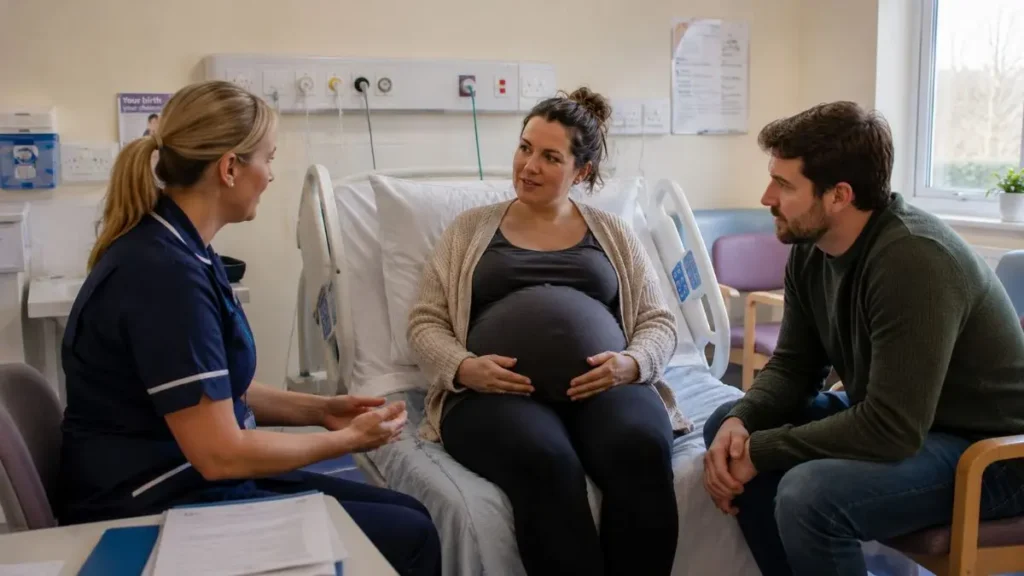
Labour can feel like one of those things everyone talks about, but nobody can promise exactly how it will unfold. There are recognised stages, and your midwife or maternity team will use those stages to guide your care, but real labour can still feel messy, stop-start, emotional and very individual.
This guide gives you a calm overview of what may happen during labour in the UK, from early contractions through to birth and the placenta stage, without pretending there is one neat script. It also helps to know when something can wait, and when it is better to call your maternity unit for advice.
Quick summary
During labour, your cervix opens, contractions usually become stronger and more regular, your baby moves down and is born, and then the placenta is delivered. In the UK, your midwife or maternity team will guide care based on how you and your baby are coping.
What that looks like can vary, but the broad pattern is usually something like this:
- Early labour can be irregular and may last hours or sometimes longer.
- Active labour is when contractions are usually stronger, longer and more regular.
- You should contact your maternity unit, midwife or triage line if you think labour is starting, your waters break, you are worried, or you have been told to call for a specific reason.
- During labour, your midwife may check how you and your baby are coping, including listening to your baby’s heartbeat and offering vaginal examinations.
- Pain relief can be discussed at different points, from breathing, movement and water through to gas and air, injections or an epidural.
- A birth pool can be a lovely option if available, but it is usually best treated as a preference rather than a guarantee.
- The birth partner’s role can be very practical, not just emotional.
- Labour can change direction depending on how you and your baby are doing, your baby’s position, your contractions, and your birth setting.
This article is for / not for
This article is for you if:
- You want a simple UK guide to what happens during labour.
- You are pregnant and want a calm overview rather than a detailed medical textbook.
- You are a birth partner trying to understand what support may actually look like.
- You want to know what can vary without reading something frightening or overwhelming.
This article is not for you if:
- You need urgent medical advice right now.
- You are trying to decide whether your symptoms mean labour has definitely started.
- You need a full guide to every pain relief option, intervention or complication.
- You have been given individual advice by your midwife, consultant or maternity unit that differs from general guidance.
Medical disclaimer
This article is general information for UK parents and birth partners. It cannot tell you whether you are in labour, diagnose a problem, or replace advice from your midwife, maternity unit, GP, NHS 111 or emergency services.
If you are worried, your waters break, you have bleeding, your baby’s movements reduce or change, you feel very unwell, you have severe pain, or something does not feel right, contact your maternity unit, midwife or maternity triage line straight away. If you think it is an emergency, call 999.

What happens during labour?
Labour is the process where your body works to open the cervix, move your baby down, birth your baby, and then deliver the placenta. In UK maternity care, it is usually described in three main stages, with early or latent labour coming before established labour.
That sounds tidy on paper, but real labour does not always feel tidy. Contractions may start and stop. You may feel unsure whether things are really happening. You may have a clear build-up, or you may feel as if everything has suddenly become more intense.
A helpful way to think about it is this: labour is less like following a timed schedule and more like watching a process gradually gather strength. Your maternity team will look at the whole picture, including your contractions, how you are coping, your baby’s wellbeing and any individual risk factors.
If you’re still getting organised before birth, our guide to Preparing for a baby: a practical UK checklist can help you sort the practical jobs before labour begins.
Early labour can feel unclear
Early labour is often called the latent phase. This is when your cervix starts to soften, thin and open. You may have contractions, but they can be irregular, spaced out, or change in strength.
This stage can be frustrating because it may not feel like “proper labour” yet, even though your body is doing useful work. Some parents can talk through contractions at first. Others need to stop, breathe or move around. You may also notice a show, backache, period-like cramps, pressure low down, or your waters breaking.
A show is a small amount of mucus, sometimes clear, pink, brown or streaked with blood, that comes away from the cervix as it begins to soften and open. During pregnancy, the cervix is sealed by a mucus plug, and a show is often part of that plug coming away. Having a show can be a sign that your body is preparing for labour, but it does not reliably predict when labour will start. Some people go into labour soon afterwards, while others may still be days away from active labour. A small blood-streaked show is usually normal, but heavier bleeding should always be reported to your maternity unit straight away.
If labour starts at night, you may be advised to rest if you can. If it starts during the day, gentle movement, food, drinks, a warm bath or shower, and distraction may help you get through the early part.
One thing worth knowing is that early labour can take time, especially with a first baby. That does not mean you are doing anything wrong. It is one of the reasons maternity units may suggest staying at home for a while if you and your baby are well and there are no concerns.
When should you call the maternity unit in labour?
Your local maternity unit should tell you when to call, and that advice matters most because it is based on your pregnancy and local services.
As a general guide, many parents are told to contact their maternity unit, midwife or triage line when contractions are becoming regular, stronger and closer together, or when they are lasting around a minute and coming every few minutes. Some services use a rough pattern such as contractions lasting about 60 seconds and coming around every 5 minutes, but local advice can vary.
If a birth partner makes the call, it can help for the mother in labour to be nearby if possible. The midwife may want to speak to them directly, hear how they are coping during contractions, or ask questions that are easier for them to answer. The partner can still do the practical talking, especially if the parent in labour needs to focus on breathing.
You should also contact your maternity unit or midwife if:
- your waters break
- you have bleeding that is more than a small show
- your baby’s movements reduce, change or worry you
- your contractions feel very intense or you are not coping at home
- you have severe pain that does not ease between contractions
- you feel unwell, faint, feverish or very worried
- you have been told to call earlier because of your pregnancy history
- labour may be starting before 37 weeks
It is better to call and be told everything sounds okay than sit at home worrying. Maternity triage teams are used to these calls. You are not wasting anyone’s time by asking for advice.
Active labour is when things usually become more intense
Active labour, also called established labour, is when contractions are usually stronger, longer and more regular, and your cervix is opening more. This is often the point where talking through contractions becomes harder and you may need to focus more on breathing, movement or support.
If you go into hospital, a midwife-led unit or another birth setting, the midwife will usually want to understand what has been happening so far. They may ask when contractions started, how often they are coming, whether your waters have broken, whether your baby has been moving normally, and how you are feeling.
You may also be offered an examination to check your cervix. Some parents want this information because it helps them understand where they are in labour. Others find examinations uncomfortable or emotionally difficult. If an examination is offered, you can ask why, what it involves, and what the result may change.
During active labour, you may be encouraged to change position, stay upright if it helps, rest when you can, drink fluids, use the toilet, and try different ways of coping. The aim is not to perform labour “properly”. The aim is to help you and your baby through it safely.
Transition can feel overwhelming
Near the end of the first stage of labour, some parents experience a short but very intense phase often called transition. This is when the cervix is getting close to fully dilated and labour may feel as if it suddenly ramps up.
Transition can feel disorienting. Some parents feel shaky, panicky, tearful, angry, restless or convinced they cannot carry on. Others have a quieter lull before pushing starts. If this happens, it does not mean you are failing. It can simply be part of labour moving towards birth.
This is often a moment where steady support matters. A birth partner might help by keeping their voice calm, reminding you to take one contraction at a time, offering sips of water, and listening carefully to the midwife’s guidance.
What checks and monitoring may happen?
During labour, your midwife will check how you and your baby are coping. This may be fairly light-touch if everything is straightforward, or more detailed if there are concerns or you have chosen certain pain relief.
Common checks may include your pulse, temperature and blood pressure. Your midwife may also feel your bump to understand your baby’s position and listen to your baby’s heartbeat during labour.
Sometimes electronic monitoring is suggested. This usually means sensors are placed on your bump to record your baby’s heartbeat and your contractions. It may be recommended if there are concerns, if your pregnancy has higher-risk factors, or if you have an epidural.
Monitoring can feel reassuring for some parents and restrictive for others, especially if it affects movement. If you are not sure why something is being suggested, it is reasonable to ask, “What are you checking for?” or “What happens if we do or do not do this?”
What pain relief might be offered during labour?
Pain relief in labour is not one decision you make once and stick to perfectly. You may have preferences in your birth plan, but your feelings can change when labour is actually happening.
Some parents start with breathing, movement, massage, water, a bath or shower, a TENS machine, or quiet support. Gas and air may be available in many birth settings and can be used during contractions. Some parents find it helpful; others dislike how it makes them feel.
If you like the idea of using water or a birth pool, it is worth treating it as a preference rather than a certainty. Even if your hospital or birth centre has pools, one may not be free when you arrive, it may take time to fill, and staff availability or your individual situation may affect whether it is suitable. That does not mean it is not worth asking for. It just helps to see it as a lovely option if everything lines up, not as something guaranteed.
In hospital, other options may include pain-relieving injections such as pethidine or diamorphine, depending on what your maternity unit offers. These injections are usually avoided if birth seems close, because they can make both parent and baby drowsy and may affect the baby’s breathing or first feed if given too close to delivery.
An epidural may be available on a labour ward and can give stronger pain relief, but it needs an anaesthetist and extra monitoring.
The main thing is that pain relief is not a test of strength. Needing more support does not mean you have failed. Wanting less intervention does not mean you are being difficult. Labour is intense, and the best option is the one that helps you cope safely in your situation.
The second stage is birth and pushing
The second stage starts when your cervix is fully dilated and ends when your baby is born. This is the stage many people think of as “pushing”, although the experience can vary.
You may feel a strong urge to push, sometimes described as pressure in your bottom or like needing to open your bowels. If you have an epidural, the urge may feel different or less obvious. Your midwife will guide you based on what is happening and how you and your baby are coping.
Sometimes people feel pressure or an urge to push before the cervix is fully dilated. This can be confusing, especially if your body seems to be telling you one thing and your midwife is asking you not to push yet. If that happens, your midwife may guide you to breathe through contractions, change position, or wait until pushing is safer.
Positions can vary too. Some parents give birth lying on their side, kneeling, standing, squatting, sitting or using a birth stool. The “right” position may simply be the one that feels possible in the moment and works with the care you need.
This stage can feel powerful, overwhelming, focused or exhausting. Your midwife may guide your breathing and pushing, especially as your baby’s head is being born. Sometimes they may ask you to slow down, pant or take shorter breaths to help your baby be born gently.
The third stage is the placenta
After your baby is born, labour is not quite finished. The third stage is when your womb contracts again and the placenta comes out.
There are usually two ways this stage may be managed. Active management means you are given medicine to help your womb contract and deliver the placenta more quickly. In practice, this usually means a quick injection into your thigh as your baby is being born or shortly afterwards. It can sound sudden if you are not expecting it, but for many births it is a routine part of managing the placenta stage.
Physiological management means the placenta is delivered without that medicine, if it is suitable for you.
Your midwife should explain the options, either before birth or during labour, so you can understand what is being suggested. In some situations, active management may be recommended because of bleeding risk or other clinical reasons.
This stage can feel strange because the baby has arrived, but your body is still working. You may be holding your baby, having skin-to-skin, being checked, or being helped with feeding while the placenta stage is managed.
What your birth partner can actually do
A birth partner does not need to know everything. They do need to be calm enough to listen, help and speak up when needed.
Useful birth partner support can be very practical. They might time contractions, keep track of what the midwife says, offer drinks, help you change position, hold a fan, remind you to breathe, pass you gas and air, or help keep the room calm.
They can also help protect your preferences. For example, if you wanted dim lighting, fewer people in the room where possible, or time to ask questions, they can gently remind staff. This does not mean arguing with the maternity team. It means helping you stay involved when labour makes it hard to think clearly.
A good phrase for a birth partner is: “Can we have a moment to understand the options?” Another useful one is: “Can you explain what you recommend and why?”
Those small questions can help slow the moment down enough for the parent giving birth to feel more included.
What can vary during labour?
Labour varies a lot, and that is one of the hardest parts to prepare for. You can understand the stages and still not know exactly how your birth will unfold.
Early labour may be short, long, stop-start or tiring. Active labour may build gradually or suddenly feel intense. First labours are often longer than later labours, but there are exceptions.
Other things can also affect what happens, including:
- your baby’s position
- how strong and regular contractions are
- whether your waters have broken
- whether you are at home, in a midwife-led unit or on a labour ward
- whether a birth pool is available and suitable
- whether you choose or need certain pain relief
- whether there are concerns about you or your baby
- whether labour slows down or needs extra help
This is why a birth plan is best thought of as preferences, not a contract. It can still be useful, but it needs space for real life.
What may happen straight after birth?
Straight after birth, you may be offered skin-to-skin with your baby if you are both well. Your midwife may check you, monitor bleeding, help with the placenta stage and support your feeding choice.
Some babies cry straight away, while others need a little help or stimulation. Some parents feel an instant rush of emotion. Others feel shocked, quiet, shaky or simply exhausted. There is not one correct emotional response.
Your maternity team may also check whether you need stitches, help you get cleaned up, support a first feed if you want that, and keep monitoring how you and your baby are doing.
It can be a lot to take in. This is another place where a birth partner can help by listening, asking questions and remembering what has been said.
More help for getting ready before labour starts
If you want to make labour feel a little less unknown, these guides can help with the practical decisions and preparation around it. Each one goes a bit deeper into a different part of getting ready, so you do not have to hold everything in your head at once:
- Birth plan UK: what to include and what can change: useful if you want to think through your preferences for labour and birth in a realistic way, while still leaving room for things to change on the day.
- Hospital bag checklist UK: what to pack for birth: helpful if packing still feels a bit vague and you want a calmer sense of what is genuinely useful to have ready before labour begins.
- Antenatal appointments UK: what to expect before birth: useful if you want to understand the checks, conversations and questions that often come up before labour, and how those appointments help you prepare.
Helpful UK sources to check
For medical information around labour and birth, it is worth using trusted UK sources rather than relying only on personal stories or social media.
- NHS: The stages of labour and birth: explains the stages of labour, monitoring, birth and the placenta stage.
- NHS: Signs that labour has begun: helpful if you are trying to understand early labour signs and when to contact someone.
- NHS: Pain relief in labour: useful if you want more detail on the pain relief options that may be available during labour.
What to take away
Labour has recognised stages, but it is not a script you have to follow perfectly. Early labour can be unclear, active labour can become intense, transition can feel overwhelming, pushing can feel very physical, and the placenta stage still needs care after your baby is born.
The most useful preparation is not memorising every possible detail. It is knowing the broad shape of labour, knowing when to call your maternity unit, understanding that your choices can be discussed, and having support around you if possible.
If something worries you, call your maternity unit or midwife. You do not need to wait until you are certain. In labour, getting advice early is often the calmest next step.
FAQ
What are the stages of labour?
Labour is usually described in three main stages. The first stage is when your cervix opens, including early or latent labour, active labour and sometimes a short intense phase called transition. The second stage is from full dilation to the birth of your baby. The third stage is when the placenta is delivered.
What are the first signs of labour?
Early labour signs can include irregular contractions, backache, period-like cramps, pressure low down, a show, or your waters breaking. These signs do not always mean birth is about to happen quickly, so follow your maternity unit’s advice if you are unsure.
When should you call the maternity unit?
Call your maternity unit, midwife or triage line if you think labour has started and you are unsure what to do, your contractions are becoming regular and strong, your waters break, you have bleeding, your baby’s movements reduce or change, or you feel worried or unwell. Follow any individual advice you have been given during pregnancy.
What checks happen during labour?
Your midwife may check your blood pressure, pulse, temperature, contractions and your baby’s heartbeat. You may be offered vaginal examinations to check progress. Electronic monitoring may be suggested if there are concerns, if your pregnancy needs closer monitoring, or if you have certain pain relief such as an epidural.
Does labour always get stronger steadily?
Not always. Labour can build gradually, but it can also slow down, speed up, or feel stop-start, especially in early labour. Your maternity team will look at the whole picture rather than one contraction pattern on its own.
What does a birth partner do during labour?
A birth partner can offer comfort, help you move, time contractions, offer drinks, remind you of your preferences, ask questions, and help keep the room calm. If they make the call to maternity triage, it can help to have the birthing parent nearby in case the midwife wants to speak to them or hear how they are coping.