
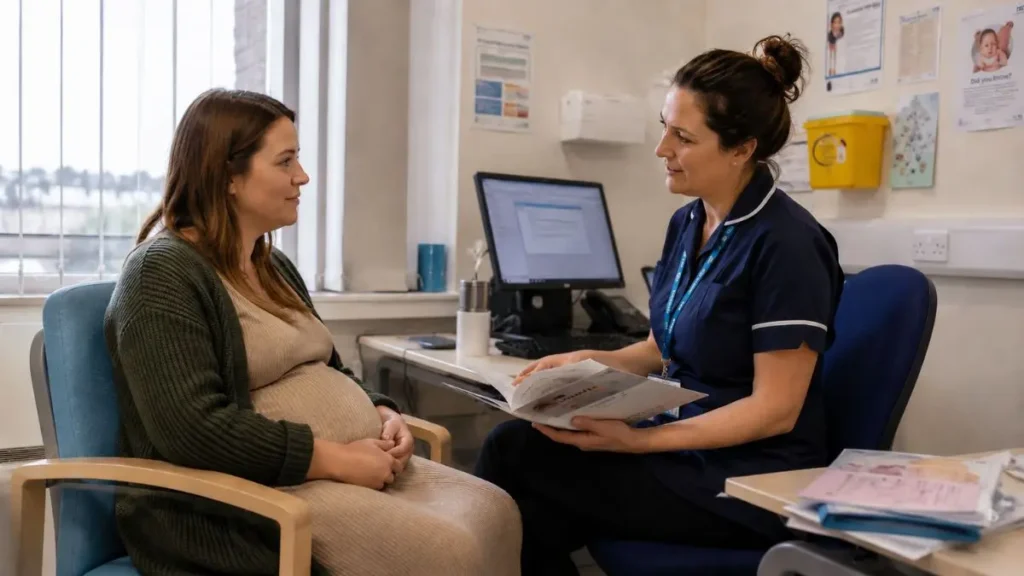
Antenatal appointments can feel a bit mysterious before you have had them, especially if this is your first pregnancy or you are feeling nervous about what you will be asked. They can sound very clinical from NHS schedules and hospital pages, but in real life they are not just about tests and tick boxes. They are also a chance to ask questions, raise worries and understand what is happening as your pregnancy moves on.
Quick summary
Antenatal appointments usually include routine checks, time to raise concerns, and chances to talk through what happens next. They are there to help you keep track of your health, your baby and the questions that come up as things progress. In simple terms, they usually help with these things:
- Checking your health and your baby’s wellbeing during pregnancy.
- Talking through symptoms, worries or changes that matter.
- Offering scans, screening and routine checks at the right times.
- Giving you space to ask about baby movements, birth preferences, feeding or mental health.
- Helping you know who to contact if something does not feel right between appointments.
- Preparing you gradually for labour, birth and the first days with your baby.
This article is for / not for
This article is for you if:
- You are pregnant and want a simple UK guide to antenatal appointments.
- You are unsure what usually happens at appointments or what they are for.
- You want to know what you can ask your midwife.
- You want a calmer explanation than a week-by-week timetable.
This article is not for you if:
- You need urgent medical advice about your pregnancy right now.
- You are looking for detailed screening or scan information only.
- You want a trust-specific appointment schedule for one local hospital.
Medical disclaimer
This article is general information about NHS antenatal care in the UK. It is not medical advice and does not replace guidance from your midwife, maternity unit, GP or hospital team.
If you are worried about pain, bleeding, reduced or changed baby movements, severe headache, visual changes, swelling, waters breaking or anything that feels wrong, contact your maternity unit, midwife or NHS 111 for advice. If you think it is an emergency, call 999.

What are antenatal appointments for?
Antenatal appointments are the regular pregnancy appointments offered through NHS maternity care. They are there to keep an eye on your health, your baby’s wellbeing and anything that may need extra support as your pregnancy progresses.
That is the formal answer, but for most parents the more useful answer is this: antenatal appointments are where you get the chance to check in properly. Yes, there may be routine things like blood pressure, urine checks, screening, scans or measuring the bump at certain stages. But they are also a place to say, “I’m not sure if this is normal,” “I keep forgetting to ask this,” or “Can someone explain what happens next?”
If you want the wider preparation picture as well as appointment support, Preparing for a baby: a practical UK checklist gives a broader overview of what to sort before birth.
How do you start NHS antenatal care?
In the UK, you can usually refer yourself to maternity services once you know you are pregnant. The NHS says it is best to do this as early as possible, ideally before 10 weeks, so care and screening options can be offered at the right time.
How you do this varies by area. Some NHS trusts have an online self-referral form, while others may ask you to contact your GP first. Once you are booked in, you will usually be told about your first appointment, often called the booking appointment.
If you feel late to it, try not to panic. It is still worth contacting maternity services as soon as you can rather than waiting because you feel behind.
How many antenatal appointments are you usually offered in the UK?
The NHS says first-time parents are usually offered around 10 antenatal appointments, including scans. If you have had a baby before, it is usually around 7. Some people are offered more appointments if they need extra monitoring, have health conditions, are carrying more than one baby, or if something comes up that needs a closer look.
So there is a usual pattern, but not every pregnancy follows exactly the same schedule. That can be reassuring if your appointments seem to differ slightly from what you have read online.
Rather than thinking of it as a fixed timetable to memorise, it is more useful to think of antenatal care as regular points where your care team checks how things are going and talks through what comes next.
What happens at your first midwife appointment?
The first appointment is usually the longest one, and it can feel more personal than people expect. It is often called the booking appointment, and it is where the midwife starts building a picture of your health, your pregnancy and the support you may need.
Partners or support people are often welcome at appointments too, and it can help to have another pair of ears there, especially at the booking appointment when a lot of information comes up. If you are unsure, it is worth checking your local maternity service guidance first.
You may be asked about your medical history, any previous pregnancies, your mental health, medication, family history, smoking, alcohol, home life, support at home and other parts of your life that can feel quite personal. Tommy’s explains this well: these questions are not there to catch you out. They help the midwife understand if you need extra support, extra monitoring, or information that is more tailored to you.
This appointment may also cover:
- Your due date and basic pregnancy details.
- Blood tests and urine checks.
- Screening choices and what they are for.
- Your maternity notes.
- How your local maternity care works.
- Who to contact if you are worried.
A lot of parents come away from this appointment thinking, “That was much more detailed than I expected.” That is normal. It is the appointment that sets up the rest of your care.
What happens at antenatal appointments after that?
Later appointments are usually shorter, but they still matter. They often include routine checks such as blood pressure and urine testing, and later in pregnancy your midwife may measure your bump, ask about baby movements, talk about your baby’s position and ask how you are feeling. Partners or support people are often welcome at these appointments too, and it can be helpful to have someone else there to remember details or ask the question you were about to forget.
Some appointments are more focused on specific parts of pregnancy, such as scans, screening results, blood test follow-up, birth preferences or what to expect later on. Others may feel quite quick and routine. Even then, they are still your opportunity to ask things you have been meaning to ask.
A useful way to think about them is that each one gives you a chance to check three things: how you are, how the baby seems to be doing, and what you need to know before the next stage.
You may not see the same midwife every time, and that is completely normal in the NHS. Your notes help each person looking after you see what has already happened and what needs following up.
What routine checks might be done?
The exact checks can vary depending on the stage of pregnancy and your own care, but routine antenatal appointments often include blood pressure and urine checks. One very practical thing to expect is that urine samples are often part of routine appointments. It helps to keep the sample pot you were given somewhere easy to find and not turn up with a completely empty bladder. Later on, your midwife may also measure your bump and ask about baby movements.
Scans and screening are part of antenatal care too, but they tend to happen at specific points rather than at every appointment. It helps to know they are part of the overall picture, even if they are not the main focus of most routine check-ins.
Your maternity notes matter here. Some trusts use paper notes, some use digital notes, and some use both. However your area does it, it is worth knowing where your notes are, bringing what you have been asked to bring, and keeping questions written down so you do not lose them between appointments.
Why do midwives ask such personal questions?
This is one of the parts that can catch people off guard. Questions about mental health, anxiety, depression, previous trauma, support at home, domestic abuse or other personal issues can feel intrusive if nobody explains why they are being asked.
The reason is care planning, not judgement. Midwives are trying to understand whether there is anything that could affect your wellbeing, your safety, your support needs or the kind of care that would help you most during pregnancy and birth.
If something feels unclear, you are allowed to ask why a question is being asked. You are also allowed to say that something is hard to talk about. The appointment should feel like support, not an interrogation.
What questions can you ask your midwife?
Even very ordinary questions are worth asking, especially if they have been sitting in your head between appointments.
A lot of parents worry that they will forget everything the moment the appointment starts. That is why it helps to keep a note on your phone and add questions as they come to you.
Useful questions often include:
- Is this symptom normal, or should I contact someone sooner next time?
- Who do I call if I am worried between appointments?
- What should I know about baby movements at this stage?
- What happens if I go past my due date?
- When do I start talking about birth preferences?
- What feeding support is available after birth?
- What should I bring to future appointments?
- Is there anything specific I should be doing before the next appointment?
You do not need to ask clever questions. Simple, practical ones are usually the most useful.
What should you bring or prepare before an appointment?
You do not need a big folder or perfect prep, but a few small habits can make appointments much more useful.
It helps to bring or have ready:
- Your maternity notes, if your trust uses them.
- A phone note or small list of questions.
- Any letters, appointment details or information you have been asked to bring.
- A quick note of symptoms or concerns you want to mention.
Before you leave the appointment, it can help to check that you know what happens next. That might mean your next appointment date, what results you are waiting for, what to do if something changes, or who to contact if you are worried.
When should you not wait for the next appointment?
This is one of the most important parts to understand. Antenatal appointments are useful check-in points, but they are not the only time you are allowed to raise concerns.
Do not wait for the next routine appointment if you have pain, bleeding, reduced or changed baby movements, severe headache, visual changes, swelling that worries you, waters breaking, or anything else that feels wrong or significantly different.
A lot of parents worry about bothering someone or overreacting. But maternity teams would rather you got checked than sat at home worrying. One of the best questions to ask at an appointment is simply, “Who do I contact if I am worried between now and next time?”
How antenatal appointments help you prepare for birth
Appointments are not just about getting through pregnancy week by week. They also help you prepare for labour, birth and the first days afterwards.
As pregnancy goes on, conversations often move towards birth preferences, baby movements, when to contact the maternity unit, feeding plans, mental health, support at home and what to expect later in pregnancy. That is why it helps to treat appointments as part of preparation, not just monitoring.
More help for the weeks before birth
If you want a bit more detail after this, these guides can help depending on what feels most useful next. They each go a bit deeper into a different part of late pregnancy and birth preparation without repeating the same information.
- Third trimester checklist: what to do before baby arrives: useful if you are trying to focus on the practical jobs that matter most in the final weeks and want a calmer sense of what to sort now versus what can wait.
- Birth plan UK: what to include and what can change: helpful if you want to think through your preferences for labour and birth in a realistic way, without feeling you need to write a perfect plan.
- What happens during labour: a simple UK guide: a good next read if you want a clearer idea of what labour may look like, what can vary, and how it all tends to fit together.
For further trusted UK guidance, these are useful to keep handy:
- NHS: Your antenatal care and appointments: helpful if you want the more detailed NHS appointment-by-appointment view as well as the calmer overview in this article.
- Tommy’s: Your First Midwife (Booking) Appointment: especially helpful if you are nervous about the first appointment and why personal questions may come up.
What matters most about antenatal appointments
The most useful way to think about antenatal appointments is that they are there for you as well as for the routine checks.
They are not just about tests, measurements or ticking off the next stage. They are also a chance to say what you are worried about, ask what happens next, and make sure you know who to contact between appointments.
You do not need to arrive perfectly prepared. A short list of questions, your notes, and the confidence to mention something that feels small are often enough to make the appointment far more useful.
FAQ
What happens at antenatal appointments?
Most antenatal appointments involve routine checks, such as blood pressure or urine testing, plus time to talk about symptoms, baby movements, questions and what comes next in your care.
How many antenatal appointments do you have in the UK?
The NHS says first-time parents are usually offered around 10 appointments, including scans. Parents who have had a baby before are usually offered around 7, although some people are offered more depending on their pregnancy and health.
What happens at your first midwife appointment?
The first appointment, often called the booking appointment, is usually the longest. It often includes questions about your health, pregnancy, mental wellbeing, support at home, screening choices and what care you may need.
What should I ask my midwife?
You can ask about symptoms, baby movements, birth preferences, feeding support, who to contact between appointments and what to expect before the next visit. Simple questions are completely fine.
When should I call maternity services between appointments?
Do not wait for your next routine appointment if you have pain, bleeding, reduced or changed baby movements, severe headache, visual changes, swelling that worries you, waters breaking, or anything that feels significantly different. If you are worried, contact your maternity unit, midwife or NHS 111 for advice.