
Choosing a baby name can feel lovely, exciting, awkward and oddly high-pressure all at once. You might have one name you keep coming back to, a long list that keeps growing, or two parents who cannot agree on anything. This guide is here to help you slow the decision down, check the practical things, and choose a name that feels right enough for your family.
Quick summary
A practical approach is to shortlist names you genuinely like, then test them in real life by saying them aloud, checking initials, nicknames, surname fit and whether they still feel right after a few days.
A good way to choose a baby name is to move from “What names do we like?” to “Which names would work well in real life?” That usually means testing the name properly before you decide:
- Start with a loose longlist rather than trying to pick the final name straight away.
- Say the full name aloud with the surname and any middle names you are considering.
- Check initials, possible nicknames, and whether the name is easy enough to spell and pronounce.
- Think about whether popularity matters to you, using UK baby name data if helpful.
- Decide how much family opinion you want before you share your shortlist.
- Try living with each shortlist name for a few days before making a final decision.
This article is for / not for
This article is for you if:
- You are pregnant and trying to choose your baby’s name before birth.
- You feel overwhelmed by too many baby name ideas.
- You and your partner like different names.
- You want a practical way to narrow down a shortlist.
- You want to think about surname fit, initials, nicknames, family pressure and popularity.
This article is not really for you if:
- You only want a long list of baby name ideas.
- You have already chosen a name and feel completely settled.
- You are looking for legal advice about changing a child’s name after registration.
If you want name ideas first, our Baby boy names and Baby girl names guides may be a better place to start before coming back to this one.
Start with names you actually like
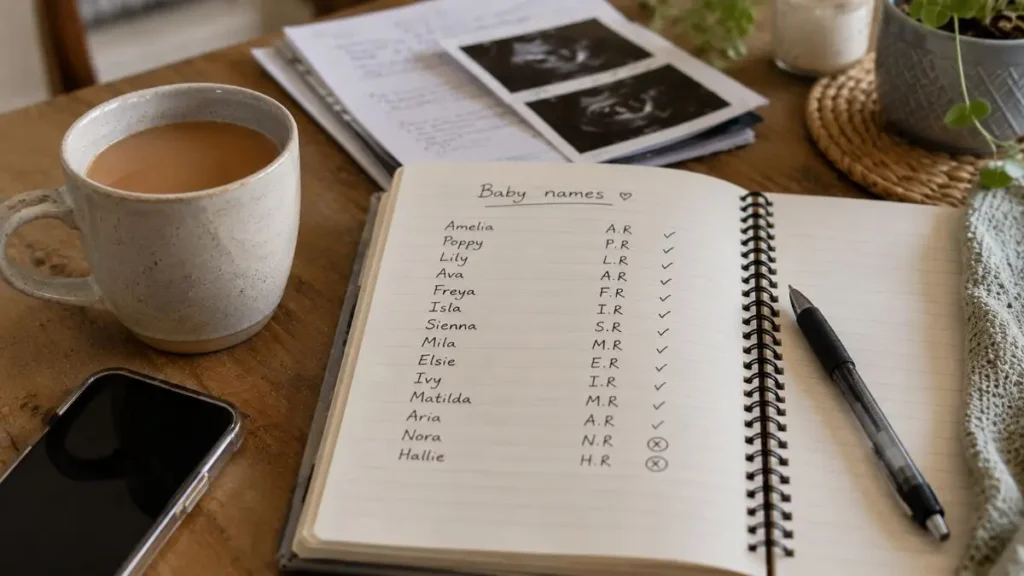
The easiest place to start is not with the “perfect” name. It is with names that make you pause and think, “I quite like that.”
At this stage, try not to judge every name too quickly. You are not signing the birth certificate yet. You are just collecting possibilities.
You might get names from family names, names you have heard in real life, books, films or music, baby name lists, names from your culture, background or faith, names that have a meaning you like, or names that simply sound nice to you.
It can help to keep a shared note on your phone, especially if ideas come to you at random times. One parent might think of a name while watching TV, another might hear one at work, and another might remember a name from school that they had forgotten about.
If you feel stuck, AI tools can be useful for generating baby name ideas and spotting things you may not have thought about, such as awkward initials, likely nicknames or patterns in the names you both keep choosing. They are usually better as a brainstorming and checking tool than as the thing that makes the final decision.
Make a shortlist before trying to choose
A common mistake is trying to go from a huge list to one final name too quickly. That can make every name feel wrong.
A calmer way is to narrow the list in stages. First, remove the names that are definite no choices. Then mark the names you would genuinely consider. After that, try to get down to a shortlist of around three to five names.
You do not need a complicated scoring system, but you can ask a few simple questions:
- Do we both like it enough to keep it on the list?
- Does either parent strongly dislike it?
- Does it work with our surname?
- Can we imagine saying it every day?
- Would it still feel suitable for a child, a teenager and an adult?
That last question is useful because some names feel adorable for a baby, but less natural when you imagine them applying for a job, introducing themselves as an adult, or being called across a school playground.
That does not mean you need a serious or traditional name. It just means the name needs to feel wearable beyond the newborn stage.
Say the full name out loud
A name can look lovely written down but feel different when you say it with the surname.
If you already have children, it also helps to say the new name alongside their names. This can quickly show whether the names feel easy to say together in real life, or whether you are drifting into a pattern you do not actually care about.
Try saying the full name aloud in normal everyday sentences. This sounds slightly silly, but it can quickly show whether a name flows naturally.
For example:
- “This is Emily Carter.”
- “Can Leo Thompson come to reception, please?”
- “We need to book an appointment for Maya Patel.”
- “Oscar James Williams, have you got your shoes?”
You are listening for rhythm, repeated sounds, awkward joins and whether the first name and surname run into each other.
Some names sound great on their own, but become a bit clunky with a surname. Others become stronger once the full name is spoken aloud.
This is also where middle names matter. A middle name can balance a shorter first name, soften a stronger surname, or include a family name without making it the everyday name.
Check initials and possible nicknames
Initials are easy to miss because most people focus on the first name. It is worth writing the full initials down before you decide.
You do not need to overthink every possible combination, but check for anything obvious that might bother you later. Think about the first name, middle name and surname together.
It is also worth thinking about how long the full legal name becomes once everything is added together. Friends of ours gave their son three quite long middle names and tried to be clever by making all five initials spell his first name. It felt fun at the time, but they later admitted it became a hassle on forms and official documents because the full name was long, awkward and did not always fit neatly on forms.
Nicknames are a bit different. You can choose a name hoping everyone will use the full version, but children, friends and family often shorten names naturally.
If you love Alexander but dislike Alex, or you like Isabelle but really do not want Izzy, it is worth thinking about that before you choose. You may still decide the full name is worth it, but at least you are choosing with your eyes open.
It also helps to think about affectionate names at home. Some families barely use nicknames. Others use them constantly. There is no right answer, just what feels natural for you.
Think about meaning, but do not let it take over
Name meanings can be lovely. A meaning might connect to strength, hope, nature, faith, family history or something personal to you.
The meaning can help a name feel more special, especially if you are choosing between two names you like equally.
At the same time, the meaning does not have to carry the whole decision. Most people your child meets will respond to the sound of the name, the spelling, the person behind it and the familiarity of hearing it.
A name with a beautiful meaning can still feel wrong if it is hard to say with your surname. A name with a simple meaning can still be the right one if it feels warm, usable and connected to your family.
A useful balance is this: let meaning support the decision, but do not let it push you into choosing a name you do not actually enjoy saying.
Should you choose a popular or unusual baby name?
Some parents love popular names because they feel familiar, easy to spell and unlikely to surprise people. Other parents prefer unusual names because they want something more distinctive.
Neither choice is automatically better.
A popular name may mean your child shares their name with another child in nursery or school. That bothers some parents and does not bother others. Many popular names are popular for a reason: they are easy to say, suit different ages and feel widely liked.
An unusual name can feel more personal, but it may also mean more spelling, explaining or correcting. Some children enjoy having a distinctive name. Others may prefer something that blends in more.
If popularity matters to you, official baby name data can help you check whether a name is rising, falling or sitting in the top 100.
It can also help to notice whether a name feels steadily popular or suddenly very trendy. Some names stay well liked for years, while others rise quickly and can end up feeling more tied to a particular moment. That may not bother you at all, but it is worth knowing if you want a name that feels less time-specific.
The key is to decide how much this matters to your family. A name being popular is not a problem by itself. A name being unusual is not a problem by itself. The question is whether you still like the name when you understand how it may feel in everyday life.
Think about baby name spelling and pronunciation
Spelling can be a small detail or a big one, depending on the name.
Some parents prefer the most common spelling because it is easier for forms, school, doctors, relatives and everyday life. Other parents choose a less common spelling because it reflects culture, family background, language, or simply what looks right to them.
The practical check is not “Will everyone get this right first time?” because plenty of good names are sometimes misspelt or mispronounced.
A better check is:
- Are we comfortable correcting people?
- Will close family be able to say it?
- Does the spelling feel manageable for everyday use?
- Does the spelling change the way people are likely to pronounce it?
- Does this spelling matter to us enough to keep it?
This matters even more if your family uses more than one language, has cultural naming traditions, or wants a name that works across different backgrounds.
A name can still be the right choice even if people sometimes ask how to say it. The question is whether that feels acceptable to you, rather than something you will resent.
It is also worth thinking about how the full name will work on forms, labels and everyday admin. Very long combinations can be slightly more awkward on school labels, name stamps and passports, which may or may not matter to you.
Decide how much family opinion you want
Family opinions can make baby names harder than they need to be.
Some relatives will love being involved. Some will have strong views. Some will accidentally put you off a name by making a face or mentioning someone they once knew with that name.
Before sharing your shortlist, it helps to decide what you actually want from people. You might want no opinions until after the baby is born, opinions only from one or two trusted people, help choosing between two names, family background on older names, or simple reassurance about spelling or pronunciation.
If you do share names before birth, try to be clear that you are not running a public vote. A simple line such as “We are not fully decided yet, but these are the names we are thinking about” can keep the conversation calmer.
If someone dislikes your favourite name, that does not mean you have to drop it. Other people are allowed reactions, but they do not need to approve the name for it to be right for your baby.
Should you share the name before birth?
There is no rule here. Some parents love sharing the name early because it makes the baby feel more real. Others prefer to wait because they do not want comments while they are still deciding.
Sharing before birth can be useful if you want to check pronunciation with family, if the name has cultural or family meaning, if you want to hear how it sounds when other people say it, or if you feel comfortable hearing opinions. Waiting can be useful if you know relatives will be critical, if you are still unsure, if you want to keep something private, or if you think negative comments would knock your confidence.
People often react more gently once a baby is here and the name belongs to a real child. A name on a shortlist can invite debate. A name attached to a newborn often feels more settled.
Try the name in everyday life
One of the most useful checks is to live with the shortlist for a few days.
You do not need to announce it. Just try the names privately in normal situations. Say them while making tea, writing them down, adding them to a pretend birthday card or imagining calling the name upstairs.
You can also test the name in different tones:
- softly, as a newborn name
- normally, as an everyday family name
- clearly, as a school or appointment name
- warmly, as a name for an older child
- formally, as a full adult name
This is where some names start to feel more real, while others quietly fade from the list.
If a name keeps coming back to you, that is worth noticing. Sometimes choosing a name is less about a sudden magical feeling and more about the name still feeling good after you have tested it properly.
Before you settle it, it can also be worth doing a quick online search of the full name. You are not trying to eliminate every possible match, just checking that it is not strongly tied to a very famous person, brand or reference that would bother you later. AI can also be useful here as a quick second check for things you may not have thought about, such as obvious associations, nickname risks or awkward initials.
What if you and your partner cannot agree?
Disagreeing on a baby name is very common. Names are personal, and each parent may have different memories, associations and preferences.
A fair starting point is that both parents get veto power over names they strongly dislike. That avoids one parent feeling forced into a name that never felt right.
Then try making separate lists. Each parent chooses around ten names they could genuinely consider. Swap lists and mark:
- names you like
- names you could live with
- names you do not want to use
You may find overlap straight away. If not, look for patterns rather than exact matches. One parent might like short names. The other might like traditional names. One might prefer soft sounds, while the other likes names that feel strong or familiar.
Once you can spot the pattern, it becomes easier to search for names that sit between both tastes.
If you are really stuck, choose a temporary shortlist and stop discussing it for a few days. Over-talking names can make every option feel tired. A short break can make the stronger names stand out again.
When do you need to decide on your baby’s name?
You do not usually need to have the final name chosen before your baby is born.
Many parents do decide during pregnancy, but some wait until they have met their baby. That can be completely understandable, especially if you have two or three names you like and want to see what feels right.
For UK context, births in England, Wales and Northern Ireland must usually be registered within 42 days of the child being born. In Scotland, births are usually registered within 21 days.
That gives you some time after birth, although it may not feel like much when you are tired and adjusting to a newborn.
A practical aim is to have a shortlist before birth rather than forcing a final decision too early. That way, you are not starting from scratch when the baby arrives, but you still have room to choose the name that feels right.
If baby names are only one part of your wider prep, Preparing for a baby: a practical UK checklist can help you keep the bigger picture organised without turning everything into one huge list.
More help for getting ready before baby arrives
If choosing a name is one part of your wider baby prep, these guides may help you feel a bit more organised:
- What you actually need for a newborn: useful if baby prep is starting to feel expensive or overwhelming, and you want to separate genuine newborn essentials from nice-to-have extras.
- Third trimester checklist UK: what to sort before birth: helpful if you want a calmer way to organise the final weeks before birth, including practical jobs that are easy to forget.
Useful UK sources for checking names
These official UK sources can help if you want to check how popular a name is where you live before you decide:
- Office for National Statistics: Baby names in England and Wales: 2024: useful for checking how popular a name is in England and Wales, including rankings and trends.
- National Records of Scotland: Babies’ First Names, 2025: useful for checking baby name data in Scotland.
- Northern Ireland Statistics and Research Agency: Baby Names 2025: useful for checking baby name data in Northern Ireland.
What matters most
The best baby name is not always the most original, the most meaningful or the one everyone else likes.
It is the name that feels right enough for your family, works with your surname, feels usable in everyday life and still sits well after you have tested it properly.
If you are stuck, aim for a shortlist rather than a final answer today. Remove the definite no names, say the stronger names aloud, check the practical details and give yourself a little time to see which one keeps feeling right.
FAQ
How do I choose a baby name?
Start with a longlist of names you like, then narrow it down by checking surname fit, initials, nicknames, spelling, pronunciation, popularity and how the name feels when said aloud. Try to get to a shortlist before choosing one final name.
Should we choose a baby name before birth?
You can, but you do not have to. Some parents like deciding before birth because it feels settled. Others prefer to meet their baby first. A practical middle ground is to have a shortlist ready before the baby arrives.
What should we do if we cannot agree on a baby name?
Each parent can make a separate list of names they would genuinely consider. Compare the lists, remove names either parent strongly dislikes, and look for patterns in the names you both like. If discussion becomes stressful, leave the shortlist for a few days and come back to it.
Should we tell family the baby name before birth?
Only if you want to. Sharing the name before birth can be lovely, but it can also invite opinions. If you think criticism would make the decision harder, it is fine to wait until after your baby is born.
Is it better to choose a popular or unusual baby name?
Neither is automatically better. Popular names can feel familiar and easy to use. Unusual names can feel more distinctive and personal. The better question is whether the name feels right for your child and your family when you imagine using it every day.
How can I check if a baby name is popular in the UK?
For England and Wales, you can check the Office for National Statistics baby names data. It shows rankings and trends based on birth registration data. Scotland and Northern Ireland publish their own baby name data separately.
Should I say the baby name with the surname out loud?
Yes, it is one of the easiest ways to spot awkward rhythm, repeated sounds or names that look better on paper than they sound in real life. Saying the full name in ordinary sentences can make strong options stand out much more quickly.