

AI bedtime stories sound like one of those ideas that could either save the evening or make it a bit worse. If you are tired, trying to get everyone settled and wondering whether a personalised story on a screen is a clever backup or just one more thing creeping into bedtime, that is a fair question. The useful answer is not all for or all against. It depends how the story is being used, how often, and whether it is supporting connection or quietly replacing it.
Quick summary
AI bedtime stories can be a fun occasional tool, but they work best when they support bedtime connection rather than taking over from it.
If you want the short version before bedtime becomes a bigger debate, it is this:
- AI bedtime stories for kids can be useful as an occasional backup, a creative prompt or a way to personalise a story around your child’s interests.
- They tend to work best when a parent stays part of the experience, rather than handing the whole bedtime story role over to a device.
- The main risk is not that every AI story is harmful. It is that convenience can slowly crowd out routine, closeness and the calmer rhythm many children need at night.
- Younger children usually benefit more from co-created or parent-led use than from listening to AI stories alone.
- A sensible middle ground is to use AI for ideas, customisation or the odd tired-night shortcut, while keeping real reading together as the main routine.
This article is for / not for
This article is for:
- Parents wondering whether AI bedtime stories are a harmless helper or something that could become an unhelpful habit
- Families who like the creativity angle but do not want bedtime to become more screen-led or less connected
- Parents looking for a balanced verdict rather than a hype piece or a blanket warning
- Adults who want practical ways to use AI stories without stepping out of the bedtime role completely
This article is not for:
- Parents looking for a product review of one specific AI story app or tool
- Families wanting a broader guide to all children’s screen time issues
- Anyone looking for sleep-training advice or medical sleep guidance
- Parents wanting AI to take over bedtime rather than support it occasionally
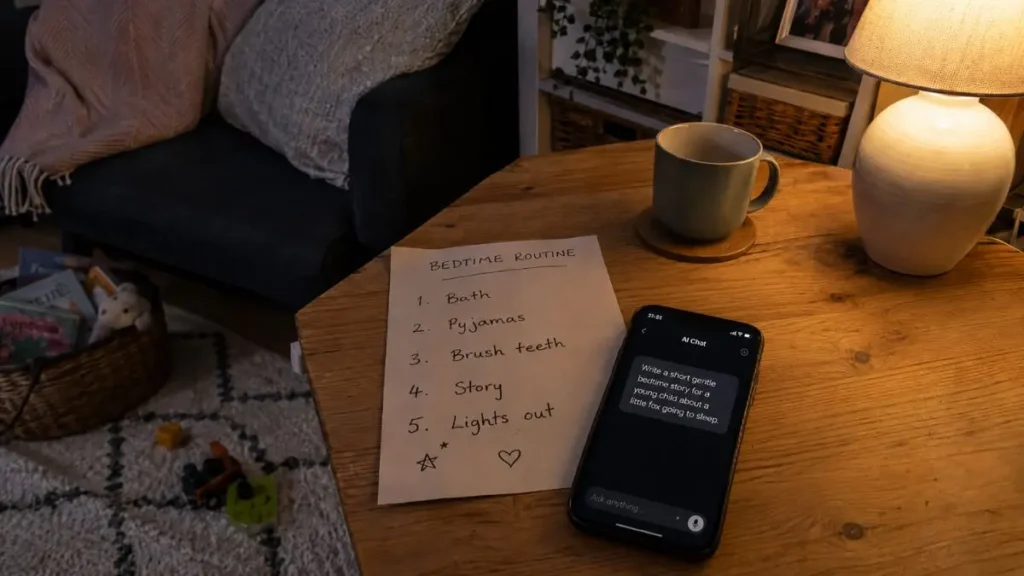
Are AI bedtime stories good for kids?
Sometimes they can be. Sometimes they are a bit too easy.
That is really the tension underneath this whole topic. On one hand, AI can create a bedtime story in seconds about dragons, diggers, unicorns, football, mermaids or whatever your child is currently obsessed with. On the other, bedtime is not only about having a story appear. For a lot of children, it is also about familiarity, rhythm, closeness and the feeling of being with you at the end of the day.
So the question is not only whether the story itself is good. It is whether the way you are using it is helping bedtime feel calmer and more connected, or more distracted and remote.
Used occasionally, AI bedtime stories can be a creative extra. Used heavily, they can start nudging bedtime away from a shared routine and towards passive listening or one more digital shortcut.
If you want the wider picture of where AI fits into everyday family life, AI for parents: practical ways to use AI in everyday family life gives that broader overview.
How can AI help with bedtime stories without taking over?
The best use is usually to treat AI as a helper behind the scenes, not the star of bedtime.
That might mean asking it to generate a quick story idea about a child who loves dinosaurs but is nervous about swimming lessons. It might mean getting three new story openings when you are too tired to think of one yourself. It could mean asking for a calming five-minute story about a sleepy fox, then reading it in your own voice. You can also guide the tone quite clearly, for example by asking for a slow-paced, calm, five-minute bedtime story with no loud surprises, no scary twists and a gentle ending.
That version is very different from handing a device to a child and letting the tool deliver the whole bedtime experience by itself.
Using AI to shape the story
In practical terms, AI can help by giving you a fresh story idea when your brain feels empty, personalising a story around your child’s current interests, simplifying the language for a younger child, helping you create a gentler story about a worry, a change or a new situation, or giving you a rough draft that you can read, shorten or adapt yourself.
AI can also help you shape a story around something your child is finding hard, without making it feel too direct or exposing. You might create a character who is nervous about school, friendship problems, swimming lessons or sleeping in their own room, then let the story show how that character slowly works things out with support. That can sometimes give children a gentler way into talking about their own feelings.
Another option is to ask AI to build choices into the story itself. For example, you could prompt it to write a calm bedtime story that pauses at three points and gives your child two simple options each time, such as whether the character takes the left path or the right one, opens the red door or the blue one, or helps the dragon or hides from it. That can make the story feel more involving, though it usually works best as an occasional creative extra rather than a regular bedtime habit if your child already gets wound up by too much excitement or choice at night.
Turning the story into something more personal
Another gentle way to use AI is to ask it to turn the story into something you can print, especially if your child enjoys having a storybook feel without using a screen at bedtime. A simple printable version with a few soft illustrations can make the story feel more personal while still keeping the bedtime experience in your hands.
Some children may enjoy bedtime stories more when they help invent the main character first. They might create their own hero, animal, monster or magical creature, choose its name, decide what it looks like and what it is good at, and then hear a story built around it. You could even turn that into a fun early-evening creative activity by asking your child to write a short description and draw a picture, then taking a photo of both for the AI to use when building the story. It can even become a fantastical version of the child themselves, which often makes the story feel more playful and personal without needing much effort from you.
That still keeps you in the role that matters most. The tool helps with imagination and variety, but the connection still comes from you.
When AI bedtime stories start becoming a habit
This is the bit most feature-led articles skip.
A bedtime story is not just content delivery. For many families, it is one of the last calm points of connection in the day. It is the moment where your child hears your voice slow down, knows what comes next, and gets the familiar signal that the day is winding down.
Because AI bedtime stories are fast and easy, they can start looking useful for exactly the nights when you are most stretched. That is understandable. The issue is that convenience has a way of becoming routine before anyone has really chosen it.
If AI stories become the default most nights, the risk is not only extra screen exposure. It is that bedtime starts losing the small shared elements that help children settle. That will matter more for some children than others, especially younger children or children who already need routine, predictability and closeness at the end of the day.
So the real question is not “is this allowed?” It is more like: “If we keep doing this, what is it gradually replacing?”
Could AI bedtime stories start replacing bedtime connection?
They could, if they move from occasional helper to regular substitute.
That does not mean every family using an AI story once in a while is creating a problem. It means the pattern matters more than the novelty. If the bedtime story becomes something generated and delivered by a device while the adult steps out of the room, checks emails or just tries to get the job done faster, the connection side can thin out quite quickly.
For a lot of children, especially at younger ages, bedtime works partly because the story is shared. They hear your reactions, your pauses, your familiar phrases and your own tone. Even when the story itself is simple, the relationship is doing some of the work.
That is why co-creation is a much stronger model than replacement. If AI helps you invent a story and you still tell it, comment on it, laugh at the silly bit and close the book or device together, the child is still getting the part that usually matters most.
How your child’s age and bedtime routine change the picture
There is no single rule that fits every child.
Some children will treat an AI bedtime story as a bit of novelty and then move on. Some will find the personalisation exciting but dysregulating. Some will love the creativity but get too wound up by the screen element. Some will start wanting a new customised story every night and struggle when the answer is no.
In general, younger children are more likely to benefit from bedtime feeling predictable, parent-led and not too screen-heavy. Older primary-age children may enjoy a co-created story more flexibly, especially if it stays occasional and still sits inside a calm bedtime routine.
It is also worth noticing whether your child gets more alert when screens are involved, fixates on novelty and wants more every night, struggles with transitions away from devices, finds comfort in repetition and familiar stories, or enjoys creating stories with you rather than just listening passively. Those details matter far more than whether the technology sounds clever.
What is the best way to use AI stories with children?
The most sensible way is usually to keep AI in a supporting role and keep bedtime recognisably yours.
That might mean using AI to help you create the story, then reading it yourself. It might mean asking for three story ideas and choosing one together before lights out. It might mean using it once in a while on a very tired evening instead of as the normal bedtime routine.
A good middle-ground approach could look like this:
- Use AI to create ideas, not to take over every night.
- Keep the story short and calm, not overly stimulating.
- Read it yourself where possible rather than letting the device do all the telling.
- Use it occasionally, not as the default bedtime fix.
- Stop if it starts making bedtime harder, more wired, more screen-focused or more demanding.
That keeps the creativity without quietly handing over the whole job.
Good use and poor use in real life
This is often easier to judge with examples than with broad rules.
A good use might be a night where your child wants a story about a fox who is scared of the dark, you ask AI for a gentle idea, and then you read the story yourself with a few changes. The tool helped, but you still shaped the tone and stayed part of bedtime.
Another good use might be asking AI for five bedtime story ideas about your child’s favourite topic, then keeping those ideas in the background for nights when you feel blank.
A poorer use would be relying on a device to generate and narrate a story every night because it is quicker, especially if your child is then more alert, more demanding or less settled without it.
Another poor use is when the technology becomes the exciting bit and bedtime turns into one more negotiation about features, voices, illustrations or “just one more”.
That is usually your clue that the convenience side has started outweighing the bedtime side.
A practical middle ground for tired evenings
Most parents do not need a perfect philosophy of AI and bedtime. They need something workable for real evenings.
A realistic middle ground is to decide in advance what role AI is allowed to have. That might be “story ideas only”, “occasional custom story on hard days”, or “we can use it together at weekends but not as our normal bedtime story”.
That matters because it stops the decision being made afresh when everyone is already tired.
You could keep it as simple as:
“AI can help us come up with stories sometimes, but bedtime stories are still mainly something we do together.”
That kind of line protects the routine without turning the whole thing into a big drama.
More help if you are weighing this up
If you want to keep exploring this without turning it into an all-or-nothing argument, these are the most useful next reads:
- How to explain AI to children in simple, age-appropriate ways: useful if your child is curious about the technology itself and you want calm, simple words.
- When children ask about using AI: what parents need to say and what rules to set: useful if story tools are becoming part of a wider rules conversation about children using AI.
- Can AI help with family meal planning? What works and what does not: useful if you are weighing the same convenience-versus-connection question in another part of family life.
For grounded guidance beyond this site, these are worth keeping open in another tab:
- NSPCC guidance on keeping children safe online for broader digital-safety context if bedtime stories are part of a wider pattern of app or device use.
What matters most
AI bedtime stories for kids are not automatically a bad habit, but they are not automatically a helpful shortcut either.
What usually matters most is whether they are supporting bedtime connection or gradually replacing it. If AI helps you come up with a story, personalise an idea or rescue the odd tired evening while you stay present and involved, that can work perfectly well. If it starts becoming the main storyteller night after night, it is worth noticing what bedtime may be losing.
The most useful middle ground is often the simplest one. Let AI help with ideas if it genuinely helps. Keep the relationship part with you.
FAQ
Are AI bedtime stories good for kids?
They can be, in moderation. The main issue is not only the story itself, but whether using AI is supporting bedtime or slowly replacing the closeness and routine many children benefit from.
How can AI help with bedtime stories without taking over?
It works best as a helper for story ideas, customisation or rough drafts that a parent then reads or adapts. That keeps the creativity while leaving the connection part with you.
Could AI bedtime stories replace reading together?
They can if they become the default rather than the exception. Occasional use is very different from relying on a device to do bedtime most nights.
What is the best way to use AI stories with children?
For most families, the best approach is to use AI occasionally, keep it calm and parent-led, and treat it as a support tool rather than a replacement for reading together.