

AI can sound calm, fluent and completely certain even when one important detail is wrong. That matters when you are using it to summarise a school letter, explain homework, check a benefit rule or answer a family question you genuinely need to act on. The useful habit is not distrusting everything it says. It is knowing how to check the parts that matter before you rely on them.
Quick summary
You can fact-check an AI answer quickly by finding the original source, checking the date and context, and confirming the important point somewhere independent.
- For a tired parent, the quickest reliable approach is:
- Treat a confident answer as a starting point, not proof.
- Check the original school letter, official website, textbook or guidance rather than relying on the AI summary.
- Open any source or citation it gives you and make sure it exists and actually supports the claim.
- Check that dates, rules, prices and eligibility information are current.
- Use extra care when the answer could affect health, money, safeguarding, legal rights or an important school decision.
This article is for / not for
This article is for:
- Parents who use AI for school, homework, admin or everyday family questions
- Anyone who wants a repeatable way to check an answer without doing hours of research
- Parents who have noticed that AI can sound certain even when something feels off
- Adults who want to use AI confidently without handing over their judgement
This article is not for:
- Anyone looking for a technical explanation of how AI models produce errors
- Parents wanting AI to make medical, legal, financial or safeguarding decisions for them
- Readers looking for a review of one particular chatbot
- Anyone who wants a guarantee that an AI answer is completely accurate
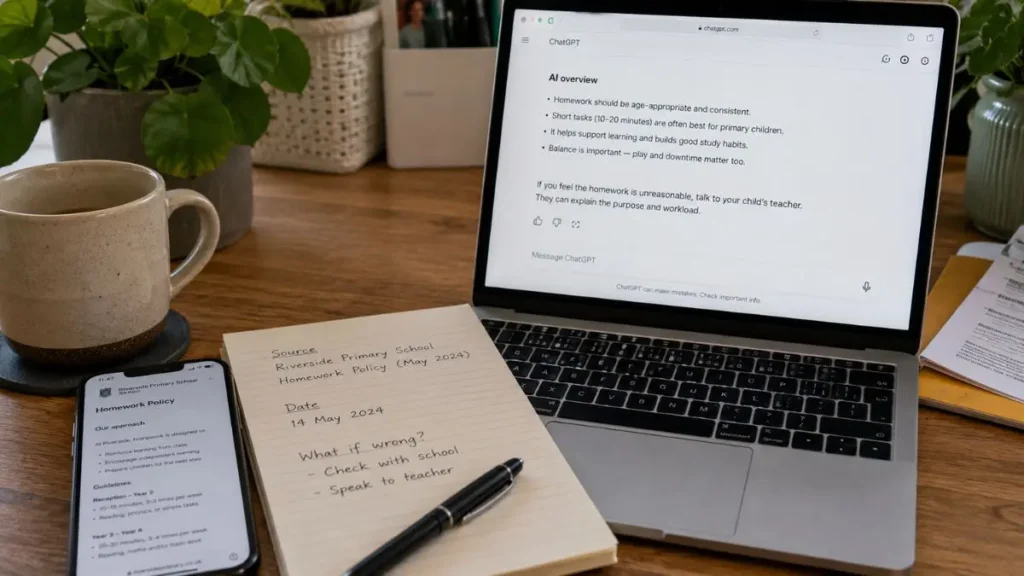
Why confident AI answers still need checking
AI tools have become better at producing useful answers, summaries and explanations, but polished wording is not the same as reliability. The most misleading answers are often not obvious nonsense. They may be mostly right, with one wrong deadline, an outdated rule, a made-up source or a detail that does not fit your situation.
I have found that this is the hardest kind of mistake to spot. When an answer is badly written, you naturally question it. When it sounds measured and helpful, it is much easier to accept the whole thing without checking the one detail that matters.
That does not mean AI is useless. It means the job needs to be split properly: AI can help you gather, organise and explain information, while you keep responsibility for checking the facts and deciding whether they fit your family.
For the wider picture of where that balance sits, AI for parents: practical ways to use AI in everyday family life explains where AI is genuinely useful and where more caution is needed.
How to fact-check an AI answer quickly
You do not need to investigate every harmless suggestion as though you are preparing a court case. The aim is to check in proportion to what could happen if the answer is wrong.
A simple five-step method works for most parenting, school and family-admin questions:
- Identify the claim that matters. Pull out the date, rule, fact, quotation or recommendation you might act on. A long answer may only contain one point that really needs checking.
- Ask where it came from. You can ask AI to show its sources, but treat those as leads rather than proof. It can misunderstand a source or occasionally invent one.
- Open the original source. Check the school letter, government page, NHS guidance, textbook, official policy or original article yourself. A summary is never stronger than the source behind it.
- Check the date and context. A rule may have changed, a page may apply to a different UK nation, or advice may be aimed at a different age group or situation.
- Cross-check the important point. For anything significant, confirm it with a second reliable source or the organisation responsible. Do not just ask a second chatbot and count that as independent confirmation.
The 30-second version: What is the original source? Is it current? What happens if this answer is wrong? Those three questions will often help you spot a problem if there is one.
A real example: checking a school deadline
Imagine you paste a long school newsletter into AI and ask it to list the dates and actions. The summary says that payment for a trip is due on Friday. That looks useful, and most of the other details appear right.
Before adding Friday to your calendar, go back to the original letter or the school website. You may find that the payment portal closes at 3 pm on Thursday, while Friday is only the date of the trip meeting. The AI has not produced wild nonsense. It has simply joined two nearby details incorrectly.
The practical check is quick: compare the deadline against the original letter, confirm it in the school app, such as ParentPay or ClassDojo, or on the school website if needed, and only then add it to your calendar. This is exactly the kind of subtle mistake that fluent summaries can hide.
What are the signs an AI answer might be wrong?
Some wrong answers look obviously strange. Others simply feel a little too neat. These are the signs that usually deserve a pause and a closer look:
- It is extremely certain. The answer gives one firm conclusion where a real situation would normally need context or exceptions.
- It gives precise dates or rules without a source. Exact details are easy to act on and easy for AI to get subtly wrong.
- The wording is vague around the evidence. Phrases such as ‘experts say’ or ‘research shows’ mean very little unless you can see who, where and when.
- It does not match the original material. A summary that conflicts with the school letter, policy or source document should not win just because it sounds clearer.
- The answer changes when challenged. If the facts shift each time you ask, the tool may be guessing rather than retrieving something reliable.
- It sounds too perfectly tailored. AI may fill gaps in your question with assumptions that feel plausible but were never actually provided.
A useful instinct is to notice when an answer removes all uncertainty from something that is usually messy. Parenting, school policies, benefits and health questions often depend on age, location, timing and individual circumstances.
Can AI make up sources and references?
Yes. AI can produce a source title, author, quotation, study or web address that looks completely believable but does not exist. It can also point to a real source that says something different from the claim it has attached to it.
A citation is simply a reference to the source the answer claims to be using. Do not treat the presence of a citation as evidence that the answer has been checked for you.
When an AI answer gives a source, open it and check that the link works, the title, author and publisher match what the AI claimed, the information is current enough for your question, and the source actually supports the sentence you are checking.
If you cannot find the source, do not use it as support. You can ask the AI for a different source, but the safer move is usually to search the claim directly and find the original authority yourself.
How to fact-check AI answers for school, health and family admin
The best source depends on the question. The checking method stays the same, but where you verify the answer should change.
- School dates and policies. Use the original letter, school app, school website or a direct message from the school. If the AI summary and the original disagree, the original wins.
- Homework facts. Check the child’s worksheet, textbook, class materials or a trusted educational source. Ask the child to explain the answer back rather than simply accepting a polished explanation.
- Benefits, tax or official admin. Use the current GOV.UK page or the organisation responsible. Eligibility rules and payment amounts can change, so an old answer may be confidently outdated.
- Parenting ideas. Treat general suggestions as options, not facts. Ask whether the advice fits your child’s age, temperament, needs and the situation you are actually dealing with.
- Health questions. Use NHS guidance and speak to a pharmacist, GP or NHS 111 when appropriate. AI can help you organise questions, but it should not replace professional assessment.
When should you never rely only on AI?
The higher the consequence of being wrong, the less appropriate it is to rely on an AI answer by itself. That is true even when the answer sounds sensible and includes sources.
Do not rely on AI alone for:
- Urgent health or safety concerns. Use emergency services, NHS 111, a clinician or the appropriate safeguarding route.
- Medication, diagnosis or treatment decisions. Check NHS guidance and speak to a qualified professional.
- Legal rights, benefits, tax or financial eligibility. Use current official guidance or a regulated adviser.
- Safeguarding concerns or disclosures. Speak to the school, local safeguarding team, NSPCC or emergency services as appropriate.
- Important school policies, deadlines or SEND arrangements. Check the original documents and confirm directly with the school when necessary.
- Any decision where a mistake would be difficult to undo. Use AI to prepare questions or organise information, not to make the final decision.
For lower-stakes things, such as rainy-day activity ideas or a first draft of a routine, a quick sense-check may be enough. The checking effort should match the risk.
A simple habit that makes AI more useful
The most useful shift is to stop asking, ‘Does this answer sound right?’ and start asking, ‘What would prove that this answer is right?’ Those are very different questions.
You can even build the check into your prompt by asking the AI to separate facts from suggestions, name the source for factual claims, flag anything it is uncertain about, and tell you what should be checked independently. That may improve the answer, but it does not replace opening the source yourself.
Over time, the process becomes quite quick. You notice the claim that matters, find the original source, check the date, and decide whether the risk justifies another check. That is usually enough for everyday use.
Where to go next if you use AI for family tasks
These related guides focus on the situations where accuracy and boundaries matter most:
- Can AI help with primary school homework and revision?: useful if you want to support learning without letting AI do the child’s work.
- When children ask about using AI: what parents need to say and what rules to set: helpful for setting clear expectations around privacy, supervision and homework.
- AI for school emails and admin: simple ways busy parents can save time: useful if you want help with summaries and drafts while keeping the final check with you.
For more about why AI answers still need checking, these two resources are useful:
- OpenAI: Does ChatGPT tell the truth?: explains why ChatGPT can produce incorrect or misleading answers and why important information should be checked.
- Full Fact: shows how claims can be checked against evidence and reliable original sources.
What matters most
AI does not need to be perfect to be useful, but it does need to be checked in proportion to the decision you are making.
For everyday questions, the habit can stay simple: find the original source, check that it is current, and confirm the point that matters. For health, money, safeguarding, legal issues or important school decisions, go directly to the relevant authority or professional.
The goal is not to turn every answer into a research project. It is to keep the convenience of AI without letting confident wording make the decision for you.
FAQ
How can you fact-check an AI answer quickly?
To fact-check an AI answer quickly, identify the exact claim you might act on, open the original source, check the date and context, and confirm the important point with a reliable independent source.
Can AI make up sources and references?
Yes. It can invent a source or attach a claim to a real source that does not support it. Open every important citation and check that it exists and says what the AI claims.
What are the signs an AI answer might be wrong?
Warning signs include unsupported certainty, precise details without sources, vague references to experts, contradictions with original documents, and facts that change when you challenge them.
When should you never rely only on AI?
Do not rely on AI alone for urgent health or safety concerns, medication, legal rights, benefits, safeguarding, or important school policies and deadlines.