

If you’re starting to wonder how your child will be supported at school, it can feel unclear or a bit overwhelming. You might hear terms like SEN or EHCP and not be sure what they actually mean in real life. This guide breaks down how dyslexia is supported in UK schools in simple terms, so you know what to expect and what usually happens next. It can feel unclear what actually happens once you raise a concern.
Quick summary
In UK schools, dyslexia is usually supported through classroom adjustments and SEN support, with more formal plans only used when needed. In practice, this often means:
- Your child’s teacher noticing patterns and adapting how they teach
- Extra support in class (like more time, reading help, or different tasks)
- A SENCO (special educational needs coordinator) helping plan support
- Regular reviews to see what is working and what needs adjusting
- An EHCP only used in more complex or higher-support situations
- Next step: speak to your child’s teacher if you’re noticing ongoing difficulties
This article is for / not for
This article is for:
- Parents trying to understand how schools support dyslexic children
- Parents unsure what happens after concerns are raised
- Anyone confused by terms like SEN or EHCP
This article is not for:
- A formal diagnosis guide
- A detailed legal breakdown of education policy
Medical disclaimer
This article is for general understanding only and does not diagnose dyslexia. If you are concerned about your child’s development, your child’s school is usually the best first step. Teachers and SENCOs can observe learning patterns and arrange support. You can also refer to NHS guidance on dyslexia in children.
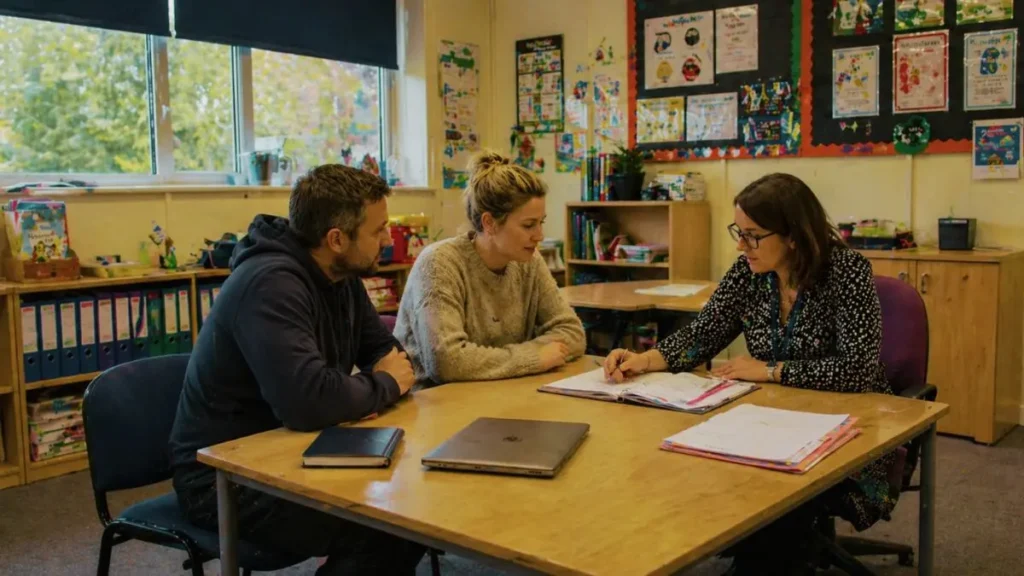
How dyslexia support usually starts in school
In UK schools, dyslexia support is usually built into everyday teaching and begins in a simple and informal way.
A teacher might notice that a dyslexic child is finding reading or writing more effortful than expected. This could show up as slower reading, difficulty spelling, or needing more time to complete written work. For example, during a reading activity your child might get through fewer pages than others, or on a worksheet they may know the answers but take longer to write them down.
Rather than jumping straight to labels or formal plans, schools usually start by adjusting teaching. This is sometimes referred to as “Quality First Teaching”, which simply means adapting everyday teaching to support different learners. In practice, this often means giving a little more time for reading or writing, breaking instructions into smaller steps, and adding more verbal explanation alongside written work. Teachers may also check understanding more regularly to make sure things are landing.
At this stage, you might not hear any formal terms. It often just looks like a teacher quietly adapting things to help your child keep up.
What SEN support means (in simple terms)
If your child needs more consistent help, schools may describe this as SEN support.
SEN stands for Special Educational Needs. In practice, it means your child is getting structured, planned support that is reviewed regularly.
This is not something to worry about. It does not mean something is “seriously wrong”. It also doesn’t mean anything about your child’s intelligence. Many dyslexic children understand just as much as their peers. It simply means the school has recognised that your child learns differently and needs support in a more consistent way.
Support like this does not require a formal diagnosis. Schools can put help in place based on what they observe. A formal diagnosis is usually only considered later, for example if support needs to be more structured or long-term, or if it’s needed for things like exam arrangements. In many cases, schools can support your child effectively without one.
The role of the SENCO
Most schools have a SENCO (special educational needs coordinator).
The SENCO helps identify children who may need additional support, works with teachers to plan strategies, monitors progress over time, and communicates with parents about what is happening.
You may meet the SENCO if support becomes more structured. They are often the person who helps connect everything together. They’re there to help, not to make things more complicated.
What support looks like day to day
This is the part many parents want to understand most.
In real life, support is usually built into the classroom rather than something separate, and much of it happens every day as part of normal lessons.
For a dyslexic child, this might include sitting in a position where they can focus more easily, being given slightly different reading materials, using coloured overlays or different formats for text, or having access to a laptop or tablet for writing. At certain times, they may also get help from a teaching assistant, either in short bursts during lessons or occasionally in small groups.
It does not usually mean being taken out of class all the time. Most support is designed to help your child stay included while making learning more accessible. For older primary children, this type of support can also lead to exam access arrangements, such as extra time, if needed.
The graduated approach (without the jargon)
Schools often follow something called a graduated approach.
In simple terms, this means the school tries support, sees what helps, adjusts if needed, and then repeats the process.
You might hear this described as “assess, plan, do, review”, but in practice it is just a cycle of trying things and refining them over time.
This is why support can change. What works at one stage may need adjusting as your child grows or school demands increase.
What an EHCP is (and when it’s used)
An EHCP (Education, Health and Care Plan) is more formal support.
It is usually only considered when a child needs a higher level of help than a school can provide through SEN support alone. You don’t need to push for this straight away.
An EHCP can include more detailed planning of support, additional resources or funding, and clear long-term goals. For example, this might include more one-to-one support or specific learning tools.
Most dyslexic children do not need an EHCP. Many are supported successfully through SEN support in school.
When to speak to your child’s school
It’s normal to feel unsure about when to raise concerns.
A good time to speak to your child’s teacher is if difficulties with reading or writing are ongoing, your child is becoming frustrated or losing confidence, or there is a gap between what they understand and what they produce in writing.
You do not need to wait for things to become serious. Early conversations are usually helpful and expected. Sometimes the school will raise concerns first, and sometimes parents notice things at home. Both are common, and either way, it’s okay to start the conversation.
What this means for your child
Support in school is not about labelling your child. It is about helping them learn in a way that works for them.
A dyslexic child can understand just as much as their peers, but may need different support to show that understanding. The aim of school support is to reduce unnecessary barriers, not lower expectations.
With the right support, many children build confidence and find ways of learning that suit them.
If you want to understand how these experiences connect to the wider picture of dyslexia, Dyslexia film: what it gets right (and what parents should know) helps bring that together.
Where to go next
If this has helped you understand the system a bit more, the next step is usually a simple conversation with your child’s teacher.
You do not need to use the right terminology or have everything worked out. Sharing what you are noticing is enough to start the process.
Most schools are used to these conversations and expect them. It can also help to jot down 2–3 specific examples you’ve noticed at home, so you have something clear to share in the conversation.
More that can help you understand this
If you’re piecing things together, it often helps to look at this from a couple of angles: what dyslexia is, what early signs look like, and how it’s sometimes talked about. These guides build on what you’ve just read and help you go a step deeper without overwhelming you:
- Dyslexia explained for parents (and why it’s often missed) – a clear, bigger-picture guide that explains what dyslexia is in everyday terms, including why it can be overlooked in school settings and at home
- Signs of dyslexia in children: what parents often notice first – a practical guide to the small, early patterns you might already be seeing, with examples that help you feel more confident in what to look for
- Is dyslexia a ‘superpower’? A more honest look for parents – a balanced take on common messaging, helping you make sense of the positives without ignoring the real challenges
For official guidance on how schools provide support in England, you can also refer to:
- GOV.UK – SEN support and EHCP guidance
What matters most
School support for dyslexia is usually gradual, flexible, and built around your child’s needs.
What matters most is not the label, but whether your child is getting the help they need to feel confident and able to learn.
FAQ
How do schools support dyslexia in the UK?
Schools usually provide support through everyday teaching adjustments, SEN support, and regular reviews to make sure the support is working. This usually happens within normal lessons, not separate programmes.
Does my child need an EHCP for dyslexia?
Most dyslexic children do not need an EHCP. It is usually only used when a higher level of support is needed.
What is SEN support in primary school?
SEN support means your child is receiving structured help that is planned, monitored, and adjusted over time.
When should I ask for help at school?
If you notice ongoing difficulties, frustration, or a gap between understanding and written work, it is a good time to speak to the teacher.