
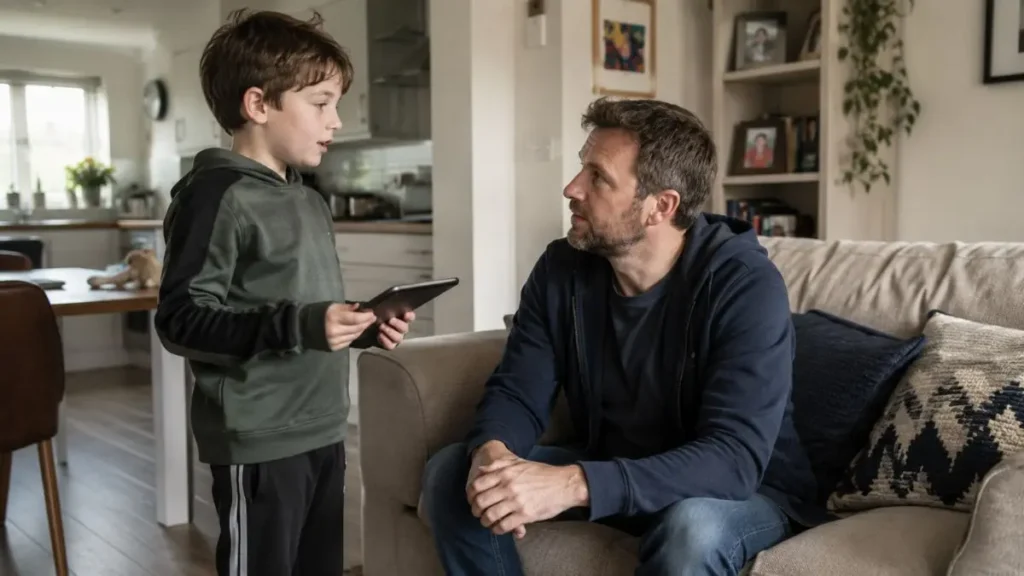
For a lot of families, the tricky part about AI is not the technology itself. It is the moment a child starts asking to use it, sees it in schoolwork, or stumbles across it online before anyone has really talked about what the rules are. That is usually when the whole thing starts to feel a bit messy. A few simple boundaries early on can make it much easier to keep AI useful, calm and in proportion.
Quick summary
Children can use AI, but it works best with clear home rules around privacy, homework and supervision.
If you want the short version before the conversation gets more complicated, it is this:
- Children need simple AI rules in the same way they need rules for phones, games and online chatting.
- The most useful boundaries are usually around supervision, privacy, homework and when it is not appropriate to use AI at all.
- Younger primary-age children generally need AI use to stay parent-led rather than feeling like an independent tool.
- A good starting rule is that AI can help with understanding, ideas and practice, but it should not replace thinking, honesty or adult judgement.
- It also helps to be clear that children should never share personal, private or upsetting information with AI tools.
This article is for / not for
This article is for:
- Parents of younger and older primary-age children who want sensible AI rules before casual use becomes normal
- Families trying to work out what children should be allowed to do, what needs supervision and when to say no
- Parents who want simple words to explain home rules without sounding dramatic or overly technical
- Adults who want family rules that work across tools rather than only on one app
This article is not for:
- Parents looking for a child-friendly explanation of what AI is from scratch
- Families who mainly want homework support without the wider rules conversation
- Anyone wanting a technical guide to parental controls or platform settings
- Parents looking for legal, safeguarding or mental health advice from a chatbot
What rules should children have for AI use?
This often starts in very ordinary ways. A child might ask if they can use AI to make a quiz, help with homework or create a picture, and that is usually the moment when vague ideas suddenly need to become actual family rules.
The most useful rules are usually the boring ones. They are not clever, and they do not need to sound like a school policy. They just need to be clear enough that a child can remember them and a parent can apply them without a debate every single time.
That also means keeping the list short enough that it can actually be used in real life. Most families do not need ten different rules for ten different apps. They need a few simple boundaries that can be repeated calmly and used across whatever tool happens to come up.
It can also help to talk the rules through with your child, explain why they are there, and even ask what rules they think would make sense before you land on the final version. That does not mean your child gets the deciding vote, but it often gives them a better chance of understanding the point of the rule instead of just hearing it as another no.
In most homes, a sensible starting point looks something like this:
- Ask before using AI.
- Use it with an adult nearby if you are younger.
- Do not share personal information.
- Do not use it to do your homework for you.
- Stop and tell an adult if something feels odd, upsetting or confusing.
That list will vary a bit depending on your child’s age and how they are already using devices, but the general shape tends to hold up well. The aim is not to make AI feel forbidden or exciting. It is to make it feel like one more tool that comes with normal family boundaries.
If you want the wider picture of where AI fits into family life, AI for parents: practical ways to use AI in everyday family life gives that overview without getting too bogged down in one type of use.
Should children ever use AI on their own?
For younger primary-age children, I would usually lean toward no, or at least not in any open-ended way.
That is not because every AI tool is automatically dangerous. It is because younger children are still learning how to judge what feels true, what is appropriate to share, and what to do when something sounds strange or overconfident. AI can make that harder because it often sounds polished, friendly and convincing.
For many older primary-age children, the more realistic model is that AI is something you use together, or something they use with a parent aware of what the task is and why they are using it. That could be asking for a spelling quiz, simplifying one part of a homework task, or checking how to phrase a question.
As children get older, the rules may loosen a bit, but even then it helps if independence grows out of supervision rather than replacing it overnight.
What should children never share with AI?
This is one of the clearest rules to make explicit.
It is worth spelling this out because children often do not think of an AI tool as somewhere information is being shared. To them, it can just feel like asking a question on a screen. That is exactly why the privacy rule needs to be simple and repeated often enough to stick.
A simple way to make this practical is to swap real details for placeholders, for example using [Child], [Teacher] or [School] instead of names.
Children should not type or paste in:
- full names
- home address
- school name if it is not necessary
- phone numbers or email addresses
- passwords or login details
- medical information
- upsetting personal problems they would normally take to a trusted adult
- photos, school letters or messages that contain private details unless a parent is involved
A simple way to say it is:
“If you would not hand it to a stranger online, do not put it into AI either.”
That tends to make more sense to a child than a broad warning about data privacy. If you do use AI together for something practical, it helps to model the safer version by replacing details with words like [Child], [Teacher] or [School] where you can.
Setting AI homework boundaries at home
A lot of children will not see that line clearly on their own, especially if the tool feels helpful and the answer sounds polished.
This is where things get slippery quite quickly if the rules are vague.
A child can easily feel that asking AI for help is fine, then drift into asking it for the answer, then end up copying something they do not really understand. That is why homework rules are worth saying out loud before a rushed evening turns them into an argument.
A useful home rule might be:
“AI can help you understand, revise or get started, but it cannot do the work you are meant to think through yourself.”
That still leaves room for sensible use. It can mean using AI for a quiz, a simpler explanation, a few project ideas or a revision prompt. It does not mean using it to write paragraphs, answer comprehension questions or solve the whole worksheet. It is also worth checking whether your child’s primary school already has its own expectations around AI use in homework, projects or home learning.
When to say no to AI use
Sometimes the clearest rule is simply that this is not the right tool for this moment.
A lot of parents need permission to trust their judgement here. Not every AI-related question needs a balanced discussion or a compromise. Sometimes the timing is wrong, the task is wrong, or the child is using it in a way that is already taking things off course.
It is okay to say no to AI use when:
- a child is already avoiding the real task
- the tool is turning into a shortcut instead of support
- the question involves something too personal, upsetting or private
- the child is using it in secret or pushing past rules you have already set
- the whole thing is creating more conflict than help
That is not anti-AI. It is just normal parenting judgement. We do this with plenty of tools and activities. A child may be allowed one thing in one context and not in another. AI does not need to be treated differently just because it sounds clever.
Sometimes the simplest line is also the best one:
“This is not a no forever. It is a no for this use, or a no without an adult.”
How can parents supervise AI use without overcomplicating it?
The easiest way is to keep supervision light but visible.
You do not need a huge AI policy on the fridge. In most homes, it is enough to know what the child is using, what they are using it for, and whether the task still leaves them doing the thinking.
The point is not to hover over every word. It is to stay involved enough that AI use still feels guided, ordinary and connected to the rules you already have. For most families, that kind of low-pressure visibility works much better than trying to monitor everything in a heavy-handed way.
It also helps if those house rules go hand in hand with parental controls where they are available. Rules matter more when the expectations at home are backed up by the settings on the device or app, rather than relying on memory and self-control alone.
That often means:
- using AI in shared spaces rather than behind a closed door
- asking what they typed in and why
- checking what came back before they act on it
- keeping AI use tied to a clear task rather than endless chatting
- returning to the same two or three family rules so they become familiar
That kind of light-touch supervision also makes it easier to answer questions as they come up, instead of feeling as though you need one big perfect conversation before a child can use anything at all.
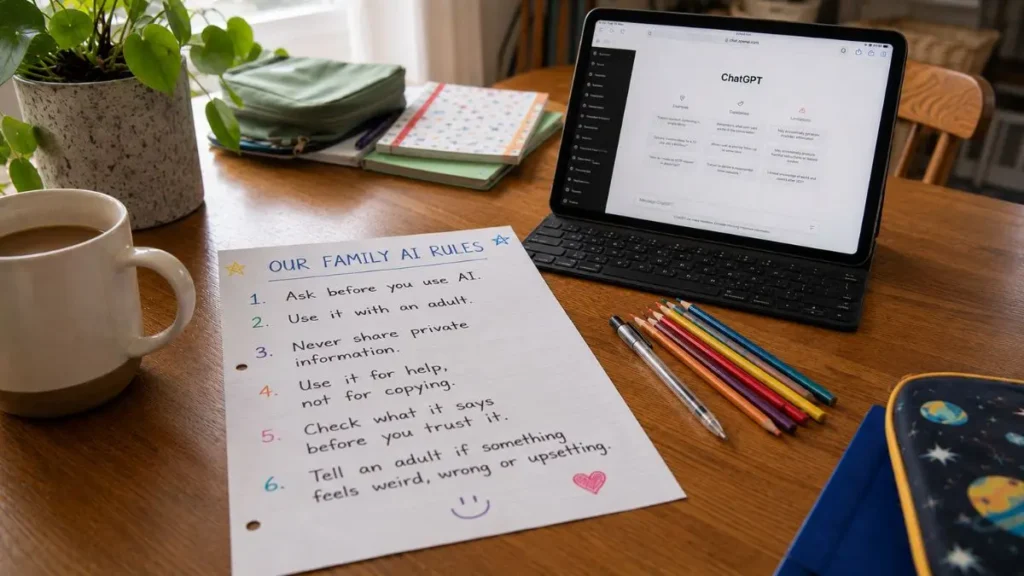
A short rules list you could actually use at home
Think of this as the short version you would actually repeat, rather than the fuller version you might talk through in a longer conversation.
If you want something simple enough to say and remember, this kind of list works well.
This is the sort of thing you could say out loud, stick on the fridge, or repeat a few times until it becomes part of the normal family routine around screens and schoolwork:
- Ask before you use AI.
- Use it with an adult if you are younger.
- Never share private information.
- Use it for help, not for copying.
- Check what it says before you trust it.
- Tell an adult if something feels weird, wrong or upsetting.
You do not need to frame this as a dramatic new set of tech rules. It can just become part of the way your family talks about online tools more generally.
More help if you want to keep this calm and clear
If you want to build on this without turning it into a bigger family conflict, these are the most useful next reads:
- How to explain AI to children in simple, age-appropriate ways: useful if your child still needs the basic explanation before the rules make sense.
- Can AI help with primary school homework and revision?: useful if the biggest question at home is what counts as support and what crosses into cheating.
- How to fact-check AI answers when you’re using them for parenting questions: useful if you want a practical way to explain why AI still needs checking.
For further grounded UK guidance beyond this site:
- NSPCC: talking to children about AI: for wider child-safety advice and conversation prompts that support what you are already doing at home.
What matters most
Children do not need perfect AI rules. They need clear enough ones that the adults around them can actually stick to.
If your rules cover privacy, supervision, homework boundaries and when to stop, that is already a strong starting point. You can adjust the detail as your child gets older and as AI shows up in new places.
The goal is not to turn AI into a huge drama. It is to make sure children meet it with enough guidance, enough honesty and enough common sense that it does not quietly become normal in unhelpful ways.
FAQ
What rules should children have for AI use?
A good basic set of rules is to ask before using AI, avoid sharing personal information, use it for help rather than copying, and tell an adult if something feels strange or upsetting.
Should children ever use AI on their own?
For younger primary-age children, it usually works better as a parent-led or supervised tool. As children get older, some independence may make sense, but it helps if that grows out of clear supervision rather than replacing it completely.
What should children never share with AI?
They should not share things like full names, addresses, passwords, school details, medical information or anything personal they would not normally hand to a stranger online.
How can parents supervise AI use without over complicating it?
Keep it simple. Know what the child is using, what they are asking it to do, and whether it is helping them think rather than replacing the part they are meant to do themselves.